Introduction
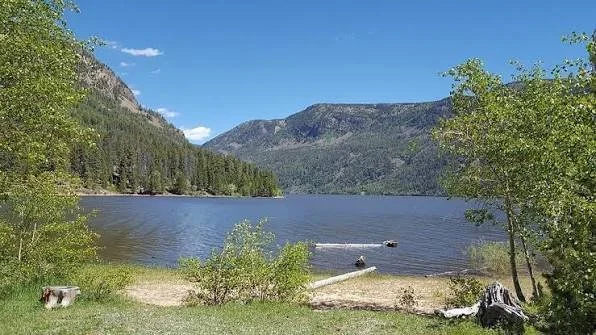
High in northeastern Utah, Moon Lake occupies a striking position near the Uinta Mountains and Uinta Basin.
Today, the lake is closely associated with modern water management. Moon Lake Dam was constructed during the 1930s as part of a major irrigation project. The Bureau of Reclamation notes that the original natural lake had an estimated capacity of approximately 13,900 acre-feet before the dam expanded the storage system.
But the human history of the region extends far beyond twentieth-century irrigation.
The Uinta Basin was occupied by Indigenous peoples for thousands of years, and archaeological evidence from the broader region includes Fremont-period sites.
The Uinta Basin
The Uinta Basin is a large geological basin surrounded by mountain ranges.
Its geography creates ecological diversity.
Mountain environments provide timber, game, water, and seasonal resources.
Lower elevations provide different plants and agricultural possibilities.
Ancient communities could move between these ecological zones.
This diversity was valuable because no single environment provided every resource needed for survival.
The Fremont
The Fremont archaeological tradition developed across much of Utah and neighboring areas during the first and second millennia A.D.
Fremont communities combined:
farming
hunting
gathering
craft production
storage
seasonal movement
They were not identical to the ancestral Pueblo communities of the Four Corners.
Their material culture is distinctive.
Agriculture in the Uinta Basin
Maize agriculture was important in portions of the Fremont world.
But farming at high elevations or in semi-arid environments was challenging.
Farmers needed to understand local precipitation.
They selected suitable soils.
They took advantage of river valleys and seasonal water.
They stored crops for later use.
This demonstrates a high degree of environmental knowledge.
Hunting
Hunting remained important.
Mountain environments supported deer and other game.
Hunting could provide meat, hides, bone, sinew, and other materials.
The combination of agriculture and hunting provided greater economic flexibility.
Gathering
Wild plant resources were also important.
Pine nuts, seeds, berries, roots, and other plants could supplement cultivated foods.
This mixed economy allowed communities to respond to seasonal changes.
Pithouses
Fremont communities frequently constructed pithouses.
These semi-subterranean structures were well suited to the regional climate.
The lowered floor moderated temperature.
A roof created shelter.
A central hearth could provide warmth and cooking.
The interior could support multiple household activities.
Storage
Food storage was crucial.
Dry maize could be stored for extended periods.
Storage facilities sometimes appear separately from residential areas.
This separation could reduce fire risk and protect food.
In some Fremont landscapes, storage structures were placed in elevated or difficult-to-access locations.
Rock Art
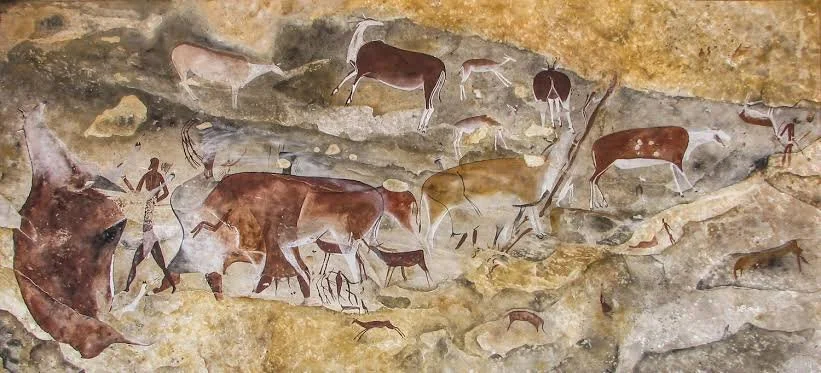
The Uinta Basin is particularly famous for rock imagery.
Fremont rock art includes distinctive anthropomorphic figures.
These figures often have trapezoidal bodies and elaborate headdresses.
Some are large enough to dominate rock panels.
The figures have been interpreted in many ways, but their exact meanings remain uncertain.
The Problem of Interpretation
Archaeologists must distinguish observation from interpretation.
Observation:
A figure has a trapezoidal body.
Interpretation:
The figure represents a supernatural being.
The first statement is directly observable.
The second requires an argument.
This distinction is essential in archaeology.
Moon Lake and Modern Water Infrastructure
The modern Moon Lake Project fundamentally changed the region's water system.
The Bureau of Reclamation states that construction began in 1935 and that the dam was substantially completed in 1938.
The project was designed to store water and supplement irrigation supplies in the Uinta Basin.
This demonstrates how modern communities also adapted to the same fundamental challenge faced by ancient farmers: water availability.
Ancient and Modern Water Management
The comparison between Fremont agriculture and modern reservoirs is revealing.
Ancient farmers used:
local streams
seasonal runoff
irrigation
soil management
small-scale water-control systems
Modern society uses:
dams
canals
reservoirs
diversion structures
large-scale irrigation networks
Both systems represent technological responses to environmental constraints.
Archaeological Surveys
Modern infrastructure projects often require cultural-resource surveys.
Before roads, pipelines, reservoirs, and other developments are constructed, archaeologists may investigate the affected landscape.
This helps identify prehistoric sites.
Some sites can be preserved in place.
Others may require archaeological documentation.
The resulting records allow researchers to reconstruct landscapes that have since changed.
The Importance of Context
An isolated artifact has limited meaning.
A projectile point can tell us about technology.
But a projectile point found beside a pithouse, grinding stone, hearth, and storage pit tells a much richer story.
It can reveal how people lived.
This is why archaeological context matters.
Regional Connections
The Fremont world was not isolated.
People interacted with neighboring communities.
Archaeologists have identified similarities and differences between Fremont and ancestral Pueblo traditions.
These connections may reflect:
migration
trade
cultural exchange
shared environmental adaptation
The evidence does not always allow researchers to distinguish among these possibilities.
Climate and Change
The Fremont period coincided with major climatic fluctuations.
Drought and changing precipitation could affect agricultural production.
Communities responded in different ways.
Some may have intensified farming.
Others may have increased hunting.
Some communities may have moved.
The end of the Fremont archaeological period was therefore likely caused by multiple interacting factors.
Modern Indigenous Connections
The Uinta Basin remains part of Indigenous homelands.
The history of the region did not end when Fremont villages changed or were abandoned.
Later Ute and other Indigenous communities continued using the landscape.
Modern archaeological interpretation should therefore recognize multiple layers of Indigenous history.
Conclusion
Moon Lake's modern history is dominated by dams, irrigation, and water storage.
But beneath that modern infrastructure lies a much older human story.
Fremont communities occupied the broader Uinta Basin through a combination of agriculture, hunting, gathering, storage, and seasonal adaptation.
Their pithouses reveal domestic architecture.
Their pottery reveals technology.
Their rock art reveals symbolic traditions.
Their agricultural practices reveal environmental knowledge.
The modern Moon Lake Project demonstrates that water remains one of the central challenges of life in the Uinta Basin.
The technology has changed dramatically, but the fundamental importance of water has remained constant.