Introduction
Modern Steinaker Reservoir is known primarily as a water-storage and recreation facility in northeastern Utah.
Yet the surrounding Uinta Basin is also part of a much older human landscape.
Before the modern reservoir, roads, ranches, and irrigation infrastructure transformed the area, Indigenous communities occupied the valleys and foothills for thousands of years.
Among the most important archaeological traditions represented in the region is the Fremont tradition, known for its pithouses, agriculture, distinctive pottery, rock art, and mixed subsistence economy.
The title's emphasis on Fremont pithouses therefore directs attention toward an archaeological landscape that predates the modern reservoir.
Steinaker and the Ashley Valley
Steinaker Reservoir lies in the Ashley Valley of northeastern Utah.
The modern reservoir is supplied by Ashley Creek and provides water storage for irrigation. Utah State Parks describes the reservoir as part of the Central Utah Project system and notes that construction began in the early 1960s.
The modern landscape therefore overlays an ancient one.
Archaeological sites in the region can include structures, artifacts, rock art, and subsistence evidence associated with earlier Indigenous communities.
The Fremont Tradition
The Fremont occupied large portions of Utah between approximately A.D. 400 and 1350.
They were characterized by a combination of agriculture, hunting, gathering, and village life.
The National Park Service identifies distinctive Fremont artifacts including specialized basketry, moccasins, pottery, clay figurines, and trapezoidal human figures in rock art.
Pithouses
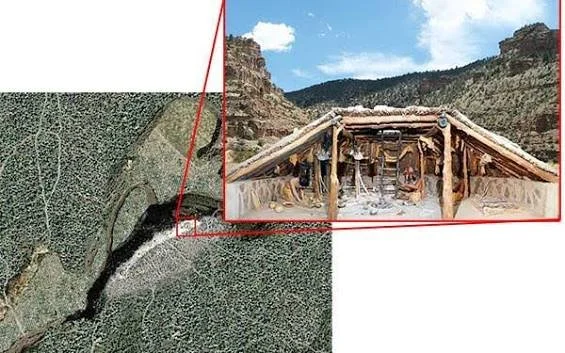
The pithouse was a major Fremont architectural form.
A pithouse was partially excavated into the ground.
Posts supported a roof.
The floor could be below the surrounding ground surface.
This design provided thermal advantages.
During winter, the partially underground structure retained warmth.
During summer, it could remain cooler than exposed surface structures.
Construction
Building a pithouse required several stages.
First, people excavated a depression.
They then prepared the floor.
Wooden posts were positioned to support the roof.
Smaller branches and other materials were added.
Earth, vegetation, and other materials could then complete the roof.
The final structure could appear relatively small from outside.
Inside, however, the lowered floor created a usable living area.
Household Life
Pithouses provide evidence about daily life.
Archaeologists may find:
pottery fragments
grinding stones
projectile points
animal bones
charcoal
plant remains
storage pits
These materials can reveal what people ate, how they prepared food, what tools they used, and how they organized their household.
Agriculture
Fremont communities cultivated maize.
Beans and squash were also important in many areas.
Agriculture required reliable access to water.
In the Uinta Basin, rivers and streams created opportunities for cultivation.
However, irrigation was not always necessary or uniform.
Different communities adapted their agricultural strategies to local conditions.
Hunting
Hunting remained important.
Deer, rabbits, and other animals contributed meat and raw materials.
Animal remains found in archaeological sites can reveal which species were hunted.
Cut marks on bones can indicate butchering.
Burning can provide evidence of cooking.
Age profiles can sometimes indicate hunting strategies.
Gathering
Wild plants remained part of the Fremont economy.
Seeds, berries, roots, nuts, and other plants provided carbohydrates, fats, vitamins, and other nutrients.
Gathering also reduced dependence on agriculture.
A household could supplement its harvest with wild resources.
Pottery
Fremont pottery is distinctive.
Much of it is gray and coil-built.
Pottery served multiple purposes.
Cooking vessels could withstand heating.
Storage jars could preserve food.
Smaller containers could be used for serving or other household tasks.
Decorative differences help archaeologists identify regional traditions.
Rock Art
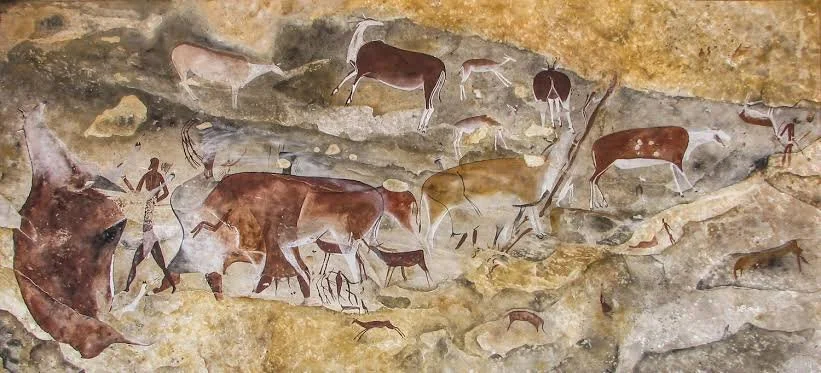
The Uinta Basin contains important Fremont rock imagery.
One of the most recognizable Fremont motifs is the trapezoidal-bodied anthropomorphic figure.
These figures sometimes have elaborate headdresses, necklaces, earrings, shields, or other features.
Their precise meaning remains uncertain.
They may have represented ritual beings, ancestors, important individuals, or symbolic concepts.
Archaeologists cannot confidently assign a single interpretation to every image.
The Modern Reservoir
The construction of a reservoir changes archaeological preservation.
Flooding can destroy or conceal archaeological sites.
Survey and mitigation archaeology are therefore often conducted before major construction projects.
Archaeologists may document sites, excavate selected contexts, recover artifacts, and preserve records.
This work creates a scientific archive even when the original landscape is transformed.
Cultural Resource Management
Modern archaeology includes a major field known as cultural resource management.
Before infrastructure projects proceed, archaeologists may evaluate whether cultural resources are present.
If significant sites are identified, agencies may:
redesign projects
avoid sites
document them
excavate selected areas
preserve artifacts
establish monitoring programs
The objective is to balance development with preservation requirements.
Water and Human History
Steinaker illustrates an important theme in archaeology.
Water attracts people across thousands of years.
Ancient farmers depended on streams.
Modern farmers depend on reservoirs.
The technologies are different, but the geographic logic remains similar.
People settle where water makes life and agriculture possible.
Climate
The Uinta Basin experiences seasonal climate variation.
Ancient communities needed to manage drought risk.
Food storage was therefore essential.
A household with stored maize could survive periods when crops failed or hunting opportunities declined.
Settlement Networks
A pithouse was not necessarily an isolated home.
Multiple pithouses could form villages.
Villages could connect with agricultural fields, storage facilities, trails, and resource areas.
This creates a settlement network.
Archaeologists study these spatial relationships to understand social organization.
Fremont Regional Diversity
One of the problems with the word "Fremont" is that it can imply greater cultural uniformity than actually existed.
Fremont communities occupied a huge area.
Their architecture and artifacts varied.
Some communities relied heavily on agriculture.
Others maintained stronger hunting and gathering traditions.
The Fremont should therefore be understood as a diverse archaeological tradition.
Conclusion
Steinaker Reservoir belongs to a modern water-management system, but its landscape has a much deeper human history.
The Fremont people occupied the region centuries before modern irrigation projects transformed the valley.
Their pithouses demonstrate architectural adaptation.
Their pottery reveals craft traditions.
Their agricultural remains reveal food production.
Their hunting and gathering practices demonstrate economic flexibility.
Their rock art reveals symbolic traditions.
The modern reservoir therefore sits within a landscape that has supported human adaptation for thousands of years.
Understanding the archaeology beneath and around such modern infrastructure helps demonstrate that Utah's landscapes are not empty spaces waiting to be developed.
They are cultural landscapes layered with generations of human history.