The Alleged Lost City of Crescentis, Louisiana
Retired architect and amateur archaeologist George Gelé has claimed the discovery of a submerged ancient city off the coast of Louisiana, near the Chandeleur Islands. According to Gelé, the site dates back approximately 12,000 years, placing it at the end of the last Ice Age, when rising sea levels submerged vast coastal landscapes. He has dubbed the hypothetical city Crescentis.
Claimed Features of Crescentis
Gelé’s decades-long investigation, beginning in 1974, has relied heavily on underwater sonar imaging. He asserts that the sonar images reveal:
Hundreds of buried buildings stretching across the seabed.
A 280-foot-tall pyramid, described as emitting electromagnetic energy that allegedly interferes with navigational compasses. Several local fishermen, including Ricky Robin, reported compasses spinning wildly when passing over the purported pyramid site.
Granite blocks that, according to Gelé, do not naturally occur in Louisiana, suggesting deliberate human transport. He speculates that early inhabitants somehow floated the stones down the Mississippi River and assembled them along the Gulf Coast.
The structures are reported to lie 30 feet underwater and are buried beneath an additional 100 feet of sediment, indicating extensive coverage over millennia.
Supporting Anecdotes
Gelé has cited local testimonies and observations to bolster his claims:
Fishermen report finding square-shaped granite stones in their nets in the same areas where compasses behave erratically.
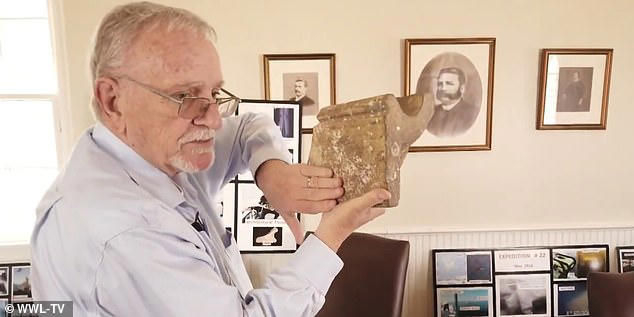
Gelé himself has collected pieces of granite from the area, believing they once formed part of the city.
He also claims the site’s layout is “geographically related” to the Great Pyramid of Giza, hinting at a mysterious global alignment of ancient structures.
Gelé has personally funded more than 40 research expeditions to the site, spanning nearly five decades, documenting sonar readings, mapping granite formations, and analyzing recovered materials.
Scientific and Historical Skepticism
Despite the dramatic claims, mainstream scientists and historians remain skeptical. Several alternative explanations have been proposed for the underwater granite formations:
Shipwreck Debris or Ballast Stones:
A study by Texas A&M University in the late 1980s concluded that the granite likely originated from ships. Ballast stones were commonly discarded from Spanish, French, and other vessels navigating the Gulf of Mexico near New Orleans to lighten their load as they approached shallow waters.
This explanation accounts for the unusual presence of granite in an area where it is not naturally found.
Artificial Reefs:
Archaeologist Rob Mann of Louisiana State University suggested that some of the granite mounds could have been deliberately dumped in the 1940s as artificial reefs or to stabilize channels for navigation.
Construction debris and stone dumping could explain clusters of large stones without invoking an ancient city.
Construction Waste or Miscellaneous Debris:
Gelé himself previously considered that the mounds might have been remnants of modern construction, though he argued that the scale, arrangement, and composition of the stones make this explanation less compelling to him.
Unverified and Controversial Claims
Some of Gelé’s more extraordinary assertions remain unverified and are considered highly speculative:
The alleged electromagnetic energy from the pyramid has no independently verified measurements.
The dating of the site to 12,000 years ago lacks support from peer-reviewed archaeological or geological research.
Claims of a direct relationship between Crescentis and the Great Pyramid of Giza are purely hypothetical and not supported by evidence.
No human artifacts definitively attributable to prehistoric occupation have been recovered from the site.
Current Status and Reception
Gelé’s discoveries have not been published in peer-reviewed journals, and the academic community generally regards the claims as anecdotal.
State archaeologists have noted that most underwater features likely result from historical dumping rather than prehistoric construction.
While the idea of a lost city captures public imagination, professional consensus points to modern or historical origins for the formations rather than a 12,000-year-old civilization.
Cultural Impact and Media Attention
The story has resurfaced multiple times in media, including interviews with Gelé and local fishermen. The narrative taps into long-standing fascination with lost civilizations, undersea archaeology, and the idea of advanced prehistoric cultures. Despite the skepticism, Crescentis has gained attention as a “what if” scenario for enthusiasts of lost civilizations, underwater mysteries, and pseudoarchaeology.