Possible Discovery of d’Artagnan’s Lost Grave in the Netherlands
More than three centuries after his death, the remains of the legendary French musketeer Charles de Batz de Castelmore d'Artagnan may have finally been uncovered beneath a church floor in the Maastricht.
The discovery has sparked excitement among historians and archaeologists alike, as it could solve one of the long-standing mysteries surrounding the burial of one of France’s most iconic historical figures.
A Discovery Beneath the Church Floor
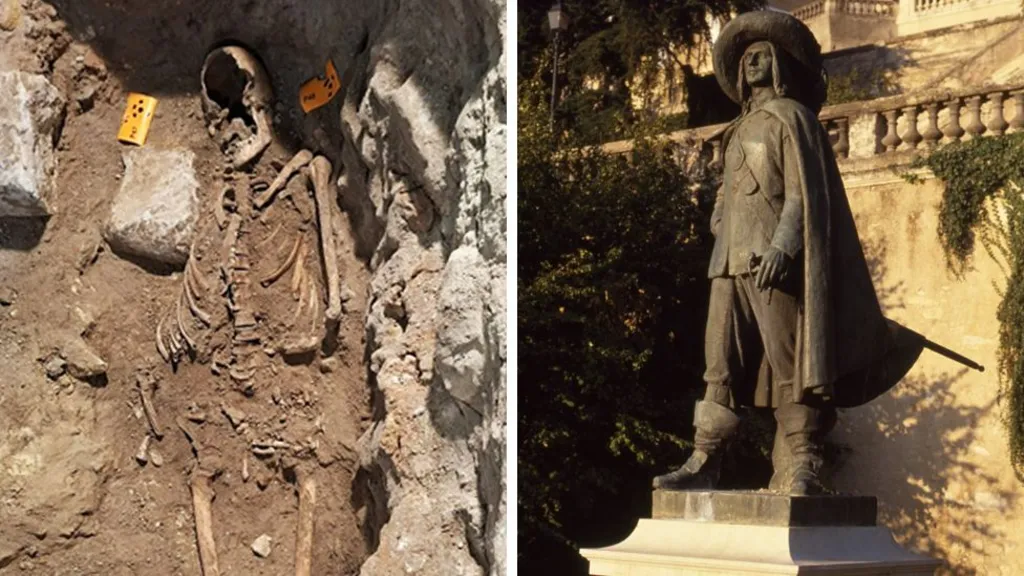
The skeleton was found under the St Peter and Paul Church, where local deacon Jos Valke helped initiate the excavation.
The investigation began almost by chance. Damaged floor tiles prompted a closer look beneath the surface. What started as a routine check quickly turned significant when a wall was uncovered. As digging continued, an archaeologist was called in—and soon after, human remains were revealed beneath what had once been the church altar.
Valke described the moment as deeply moving, noting that the team fell silent upon uncovering the first bone.
Clues Pointing to a Famous Soldier
Several pieces of evidence suggest that the skeleton could indeed belong to d’Artagnan, a trusted officer of Louis XIV:
Burial location: The body was placed in sacred ground directly beneath the altar—an honor typically reserved for individuals of high status.
A fatal bullet: A musket ball was found with the remains, consistent with historical accounts of d’Artagnan’s death in battle.
A dated coin: A coin from around 1660 was discovered in the grave, linked to a bishop who served during the reign of Louis XIV.
Together, these findings strongly align with what is known about d’Artagnan’s life and death.
Death at the Siege of Maastricht
Historical records state that d’Artagnan was killed in 1673 during the Siege of Maastricht. He is believed to have been struck in the throat by a musket ball while leading French troops.
At the time, the army was operating in the area, and due to the summer conditions, he was reportedly buried nearby—making the church a plausible burial site.
From History to Legend
While d’Artagnan was a real historical figure, his fame was cemented through literature. He was immortalized by Alexandre Dumas in The Three Musketeers, where he appears as a central character alongside the fictional trio of musketeers.
These stories transformed him into a symbol of bravery, loyalty, and adventure—blending fact with fiction in a way that captured global imagination.
Scientific Verification Still Pending
Despite the compelling clues, experts are approaching the discovery with caution. Archaeologist Wim Dijkman emphasized the need for scientific confirmation before drawing conclusions.
DNA samples have been sent to laboratories in Germany
Additional analysis is being conducted in Deventer
Researchers are examining the skeleton’s age, origin, and biological profile
Dijkman, who has studied d’Artagnan’s possible burial site for nearly three decades, described the find as a potential career-defining moment—but stressed that definitive proof is still needed.
A Mystery Close to Resolution
For centuries, the exact resting place of d’Artagnan remained unknown, with only rumors suggesting he was buried near Maastricht. This discovery may finally provide concrete evidence—pending scientific validation.
If confirmed, the find would not only resolve a historical mystery but also connect a legendary literary figure to a real, physical resting place—bridging the gap between history and myth.
A Legacy That Endures
Whether as a soldier in the service of Louis XIV or as the daring hero of Alexandre Dumas’ novels, d’Artagnan remains one of the most enduring figures of European history and culture.
Now, more than 350 years later, archaeology may finally be bringing his story full circle.