Introduction
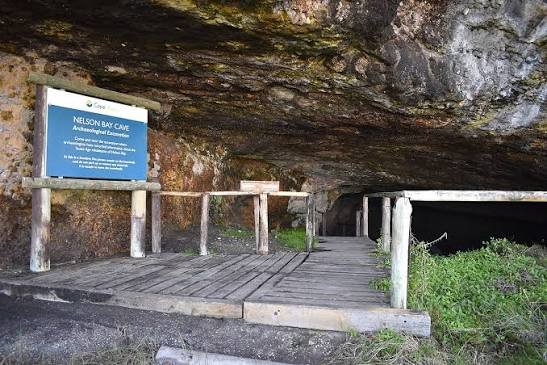
Nelson Bay Cave, situated on the Robberg Peninsula near Plettenberg Bay in South Africa’s Western Cape, is an important archaeological site for understanding the Later Stone Age. Its deposits preserve evidence of hunter-gatherer occupation, stone-tool production, animal exploitation, and changing environmental conditions along the southern Cape coast.
The site is especially useful for studying microlithic technology: the production and use of small, carefully shaped stone tools. Microliths are important because they reveal how prehistoric communities developed versatile tool systems suited to different activities.
Nelson Bay Cave also illustrates the complexity of archaeological chronology. Different layers preserve different periods of occupation, and changes in tool types cannot always be treated as precise markers of a single cultural transition. Researchers have revised the dating of the site using improved radiocarbon methods, helping clarify the sequence of technological change in the region. <Cite refs={["turn487166search7","turn487166search8"]} />
The Coastal Landscape
Nelson Bay Cave overlooks the Indian Ocean from the Robberg Peninsula. The peninsula’s coastal environment provided access to marine resources, while the surrounding land supported terrestrial animals and plant foods.
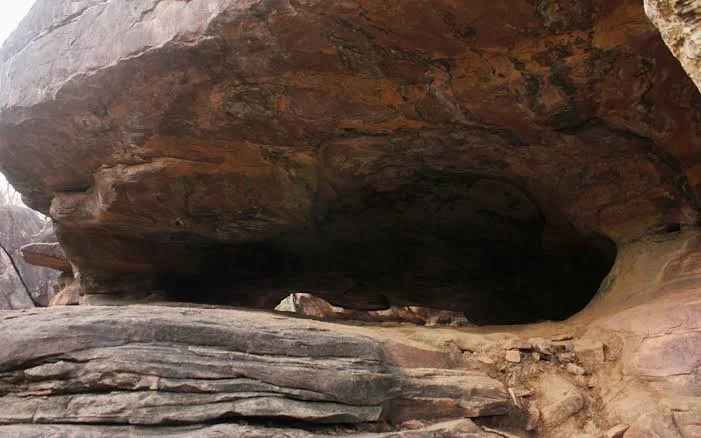
The cave formed in a geological setting involving sandstone and other sedimentary formations. Long-term erosion and changes in sea level helped shape the coastal landscape. Its sheltered position made it a useful location for human activity, although the extent and frequency of occupation varied over time.
Coastal sites are particularly informative because they preserve evidence of how people used both marine and terrestrial resources. Shellfish remains, animal bones, stone tools, and other artefacts can reveal aspects of diet and daily activities.
However, a coastal location does not mean that its inhabitants depended entirely on the sea. Archaeologists must compare marine remains with evidence of terrestrial hunting, plant gathering, and other activities to reconstruct the range of resources people used.
What Are Microliths?
Microliths are small stone artefacts shaped for use as parts of larger tools or implements. Some were made from narrow blades or bladelets, then modified through retouching to create particular edges or shapes.
A microlith could be inserted into a wooden shaft or another organic component, forming a composite implement. Such designs allowed people to create specialised tools while using relatively small amounts of high-quality stone.
The advantages of microlithic technology included portability and repairability. A damaged stone component could be replaced without discarding the entire tool. The small size of microliths also made them useful for producing particular cutting edges or points.
Nevertheless, the function of any specific artefact must be established through evidence. Archaeologists examine microscopic wear, residues, manufacturing patterns, and the context in which the artefact was found. Small size alone does not prove that an object was used as an arrowhead or as part of a particular hunting weapon.
The Later Stone Age Sequence
Nelson Bay Cave preserves an extensive archaeological sequence, including assemblages associated with different Later Stone Age technological traditions. These include the Robberg, Oakhurst, and Wilton traditions, although the precise chronology and boundaries between assemblages have required refinement.
The Robberg tradition is associated with the production of bladelets and small stone artefacts during the Late Pleistocene. The Oakhurst Complex is generally characterised by a different emphasis in tool production, including larger scrapers. Wilton assemblages are associated with microlithic technology.
These labels are archaeological classifications based on recurring patterns in material culture. They do not necessarily represent sharply bounded populations or cultures that replaced one another in a single event.
A study published in Radiocarbon presented new accelerator mass spectrometry dates and Bayesian chronological models for Nelson Bay Cave and Byneskranskop. The research showed why older radiocarbon dates and earlier layer assignments needed reassessment to establish more reliable sequences. <Cite refs={["turn487166search8"]} />
This work is important because archaeological interpretations depend on chronology. If a layer is older or younger than previously believed, the apparent timing of technological change may need to be revised.
Dating Archaeological Layers
Radiocarbon dating measures the decay of carbon-14 in suitable organic material. The method is particularly useful for archaeological deposits from the period in which enough carbon-14 remains for reliable measurement.
However, radiocarbon results must be calibrated because the concentration of carbon-14 in the atmosphere has varied over time. Researchers also need to consider contamination, sample preservation, and whether the material being dated is directly associated with the artefacts under study.
Bayesian modelling can combine radiocarbon results with information about the order of archaeological layers. Rather than treating every date independently, researchers use the known stratigraphic sequence to estimate more coherent chronological ranges.
These models do not eliminate uncertainty. Their results depend on the quality of the samples and the assumptions used to construct the model. Nevertheless, they can provide a more reliable framework than older chronologies based on a small number of uncalibrated dates.
Subsistence and Coastal Resources
The animal remains from Nelson Bay Cave help researchers investigate how people obtained food and responded to changing environmental conditions. Shellfish can indicate the use of rocky shores and other coastal habitats, while bones of terrestrial animals provide evidence of hunting or carcass processing.
The relative abundance of different species may reflect changes in resource availability, human preferences, or the season in which a site was occupied. Archaeologists also examine the sizes and ages of animals represented in the deposits to investigate hunting practices and environmental conditions.
Microlithic tools may have formed part of a broader technological system used to process resources and manufacture equipment. Their presence should not, however, be interpreted as direct proof of a particular subsistence strategy without supporting evidence.
The relationship between coastal and inland resources is also important. Communities could move between different environments or maintain connections with other groups, using a variety of resources according to seasonal availability.
Nelson Bay Cave and Human Adaptability
The site’s long sequence demonstrates that human communities changed their technologies over time while continuing to make use of the surrounding landscape. Toolmaking was not simply a matter of inventing a better implement and abandoning older forms. Different designs could be suitable for different tasks and environments.
Changes in raw-material selection, artefact size, and manufacturing techniques can reflect practical requirements as well as social learning and cultural traditions. Archaeologists therefore interpret stone tools as evidence of behaviour within a broader social and ecological setting.
Conservation and Scientific Importance
Nelson Bay Cave’s deposits are an irreplaceable archaeological resource. Once excavated, an artefact cannot be returned to its original context, making accurate documentation essential. Uncontrolled collecting and disturbance can destroy relationships between artefacts, animal remains, and sediment layers.
Preserving the site and its collections allows researchers to revisit earlier interpretations using new methods. It also supports public education about the long history of human settlement along South Africa’s coast.
Conclusion
Nelson Bay Cave is a major source of evidence for microlithic technology and the changing lives of Later Stone Age hunter-gatherers. Its coastal location provides information about marine and terrestrial resource use, while its archaeological sequence reveals shifts in stone-tool traditions.
Improved radiocarbon dating has helped refine the chronology of these changes, demonstrating that archaeological classifications must be evaluated against reliable dates and carefully documented contexts. <Cite refs={["turn487166search7","turn487166search8"]} />
The site’s lasting importance lies in its ability to connect small stone artefacts with broader questions about technology, mobility, subsistence, and human adaptation in southern Africa.