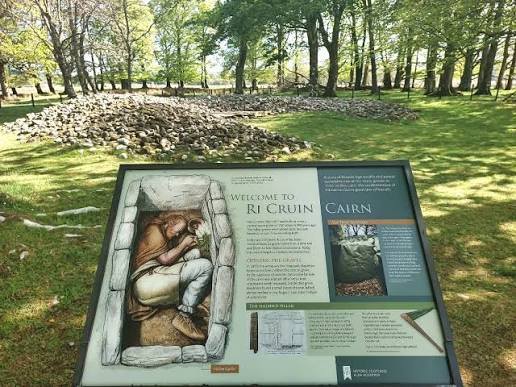
Ri Cruin Cairn occupies the southern end of Kilmartin Glen's remarkable prehistoric linear cemetery.
The monument forms part of a landscape in which burial cairns, standing stones, stone circles, and carved rocks were arranged in close proximity.
Its Bronze Age construction provides evidence for changing burial customs and social practices in prehistoric Argyll.
A Monument Within a Larger Landscape
Ri Cruin is not an isolated cairn.
It belongs to the broader ceremonial landscape of Kilmartin Glen, where several large burial monuments were positioned along the valley.
The placement of Ri Cruin at the southern end of the cemetery contributed to the visual and spatial organization of the landscape.
Bronze Age Burial
Ri Cruin belongs primarily to the Bronze Age phase of Kilmartin Glen's prehistoric cemetery.
Bronze Age burial practices differed from earlier Neolithic traditions.
Instead of large communal chambered tombs, communities increasingly used individual cists and cairns.
This shift may reflect changing ideas about:
individual identity;
ancestry;
social status;
and leadership.
Cairns as Monuments
A cairn is essentially a mound constructed from stones.
Building one required the gathering, transporting, and carefully positioning of large quantities of material.
A monumental cairn therefore represented a significant investment of labor.
Elite Burials
Bronze Age burial monuments sometimes contained objects associated with status.
These could include:
bronze weapons;
tools;
pottery;
ornaments;
and other valuable objects.
Such objects can provide clues about social hierarchy.
Kilmartin Glen's Burial Tradition
The repeated construction of burial monuments in Kilmartin Glen indicates that the area retained religious importance for generations.
Ri Cruin therefore forms part of a long-term tradition of commemorating the dead within a highly visible landscape.
The Importance of Visibility
Many of Kilmartin Glen's monuments can be seen from one another.
This suggests that prehistoric people may have understood the valley as a connected ceremonial environment.
The monuments could have served as physical reminders of ancestors and earlier communities.
Archaeological Interpretation
Archaeologists must distinguish between what is directly demonstrated by evidence and what is reconstructed through interpretation.
We can establish the monument's prehistoric date and relationship to the wider cemetery.
However, the exact rituals performed there remain unknown.
Conclusion
Ri Cruin: Argyll's Bronze Age Cairn Circle demonstrates the continuing importance of burial and monumental construction during prehistoric Scotland's Bronze Age.
Its position within Kilmartin Glen's linear cemetery reveals that prehistoric communities were deliberately creating relationships among tombs, stones, landscapes, and ance