Sardinia’s Nuragic towers have endured for 3,500 years without mortar, cement, or metal, and new scientific research is now explaining the ancient engineering principles that allowed these Bronze Age structures to defy gravity for millennia.
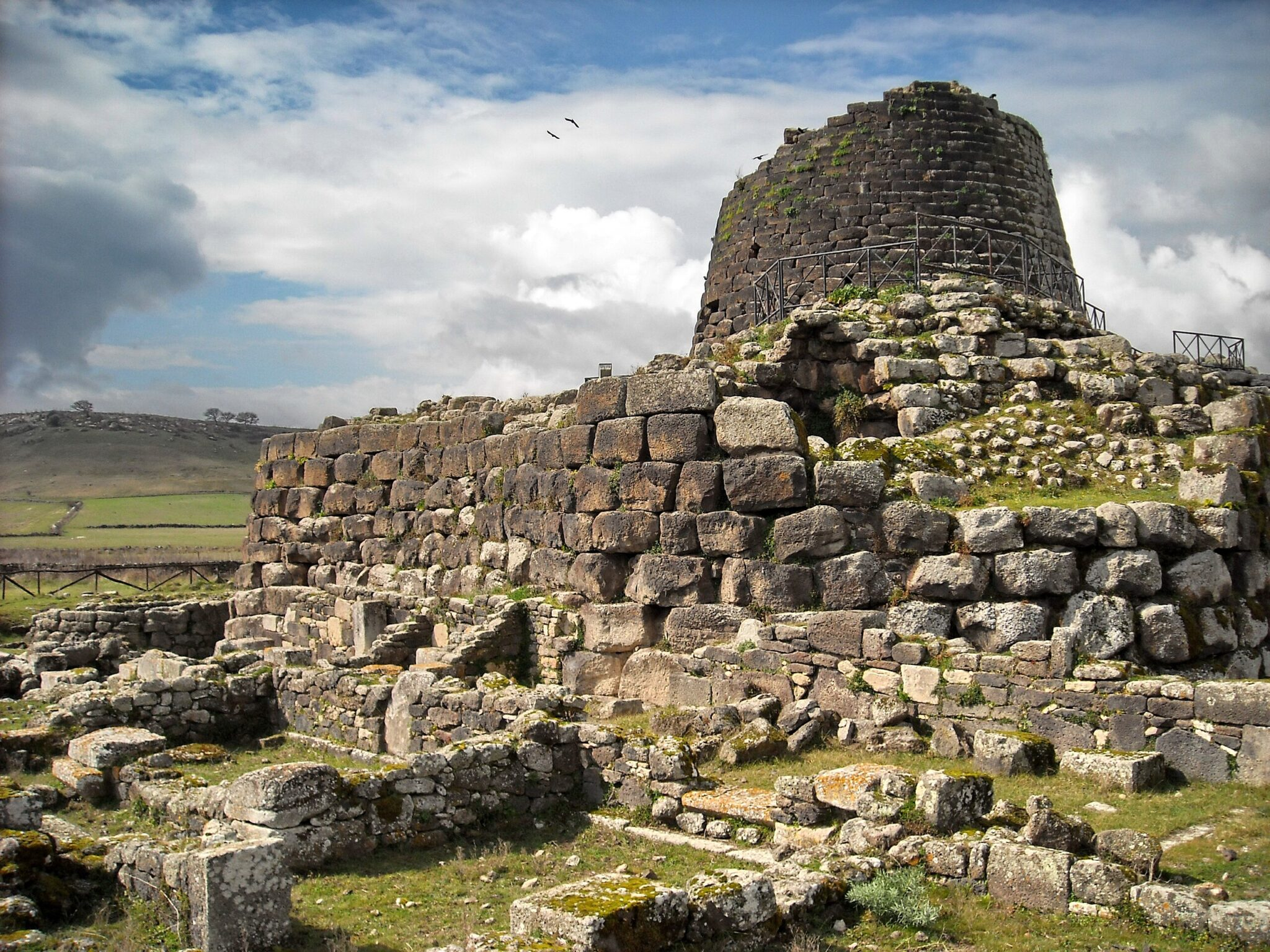
Across Sardinia’s hills, plains, and volcanic plateaus, the stone towers known as nuraghi have stood for over three thousand years. Erected by the Nuragic civilization between about 1800 and 700 BCE, these imposing monuments have long challenged archaeologists and engineers. Despite being built entirely of stone blocks, with no binding materials or metal supports, many remain standing in impressive condition today.
A recent scientific study has uncovered the structural logic behind their remarkable durability. The findings show that their strength comes not only from the size of the stones used, but also from materials once thought to be insignificant—loose rubble hidden within the walls.
An ancient puzzle shaped in stone
More than 8,000 nuraghi are spread throughout Sardinia, ranging from modest single towers to large, complex fortifications with multiple towers, walls, and courtyards. Their defining feature is a unique design: an outer tower shaped like a truncated cone that surrounds an inner chamber topped by a corbelled false dome, or tholos. The space between the inner and outer walls is filled with a thick mix of soil, small stones, and pebbles.
For many years, this fill was seen as little more than leftover material or dead weight. Researchers debated whether the towers’ stability relied mainly on the sheer mass of the stones, their circular form, or the dome-like structure of the tholos. What had not been closely examined until now was whether the fill itself played an active mechanical role in keeping the towers stable.
That question has now been answered.
Recreating the past through modern physics
In research published in the International Journal of Architectural Heritage, an Italian team led by Augusto Bortolussi used advanced computational modeling to study a typical Nuragic tower. They employed the Distinct Element Method (DEM), a technique suited for analyzing structures composed of individual blocks and granular materials, allowing them to replicate the tower as it actually functions—countless stones interacting through gravity, friction, and pressure.
The digital reconstructions matched the real proportions of nuraghi, with outer towers reaching up to 16 meters in height and inner chambers measuring up to six meters across. Importantly, the models also accounted for how the granular fill behaves when compressed.
The findings were conclusive.
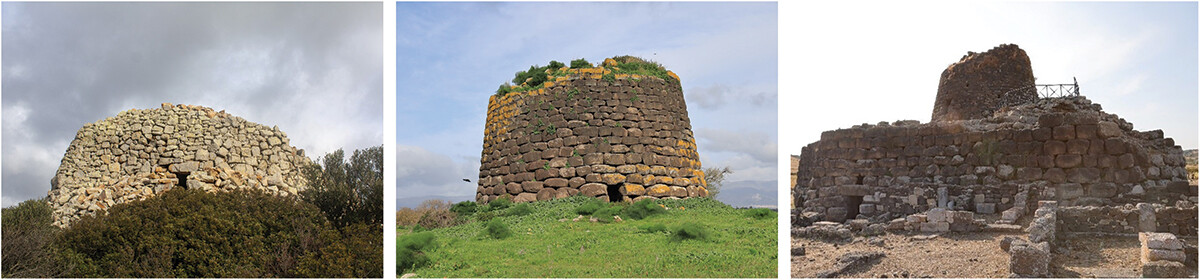
Archaic Nuraghe Sa perdaia (1), Teulada (SU); single Tower Nuraghe Lighei (2) sedilo (OR), Santu Antine complex Nuraghe (3), Torralba (SS)
The fill that holds everything together
The study demonstrates that the tholos is composed of stacked horizontal rings of stone blocks that, on their own, would be unstable. Without external support, these rings tend to rotate inward and spread outward under gravity, eventually collapsing.
The compacted fill material changes everything.
As the weight of the structure presses down, the loose fill compresses and generates horizontal radial pressure in all directions. This pressure acts inward on the tholos, locking its stone rings into a stable, continuous structure. In effect, the fill transforms independent blocks into a unified system capable of standing for centuries.
But physics is unforgivingly symmetrical. The same pressure that stabilizes the tholos also pushes outward—directly against the external tower.
Why the outer wall is built like a fortress
This is where the iconic cyclopean stones of the outer wall come into play. Often weighing several tons each, these massive blocks create enormous friction at their horizontal joints. That friction counteracts the outward thrust exerted by the compressed fill.
In structural terms, the external tower functions as a gigantic retaining wall or buttress. While the fill is essential for the stability of the inner chamber, it also places the outer wall under constant stress. The balance between these three elements—the tholos, the fill, and the external tower—is what keeps the entire structure standing.
The simulations quantified this balance. The static safety factor of the tholos was calculated at an exceptionally high 6.7, thanks to the stabilizing effect of the fill. By contrast, the external tower’s safety factor was 1.5, making it the most critical and vulnerable component of the system. Its stability depends almost entirely on friction between the massive stone blocks.
Reconstructing how the nuraghi were built
Understanding the statics also revealed how these towers must have been constructed. Building the tholos first would have caused it to collapse without lateral support. Constructing both stone walls and then adding fill later would not allow proper compaction.
The only feasible method, confirmed by the study, is construction by successive horizontal rings. The Nuragic builders raised one level at a time: an inner ring of tholos blocks, an outer ring of tower blocks, and then poured and compacted fill between them before moving upward.
This step-by-step technique ensured that the tholos received immediate horizontal support at every stage, while the outer wall resisted the growing pressure. It reflects a sophisticated empirical understanding of statics—achieved without mathematics, writing, or formal engineering theory.
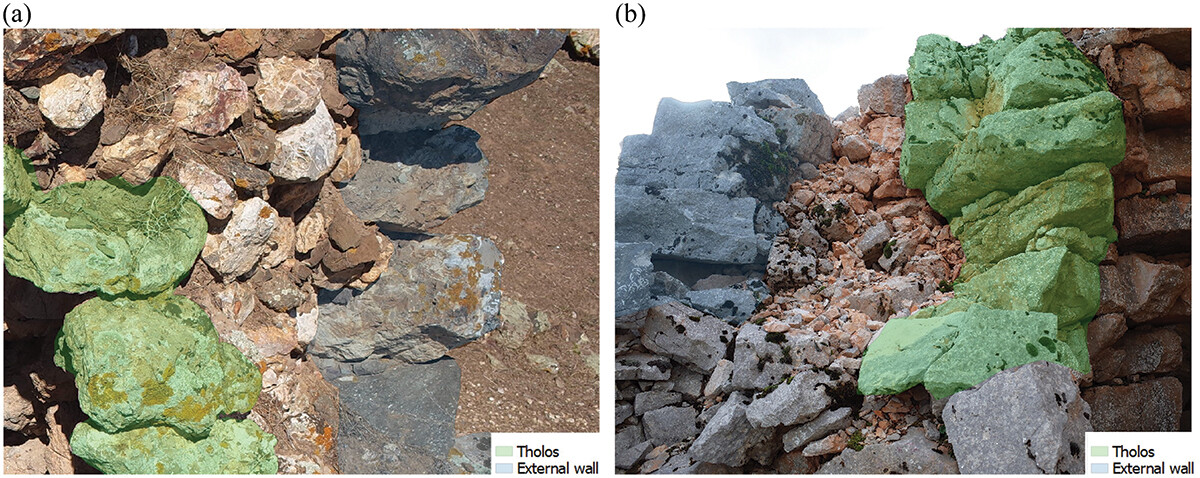
Backfill material: (a) Soil and stones of various sizes, in Nuraghe Sa Domu e’ S’Orcu, Domusnovas (SU); (b) Stones, in Nuraghe Mereu, Orgosolo (NU)
Implications for UNESCO and conservation
These discoveries come at a pivotal time, as thirty-two Nuragic sites are under consideration for UNESCO World Heritage status. Knowing how these towers function is vital for their protection.
Any restoration that removes or alters the fill or disrupts the friction between the outer wall stones could seriously threaten stability. The study offers a scientific basis for conservation practices that honor the original engineering principles rather than unintentionally weakening them.
A legacy of intuitive genius
The survival of the nuraghi is not accidental or due to sheer strength. It reflects a sophisticated construction method where every component—from the smallest stone in the fill to the largest exterior block—serves to balance forces.
Long before formal engineering existed, the Nuragic civilization mastered gravity through observation, experience, and clever design. These towers remain today not only as emblems of Sardinian heritage but as universal testaments to humanity’s early grasp of physics—a knowledge that modern science is only now fully revealing.