There’s a mystery surrounding Chadwell Heath—where does its name originate?
I decided to explore the area on foot, which turned into a two-hour walk.
My route took me from Collier Row Road, up Whalebone Lane North, down Forest Road, along Hainault Road, and finally onto Billet Road, looping back to Whalebone Lane North.
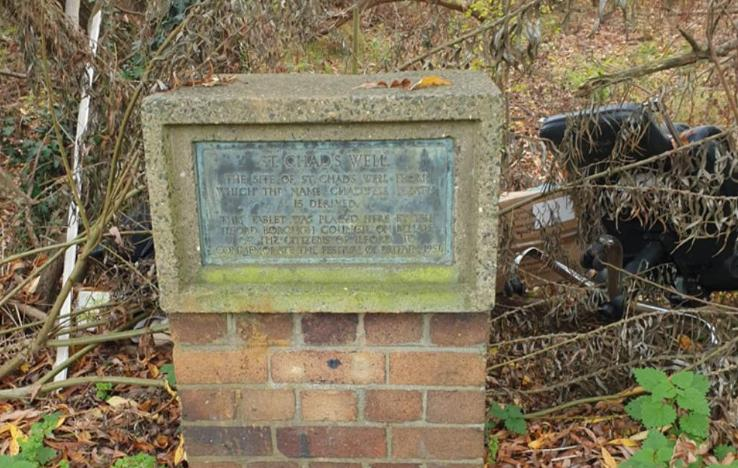
By the last stretch, I was feeling tired, but on Billet Road I stumbled upon a hidden piece of history tucked among roadside bushes and fly-tipped rubbish near the junction with Hainault Road.
I had seen this spot from the 296 bus almost daily, but it wasn’t until I walked past a brick and concrete monument with a faded plaque that it truly caught my eye.
Chad’s name lives on in a monument passed daily
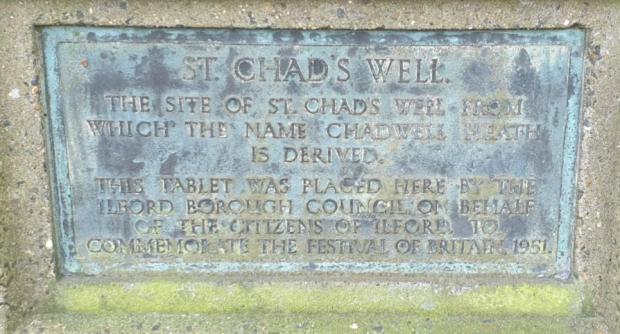
The plaque reads:
ST. CHAD'S WELL
THE SITE OF ST. CHAD'S WELL FROM WHICH THE NAME CHADWELL HEATH IS DERIVED.
THIS TABLET WAS PLACED HERE BY THE ILFORD BOROUGH COUNCIL ON BEHALF OF THE CITIZENS OF ILFORD, TO COMMEMORATE THE FESTIVAL OF BRITAIN, 1951.
As a former archaeology student, I was intrigued and wondered how well the monument was remembered.
I started digging and discovered the monument is listed as a historical landmark on Google Maps, including photos and a visitor comment from four years ago.
Checking Wikipedia, however, offered a different explanation for the town’s name:
“Chadwell” was first recorded in 1254 as Chaudewell, meaning “the cold spring.”
The name was initially applied to a settlement on the Barking side of the Dagenham–Barking boundary and was also called Chadwell Street (with “street” meaning hamlet).
In the 17th century, Blackheath Common in Dagenham parish was renamed Chadwell Heath.
As settlements merged, Chadwell Street was replaced by Chadwell Heath.
Searching for links to a person named Chad or St. Chad, I found St. Chad’s parish church in Chadwell Heath on St. Chad’s Road, dedicated to Chad, brother of Cedd, both bishops and saints.
Chad was a 7th-century Anglo-Saxon monk, abbot, and later bishop of the Northumbrians, Mercians, and Lindsey people. According to Bede, he and Bishop Wilfrid of Ripon introduced Christianity to Mercia. Chad died around March 2, 672, probably from the plague, and was canonized in Anglican, Roman Catholic, Celtic Orthodox, and Eastern Orthodox traditions. His feast day is March 2.
Chad is associated with wells: he dug wells for travelers, believed to have miraculous properties. While there’s no direct evidence of Chad overseeing springs, the Spa Research Fellowship calls him the patron saint of medicinal springs. This might explain why St. Chad’s Well, linked to a “cold spring” in Essex, bears his name despite him not ministering there.
Pixy Led Publications notes:
A reputed medicinal well on Billet Lane, near Little Heath, was frequented by people with weak eyesight, as the water was believed to help the eyes.
Missionaries often baptized converts at local wells, which were sometimes named after famous saints. It’s said Cedd baptized people here, and the well became associated with Chad due to its healing properties.
Nearby waterways on Google Maps show an irrigation ditch across the road and small creeks behind the monument.
Questions remain:
Should the Wikipedia explanation of Chadwell Heath’s name reconcile with St. Chad’s Well?
Is the similarity between Chaudewell and Chad’s Well coincidental?
What exactly does Chaudewell mean?
The name Chad comes from the Celtic Ceadda, derived from Proto-Brythonic kad (“battle”), with no link to wells or springs. “Chaude” is French for “hot” or “warm,” not related to Chad. Old English for “cold” is cald, with Proto-West Germanic roots kald, and ultimately Proto-Indo-European gel- (“cold”). Perhaps chaude was a corruption of cheald, but that seems unlikely.
Thus, there appears to be a discrepancy between Wikipedia’s etymology and local understanding in 1951. While Chad did not directly minister in Essex, missionaries or his brother Cedd may have, leading to the naming of the well (by 1254), the church (1886), and the road (c.1900) after him.
The monument deserves attention: not every area has its origin story engraved in stone, and the council should consider restoring this 74-year-old piece of local history.