Introduction
Ogden Union Station stands as one of Utah's most important railroad heritage sites.
Its significance derives from Ogden's strategic location at the intersection of major transportation routes and from the station's role in connecting Utah with national railroad networks.
Today, the historic station complex serves as a museum and cultural site, preserving the technological and social history of rail transportation.
Ogden and the Railroad
Before the railroad, transportation across Utah depended heavily on wagon roads, stage routes, and other overland systems.
Railroads transformed the geography of transportation.
Ogden became especially important because it developed as a major railroad junction.
The city became a gateway between the East and West.
The Transcontinental Railroad
The completion of the first transcontinental railroad in 1869 dramatically altered Utah's economy.
The Central Pacific and Union Pacific railroads met at Promontory Summit.
Ogden subsequently became a major connection point for western railroad transportation.
The city grew as rail traffic increased.
Union Station
The station complex served passengers and rail operations.
Large railroad stations were not simply buildings where people waited for trains.
They contained ticketing facilities, waiting rooms, restaurants, offices, baggage facilities, communication systems, and operational spaces.
They were transportation hubs.
Architecture
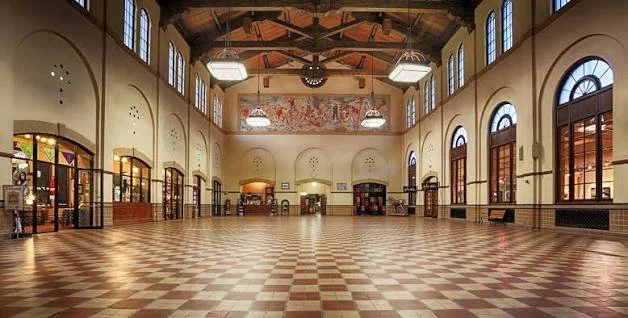
Ogden Union Station reflects the architectural ambition of major railroad companies.
The building's design communicated permanence and institutional importance.
Large public spaces accommodated passengers.
Decorative elements reinforced the idea that railroad stations were civic landmarks.
Railroads and Economic Transformation
Railroads transformed Utah's economy.
Agricultural products could reach distant markets.
Mining companies could ship ore more efficiently.
Manufactured goods could enter Utah more cheaply.
Tourism became more accessible.
Population movement accelerated.
Railroads therefore contributed to the integration of Utah into the national economy.
Workers
Railroads employed enormous numbers of workers.
Engineers, conductors, brakemen, maintenance crews, telegraph operators, station workers, mechanics, and laborers formed a specialized workforce.
Railroad employment required discipline and coordination.
Timetables were critical.
Communication systems had to function accurately.
A mistake could produce catastrophic consequences.
Immigrant Labor
Railroad construction relied heavily on immigrant workers, including large numbers of Chinese laborers who built the Central Pacific across the Sierra Nevada and Great Basin.
Irish, European, Mexican, and other workers also participated in railroad construction and operation at different times and locations.
The history of railroad expansion is therefore inseparable from labor migration.
Museum Preservation
Ogden Union Station now preserves artifacts associated with railroad history.
These can include locomotives, passenger cars, tools, photographs, uniforms, communication equipment, and historical documents.
Railroad museums are especially valuable because transportation technology is difficult to understand from photographs alone.
Visitors can see the scale of locomotives and equipment directly.
Social History
Stations were also places where people experienced migration, separation, reunion, tourism, commerce, and wartime transportation.
The social history of railroads therefore extends far beyond technology.
A station could be the location where families said goodbye, workers began new jobs, soldiers departed, or travelers entered a new region.
Conclusion
Ogden Union Station preserves the history of a transportation system that transformed Utah's relationship with the rest of the United States.
Its architecture, collections, railroad equipment, and location together demonstrate how railroads reshaped economic development, labor, migration, communication, and urban life.