Introduction
Pecos Pueblo occupies one of the most historically important crossroads in New Mexico.
Located near the eastern edge of the Upper Pecos Valley, the settlement stood close to the Glorieta Pass, a natural corridor connecting the Rio Grande region with the Great Plains.
For centuries, this geography helped make Pecos an important center of farming, trade, diplomacy, and cultural interaction.
The site later became deeply involved in Spanish colonization and Catholic missionary activity.
That history makes Pecos Pueblo far more than an archaeological ruin.
It is a layered cultural landscape in which Indigenous history, Spanish colonialism, Christianity, trade, warfare, and later American expansion intersect.
A Strategic Location
The location of Pecos was one of the principal reasons for its importance.
The National Park Service describes the Upper Pecos Valley as a major gateway between the Sangre de Cristo Mountains and Glorieta Mesa.
The geography connected different ecological and cultural regions.
To the west were the Pueblo communities of the Rio Grande.
To the east were the Plains.
The Great Plains provided access to bison and other resources, while the Rio Grande region offered agricultural products and connections to other Pueblo settlements.
Pecos therefore occupied a strategic position within a much larger exchange network.
The Early Settlement
Human occupation of the Upper Pecos Valley extends far beyond the Pueblo period.
The National Park Service identifies evidence of Paleoindian activity dating back more than 10,000 years, including hunting of large animals. Later Archaic populations adopted increasingly intensive plant use and eventually agriculture.
By the early centuries of the Common Era, people were living in more permanent structures.
Around A.D. 800–900, pithouses were used in the region.
By the mid-eleventh century, above-ground pueblo architecture became increasingly important.
This transition reflects broader changes in Southwestern settlement.
The Rise of Pecos Pueblo
During the fifteenth century, many smaller settlements in the Upper Pecos region became increasingly concentrated.
According to the National Park Service, between 50 and 100 or more smaller pueblos eventually became part of a larger Pecos settlement during the 1400s.
The resulting community was enormous by Southwestern standards.
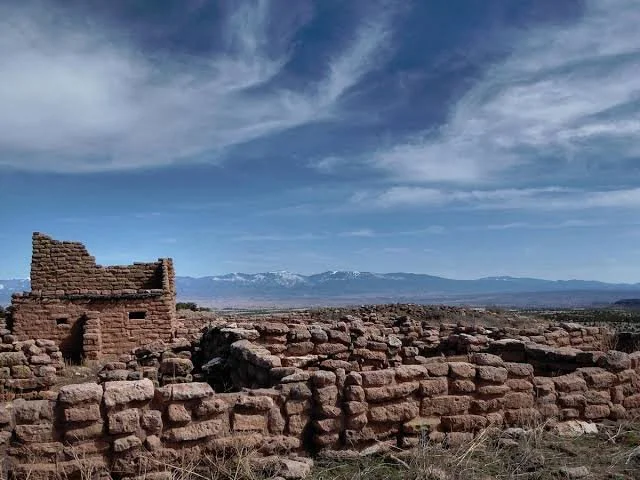
Large multi-story buildings were constructed from stone and stabilized with adobe mortar.
The settlement also contained numerous kivas.
The architectural scale demonstrates considerable organization.
Stone had to be gathered and transported.
Walls had to be planned and constructed.
Wood had to be obtained for roofing.
Food had to support workers.
The settlement therefore depended on cooperation and economic coordination.
Pecos as a Trading Center
Trade was one of Pecos's greatest strengths.
Its location near Glorieta Pass connected the Plains and Pueblo worlds.
The community could participate in exchanges involving:
agricultural products
bison products
pottery
stone tools
pigments
shells
textiles
other regional goods
Trade was not simply an economic activity.
It created relationships.
Merchants, travelers, diplomats, and representatives of different communities could meet at Pecos.
The settlement's political influence was therefore connected to its economic geography.
The Spanish Arrive
The Spanish encounter with Pecos began in the sixteenth century.
The National Park Service notes that the Coronado expedition reached Pecos Pueblo in 1541.
This began a fundamentally different chapter in the settlement's history.
Spanish explorers entered a complex Indigenous world that already possessed its own political structures, religious traditions, agricultural systems, trade networks, and regional relationships.
Spanish colonization did not simply add a new population.
It transformed existing institutions.
Missionary Activity
Catholic missionaries accompanied Spanish colonization.
Their objective included converting Indigenous populations to Christianity and establishing permanent religious institutions.
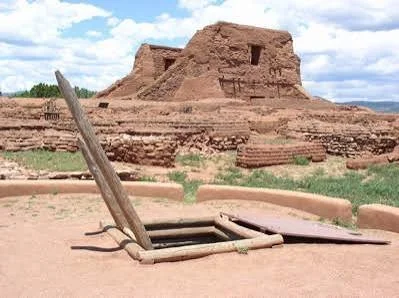
At Pecos, this resulted in the construction of a large Spanish mission church.
The church became one of the most visible symbols of the colonial transformation of the settlement.
Yet the relationship between Pueblo communities and Spanish missionaries was complex.
Christianity was not simply accepted uniformly.
Indigenous communities negotiated, resisted, adapted, and sometimes incorporated elements of Christianity into existing cultural systems.
The Mission Church
The Spanish mission at Pecos demonstrates colonial architectural technology.
Adobe was essential.
Adobe construction uses earth mixed with water and often organic materials to form walls.
In the dry Southwest, adobe can survive for centuries if protected from excessive moisture.
The mission church was substantially larger than ordinary Pueblo structures and represented a new institutional presence.
Its scale reflected the ambitions of the colonial Church.
But the church stood within an Indigenous settlement.
This created an architectural landscape in which Pueblo and Spanish traditions existed side by side.
Religion and Cultural Conflict
The colonial religious encounter was not peaceful in every period.
Pueblo communities experienced pressure to abandon Indigenous religious practices.
Spanish authorities sometimes attempted to suppress traditional ceremonies and sacred objects.
These policies contributed to resistance.
The most famous episode was the Pueblo Revolt of 1680, during which Pueblo communities across New Mexico coordinated an uprising against Spanish colonial rule.
Pecos participated in the broader events of this period.
The revolt temporarily expelled Spanish authorities from New Mexico.
It remains one of the most significant Indigenous resistance movements in North American colonial history.
The Return of Spanish Rule
Spanish colonial authority eventually returned.
The relationship between Pueblo communities and colonial institutions continued to evolve.
Some Indigenous people adopted Christianity.
Others maintained traditional practices.
Many communities developed forms of cultural coexistence.
Archaeology reveals this complexity.
Objects, architecture, burials, ceramics, and other evidence can demonstrate how cultural traditions changed without necessarily disappearing.
Pecos and the Santa Fe Trail
Centuries later, the landscape became important again because of the Santa Fe Trail.
The route connected Missouri with Santa Fe and became a major corridor of trade between the United States and New Mexico during the nineteenth century.
Pecos's location near Glorieta Pass made it relevant to this expanding transportation system.
The same geography that had facilitated Indigenous trade now supported long-distance commercial traffic.
This is a recurring theme in the history of Pecos.
The landscape repeatedly became important because of its position between regions.
The Civil War at Glorieta Pass
The importance of the corridor continued during the American Civil War.
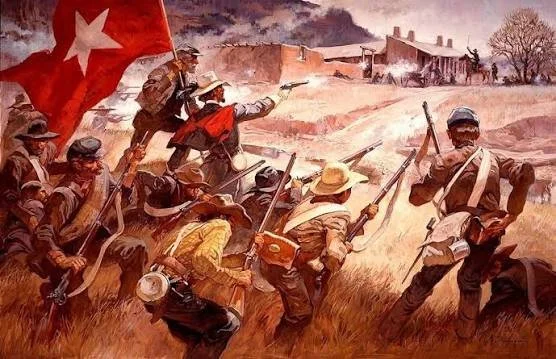
In 1862, Confederate and Union forces fought the Battle of Glorieta Pass in the vicinity.
The battle has sometimes been called the "Gettysburg of the West," although such comparisons can oversimplify the distinct military context of the New Mexico Campaign.
Its importance lies in the fact that control of the region affected Confederate ambitions in the Southwest.
The National Park Service identifies the Glorieta battlefield as the site of the farthest-west pivotal battle of the Civil War.
Archaeology at Pecos
Pecos became one of the most important archaeological research sites in the American Southwest.
Excavations revealed extensive information about:
architecture
ceramics
agriculture
trade
diet
warfare
social organization
colonial encounters
religious change
Archaeologist A. V. Kidder played a major role in the development of Southwestern archaeology through his work at Pecos.
His research helped establish chronological frameworks based on pottery and architecture.
The resulting archaeological sequence became influential far beyond New Mexico.
The Pecos Classification System
The archaeology of Pecos contributed to broader attempts to organize Southwestern chronology.
Researchers developed ceramic and architectural classifications to identify changes over time.
These classifications allowed archaeologists to compare sites across large regions.
However, modern archaeology recognizes that cultural development was rarely as neat as a series of fixed periods.
Communities overlapped.
Styles spread.
People migrated.
Traditions persisted.
The archaeological record is therefore more complex than any classification system can completely represent.
The Pecos Conferences
Pecos also became important in the history of archaeological scholarship because of the Pecos Conference.
Archaeologists used these meetings to discuss Southwestern archaeology, chronology, theory, and research methods.
The conference became an important institution in the development of the discipline.
Pecos therefore influenced archaeology not only through its ancient remains but through modern scholarship.
Indigenous Descendants
The people who built Pecos Pueblo did not simply vanish.
The surviving community eventually became closely connected with Jemez Pueblo.
Today, descendants maintain cultural connections with the site.
The National Park Service explicitly emphasizes that Pecos descendants continue to live nearby and that the ancestral settlement remains culturally significant.
This is crucial when discussing the site.
Pecos should not be described merely as a "lost civilization."
It represents a continuing Indigenous heritage.
Preservation
Pecos contains fragile adobe and stone architecture.
Adobe requires constant maintenance.
Water is particularly destructive.
Even small amounts of erosion can gradually undermine walls.
Archaeologists and preservation specialists therefore monitor structures and periodically stabilize them.
Preservation is not simply about making ruins visually attractive.
The goal is to maintain as much original material and archaeological context as possible.
A Layered Landscape
Perhaps the most remarkable feature of Pecos is the number of historical layers present in one location.
The landscape preserves evidence of:
Paleoindian hunting
Archaic lifeways
early agriculture
pithouse communities
large Pueblo settlements
regional trade
Spanish exploration
Catholic missionary activity
Pueblo resistance
Spanish colonial society
Santa Fe Trail commerce
Civil War conflict
modern archaeology and preservation
Few archaeological sites demonstrate such a long sequence of human interaction so clearly.
Conclusion
Pecos Pueblo was powerful because of geography.
Its position near Glorieta Pass connected different ecological and cultural worlds.
That location supported agriculture, trade, diplomacy, and political influence for centuries.
Spanish colonization transformed the settlement but did not erase its Indigenous identity.
The mission church became an enduring symbol of colonialism, while Pueblo traditions continued through periods of profound political and religious change.
Later, the Santa Fe Trail and Civil War brought new historical layers.
Today, Pecos National Historical Park preserves this extraordinary sequence.
Its ruins are not merely stones and adobe.
They are evidence of thousands of years of human adaptation, commerce, conflict, cultural transformation, and continuity.