• MAIN PAGE
  • LATEST NEWS
    • Lost Cities
    • Archaeology's Greatest Finds
    • Underwater Discoveries
    • Greatest Inventions
    • Studies
    • Blog
  • PHILOSOPHY
  • HISTORY
  • RELIGIONS
    • Africa
    • Anatolia
    • Arabian Peninsula
    • Balkan Region
    • China - East Asia
    • Europe
    • Eurasian Steppe
    • Levant
    • Mesopotamia
    • Oceania - SE Asia
    • Pre-Columbian Civilizations of America
    • Iranian Plateau - Central Asia
    • Indus Valley - South Asia
    • Japan
    • The Archaeologist Editor Group
    • Scientific Studies
    • Aegean Prehistory
    • Historical Period
    • Byzantine Middle Ages
    • Predynastic Period
    • Dynastic Period
    • Greco-Roman Egypt
  • Rome
  • PALEONTOLOGY
  • About us
Menu

The Archaeologist

  • MAIN PAGE
  • LATEST NEWS
  • DISCOVERIES
    • Lost Cities
    • Archaeology's Greatest Finds
    • Underwater Discoveries
    • Greatest Inventions
    • Studies
    • Blog
  • PHILOSOPHY
  • HISTORY
  • RELIGIONS
  • World Civilizations
    • Africa
    • Anatolia
    • Arabian Peninsula
    • Balkan Region
    • China - East Asia
    • Europe
    • Eurasian Steppe
    • Levant
    • Mesopotamia
    • Oceania - SE Asia
    • Pre-Columbian Civilizations of America
    • Iranian Plateau - Central Asia
    • Indus Valley - South Asia
    • Japan
    • The Archaeologist Editor Group
    • Scientific Studies
  • GREECE
    • Aegean Prehistory
    • Historical Period
    • Byzantine Middle Ages
  • Egypt
    • Predynastic Period
    • Dynastic Period
    • Greco-Roman Egypt
  • Rome
  • PALEONTOLOGY
  • About us
No results found

Petroglyph National Monument: Albuquerque's Rock Art

September 18, 2026

Introduction

Petroglyph National Monument preserves one of the largest collections of volcanic rock art in North America.

Located on the western edge of modern Albuquerque, New Mexico, the monument contains thousands of petroglyphs created by Indigenous peoples over many centuries, together with later historic inscriptions.

A Volcanic Canvas

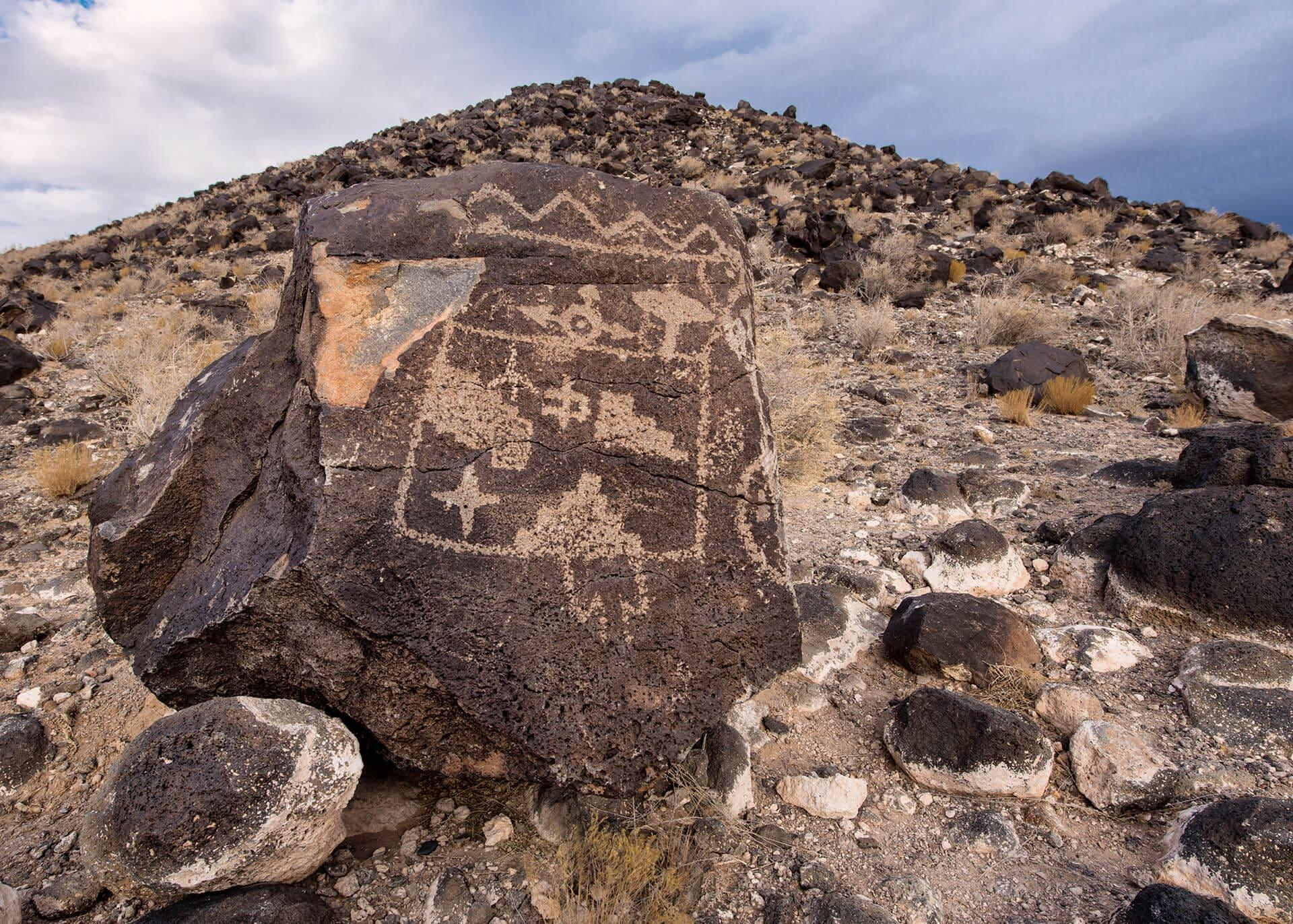
The monument's volcanic landscape contains dark basalt surfaces.

Weathering gradually creates a dark patina on exposed rock.

Ancient artists could remove this surface using stone tools, creating lighter images beneath.

The result was a natural contrast that made designs visible.

Indigenous Imagery

Petroglyphs include humans, animals, geometric forms, footprints, spirals, masks, and other designs.

Some images may represent religious or cosmological concepts.

Others may relate to identity, storytelling, ritual, or communication.

However, interpreting individual images is difficult without written explanations from the original creators.

The Importance of Context

Rock art should not be treated as a collection of isolated pictures.

Its location within a landscape matters.

Volcanic ridges, mountain views, water sources, pathways, and settlements could all contribute to the meaning of a place.

Long-Term Use

The monument represents a long period of human interaction with the landscape.

Different generations created images.

Some designs may have been deliberately placed near earlier carvings.

This means the landscape could function as a visual archive in which successive communities added their own marks.

European Contact

Later historic inscriptions demonstrate that the landscape continued to attract human activity after European arrival.

These later markings form a different historical layer and must be distinguished from Indigenous prehistoric art.

Archaeological Interpretation

Modern archaeology emphasizes caution.

Researchers cannot automatically assign a fixed meaning to a symbol simply because it resembles a modern image.

Meaning is culturally specific.

The strongest interpretations combine imagery with archaeological evidence, ethnographic information, Indigenous knowledge, and regional comparisons.

Preservation

The petroglyphs are fragile.

Weathering occurs naturally, but deliberate damage can accelerate deterioration.

Modern preservation therefore focuses on limiting physical contact and protecting the archaeological landscape.

Conclusion

Petroglyph National Monument demonstrates the importance of visual expression in Indigenous Southwestern societies.

The basalt rocks preserve thousands of moments of human creativity.

Together they form a cultural landscape that connects art, environment, identity, spirituality, and memory.
← Three Rivers Petroglyphs: New Mexico's 21,000 ImagesGalisteo Basin: New Mexico's Kiva Villages →
Featured
image_2026-09-15_213233600.png
September 18, 2026
Kaloko-Honokohau: Hawaii's Ancient Salt Pans
September 18, 2026
Read more →
September 18, 2026
image_2026-09-15_213313883.png
September 18, 2026
Anasazi Chacoan Outliers: New Mexico's Road Network
September 18, 2026
Read more →
September 18, 2026
image_2026-09-15_213356305.png
September 18, 2026
Salmon Ruins: New Mexico's Chaco Colony
September 18, 2026
Read more →
September 18, 2026
image_2026-09-15_213433098.png
September 18, 2026
Aztec West: New Mexico's Great House Community
September 18, 2026
Read more →
September 18, 2026
image_2026-09-15_213526907.png
September 18, 2026
Casamero Pueblo: New Mexico's Chaco Outlier
September 18, 2026
Read more →
September 18, 2026
image_2026-09-15_214058824.png
September 18, 2026
Chimney Rock: Colorado's Astronomical Great House
September 18, 2026
Read more →
September 18, 2026
read more

Powered by The archaeologist