Introduction
The Point of Pines region of east-central Arizona is archaeologically important because it preserves evidence of interaction among several major Southwestern traditions.
Researchers have identified associations with Mogollon, Ancestral Puebloan, and Hohokam-related material traditions, making the region particularly valuable for studying cultural interaction.
The University of Arizona describes Point of Pines as a major prehistoric population center where archaeological research documented numerous sites and a substantial agricultural economy.
A Region Rather Than One Settlement
Point of Pines is best understood as an archaeological landscape containing numerous sites.
The region supported substantial prehistoric populations.
At its peak, estimates suggest that thousands of people may have participated in an agricultural economy in the broader region.
This scale demonstrates that the mountainous interior of Arizona could sustain substantial communities.
The Mogollon Tradition
The Mogollon archaeological tradition occupied large portions of what is now Arizona and New Mexico.
Its communities practiced agriculture while maintaining important hunting and gathering activities.
Architecture varied considerably according to environment.
In some locations people built pit structures.
Elsewhere they constructed substantial masonry pueblos.
Hohokam Connections
Hohokam-related materials at Point of Pines demonstrate that cultural boundaries were not rigid.
Objects and ideas could travel between regions.
Trade networks connected communities separated by considerable distances.
Ceramic styles are particularly useful for tracing these connections because pottery traditions often display recognizable regional patterns.
Ancestral Pueblo Connections
Ancestral Pueblo traditions also influenced the region.
This demonstrates that prehistoric Southwestern communities were connected through interaction rather than living in completely isolated cultural zones.
The archaeological record frequently reveals mixtures.
A community might adopt architectural techniques from one region while maintaining local pottery traditions and food practices.
Archaeological Fieldwork
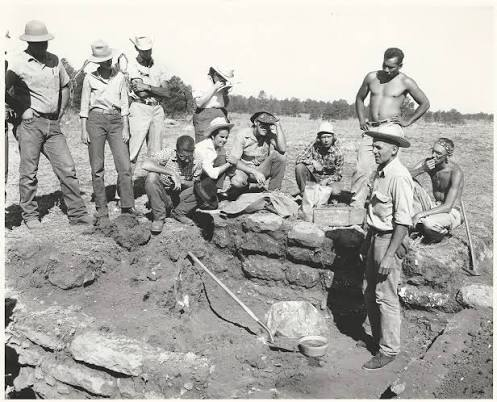
Point of Pines became particularly important to American archaeology through fieldwork associated with Emil Haury and the University of Arizona.
Research in the area helped develop broader understandings of Southwestern archaeology.
Excavations documented architecture, pottery, tools, food remains, and other materials.
These remains allowed researchers to reconstruct settlement patterns and technological changes.
Why Cultural "Mixing" Matters
The idea of a Mogollon-Hohokam mix should not be interpreted as evidence that separate tribes simply merged into one population.
Cultural exchange can occur through trade, marriage, migration, imitation, diplomacy, or the movement of specialists.
Archaeological similarities therefore require careful interpretation.
Agriculture
The region's agricultural system was adapted to mountainous terrain.
Farmers cultivated crops where soils and moisture permitted.
Rainfall patterns were critical.
Communities needed strategies for dealing with drought and seasonal variation.
Conclusion
Point of Pines demonstrates the interconnected nature of the prehistoric Southwest.
Its importance lies not simply in belonging to one archaeological tradition but in revealing how different communities interacted.
The site provides evidence that cultural boundaries were permeable and that ideas, objects, technologies, and people moved across the landscape.