Excavations of a workshop that was buried in Pompeii almost 2000 years ago have given archaeologists unique insights into Roman construction techniques and the longevity of the empire’s concrete
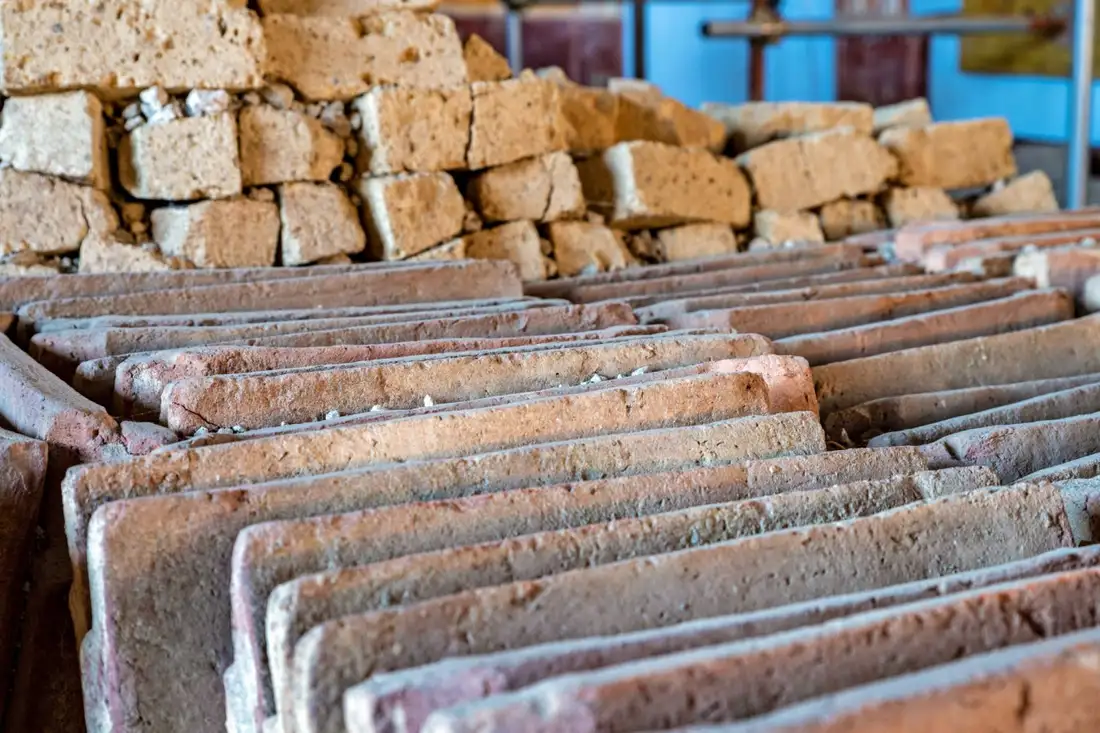
Ceramic roof tiles and tuff blocks excavated at an ancient building site in Pompeii
Ancient Pompeii Workshop Reveals True Secrets of Roman Concrete
A newly uncovered construction site in Pompeii preserved in astonishing detail after the catastrophic eruption of Mount Vesuvius has given archaeologists their clearest insight yet into how the Romans made their famously durable concrete. This discovery, frozen at the very moment workers were preparing their materials in AD 79, has allowed researchers to study Roman construction methods with a level of accuracy that has never been possible before.
Pompeii, located near modern-day Naples in southern Italy, was buried under meters of volcanic ash and debris when Vesuvius erupted. Much of the city remained sealed for nearly two thousand years, creating a time capsule of Roman daily life. Although the building site in question was first noticed in the 1880s, excavations halted for more than a century. Work only resumed in early 2023 as part of a large, renewed archaeological effort focused on areas previously left unexplored.
What archaeologists uncovered exceeded all expectations: a nearly untouched concrete workshop, preserved exactly as the ancient builders left it the day the eruption occurred. The room still contained piles of raw materials, construction tools, and even scribbled markings on the walls that listed work schedules, ingredient measurements, and instructions for mixing. The site included trays of quicklime, reused roof tiles waiting to be crushed, and scattered evidence of in-progress construction.
For Admir Masic of the Massachusetts Institute of Technology, the preservation was nothing short of extraordinary. He described the experience as if he and his team had stepped into a living Roman workshop moments after the workers walked away.
“The materials were exactly as they were at the moment the eruption froze the city in time,” Masic explains. “Studying it truly felt as if I had travelled back to 79 CE and was standing beside the workers as they mixed and placed their concrete.”
Challenging Long-Held Beliefs About Roman Concrete
For centuries, historians and scientists believed that Romans made concrete using slaked lime, or calcium hydroxide. Ancient texts seemed to support this view, describing how lime was mixed with water to create a paste before other ingredients like volcanic ash were added.
However, the newly discovered workshop overturned this assumption.
Chemical analysis of the dry, untouched piles of material found in the workshop revealed something unexpected: the Romans were not using slaked lime for structural concrete. Instead, they relied on quicklime (calcium oxide) and a technique known as hot mixing.
In this method, workers mixed quicklime directly with dry ingredients such as volcanic ash or a mineral additive before introducing water. When water finally contacted the quicklime, a strong chemical reaction occurred, producing significant heat. This not only accelerated the curing process but also changed the internal structure of the concrete.
According to Masic, this technique appears to have been central to the remarkable longevity of Roman buildings many of which have survived earthquakes, erosion, and centuries of wear.
Why Hot-Mixed Concrete Worked So Well
One surprising discovery was the presence of lime clasts mall, unmixed fragments of lime—embedded throughout the hardened concrete. Rather than being a flaw, these clasts played a crucial role in the material’s long-term durability.
“As the structure ages,” Masic explains, “these lime clasts slowly dissolve and recrystallize within tiny cracks and pores. They essentially act as built-in repair units.” When moisture or stress forces create microcracks, calcium-rich material flows into the gaps and naturally seals them, strengthening the concrete from within.
This built-in self-healing system is one reason why ancient piers, aqueducts, domes, and foundations have survived for nearly two millennia—often outlasting modern concrete structures by centuries.
In contrast, slaked lime appears to have been used mainly for plastering, mortars, and finishing surfaces areas where smooth texture, spreadability, and fine application were more important than structural strength.
A Craft Frozen in Time
Beyond the scientific discoveries, the workshop provided a rare, emotionally powerful window into ancient craftsmanship. The tools, materials, and layout were familiar enough that, as Masic remarked, a modern construction worker could walk into the space and understand exactly what to do.
“The chemistry is ancient,” he says, “but the craft is recognisable.”
The finding underscores just how advanced Roman engineering was and how their innovations continue to surpass many modern building techniques. With this discovery, researchers now have a more accurate and complete understanding of Roman concrete, potentially inspiring new, longer-lasting construction methods today.