Hidden in the Cliffs of Mustang: The Ancient Himalayan Hermitage That Seems to Defy the Mountains
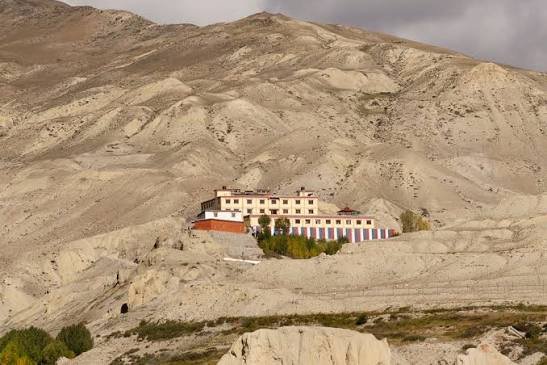
High in the dramatic landscapes of Mustang, Nepal, where deep valleys cut through the rain-shadow of the Himalayas and ancient trade routes once connected Tibet with the Indian subcontinent, Buddhist monasteries, meditation sites, and cliffside religious structures preserve evidence of centuries of Himalayan spiritual life. Among the names associated with this extraordinary cultural landscape is Namgyal Gompa, a site whose identity as a remote Buddhist hermitage reflects one of the most enduring traditions of the Tibetan cultural world: the deliberate search for isolation.
Unlike monumental palaces or vast urban temples, a Himalayan hermitage represents a different kind of architecture. Its importance does not necessarily depend on size. Instead, its significance lies in location, religious function, landscape, and the relationship between human beings and an environment that appears almost impossible to inhabit. A structure built near a cliff, cave, or remote mountain valley was often intended to separate religious practitioners from ordinary social life and bring them closer to the spiritual ideals of meditation, discipline, and contemplation.
The story of Namgyal Gompa must therefore be understood within the much larger history of Mustang. This region was never merely an isolated corner of the Himalayas. For centuries, Mustang stood at the intersection of cultures, trade routes, political powers, and religious traditions. Its settlements, caves, monasteries, fortifications, and painted temples preserve a remarkable record of the interaction between the Tibetan Plateau and the Himalayan world.
Mustang: A Himalayan Landscape Shaped by Isolation and Connection
Modern maps can make Mustang appear remote, but remoteness did not mean historical insignificance. The Kali Gandaki Valley formed one of the major corridors linking regions north and south of the Himalayas. Traders, pilgrims, herders, monks, political envoys, and travelers moved through these mountain routes for centuries.
This movement brought cultural influences into Mustang from Tibet and other Himalayan regions. Buddhism became deeply rooted in local society, while Tibetan languages, artistic traditions, religious institutions, and architectural styles shaped the cultural identity of the region.
At the same time, Mustang developed its own political history. The Kingdom of Lo, centered historically around Lo Manthang, emerged as an important Himalayan kingdom. Its fortified settlements, monasteries, and religious monuments demonstrate that Mustang was both a frontier and a cultural center.
A hermitage such as Namgyal Gompa must be viewed against this background. Even the most isolated monastery was connected to a wider network of communities, religious lineages, pilgrimage routes, and systems of patronage.
Why Build a Monastery on a Cliff?
The dramatic placement of Himalayan religious sites was not simply an architectural challenge. Mountains and cliffs possessed profound symbolic importance in Tibetan and Himalayan religious traditions.
The mountains could be understood as sacred landscapes.
Caves could become places of meditation.
Remote valleys could be associated with saints, teachers, or hidden spiritual realms.
Isolation itself could become a religious tool.
A monk living in a remote hermitage was physically separated from many of the distractions associated with ordinary life. The difficult journey required to reach such a location could reinforce the site's spiritual importance. The landscape itself became part of religious practice.
This is why cliffside monasteries and cave complexes appear repeatedly throughout the Himalayan world.
The architecture did not dominate the mountain.
It adapted to it.
Walls followed irregular rock surfaces. Small structures occupied narrow terraces. Prayer spaces were built where geography allowed. Natural caves could be transformed into meditation chambers or shrines.
The Buddhist Tradition of Retreat
In Tibetan Buddhism, religious life has never been limited to large monasteries filled with hundreds of monks. Alongside institutional monasticism existed traditions of solitary and semi-solitary retreat.
A practitioner might withdraw for an extended period to meditate.
This could involve:
Living in a cave.
Occupying a small hermitage.
Practicing under the guidance of a religious teacher.
Performing rituals and recitations.
Studying sacred texts.
Engaging in intensive meditation.
The physical environment of a cliffside hermitage could therefore serve a practical and symbolic purpose. It created distance from ordinary settlements while placing the practitioner within a landscape considered spiritually powerful.
Architecture in an Extreme Environment
Constructing religious buildings in Mustang required adaptation to climate and available materials.
Traditional structures frequently relied on combinations of:
Stone.
Mud mortar.
Timber.
Earth.
Whitewashed walls.
Flat roofs.
Small windows designed to reduce exposure to harsh conditions.
In more protected locations, builders could develop larger complexes. On narrow or elevated sites, architecture had to respond directly to the available terrain.
This produced one of the most visually striking characteristics of Himalayan architecture: buildings often appear to grow directly from the landscape.
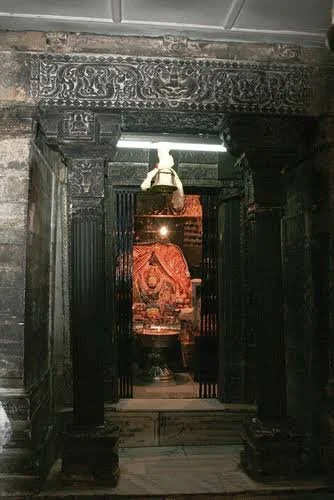
At Namgyal Gompa, the idea of a cliffside hermitage reflects this broader tradition of architecture shaped by geography rather than imposed upon it.
Mustang and the World of Cave Dwellings
Mustang is internationally famous for its ancient cliff caves.
Thousands of human-made cavities have been identified in different parts of the region. Some were used for burial, storage, habitation, or religious activity. Others remain difficult to interpret.
These caves demonstrate that humans had been adapting to Mustang's cliffs for centuries, and in some areas for much longer periods.
The later development of Buddhist monasteries and hermitages therefore occurred within a landscape where cliffs had already been transformed by human activity.
The mountain was not empty.
It was part of history.
Art, Religion, and the Tibetan Cultural World
A Himalayan monastery was rarely just a building.
Its interior could contain:
Buddhist statues.
Painted murals.
Thangka paintings.
Religious manuscripts.
Images of Buddhas and bodhisattvas.
Protective deities.
Ritual objects.
Prayer flags and symbolic decorations.
The artistic traditions found throughout Mustang reveal connections with wider Tibetan Buddhist cultures. At the same time, local artists and communities adapted these traditions according to available resources and regional practices.
This combination of local identity and trans-Himalayan influence is one of the defining characteristics of Mustang's religious heritage.
The Challenge of Preservation
Remote religious sites face unique preservation problems.
Earth construction can be vulnerable to water damage.
Timber can deteriorate.
Earthquakes can threaten centuries-old structures.
Climate change can alter rainfall patterns.
Modern development can introduce new pressures.
In addition, the increasing accessibility of Mustang has created a paradox. Tourism can bring attention and resources to heritage sites, but it can also create physical and cultural pressures.
Preservation therefore requires a balance between access and protection.
Why Namgyal Gompa Matters
The importance of a site like Namgyal Gompa cannot be measured only through monumental scale or famous artifacts.
Its significance lies in what it represents.
It represents the religious geography of Mustang.
It represents the Himalayan tradition of retreat.
It represents the ability of communities to construct sacred spaces in extreme landscapes.
And it demonstrates a fundamental principle of human history: people do not simply inhabit landscapes. They give landscapes meaning.
A cliff becomes a place of meditation.
A cave becomes a shrine.
A remote mountain becomes a sacred destination.
Namgyal Gompa stands within this ancient relationship between geography, religion, and human imagination.
For centuries, the cliffs of Mustang have appeared almost untouched by civilization. Yet closer examination reveals something very different.
The mountains are filled with history.
And hidden among them are places where generations of people sought not wealth, conquest, or political power—but silence, discipline, and spiritual transformation.