A rare Iron Age battle trumpet, known as a carnyx, has been uncovered in west Norfolk during routine archaeological work ahead of a new housing development.
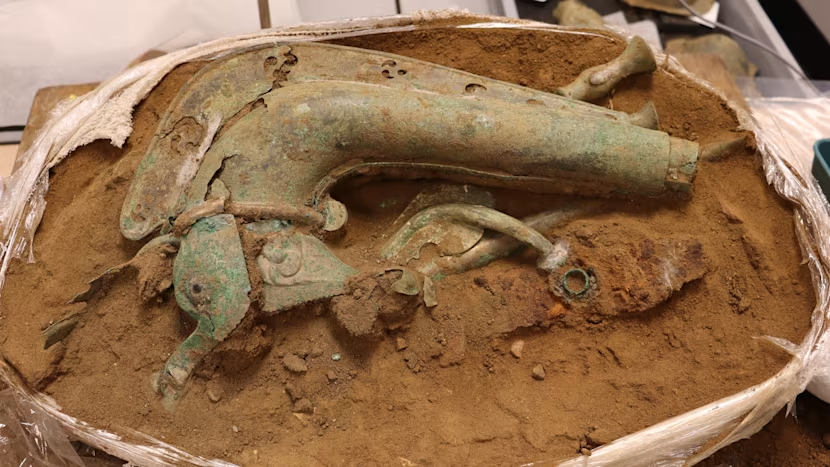
The nearly complete bronze instrument was part of a hoard discovered last summer on privately-owned land. One of only three carnyces known in Britain, it is among the most intact examples found in Europe, according to Historic England.
The trumpet, featuring an animal head, would have been used by Celtic warriors to rally troops and intimidate enemies, and it also captivated the Romans, who often depicted such instruments as war trophies.
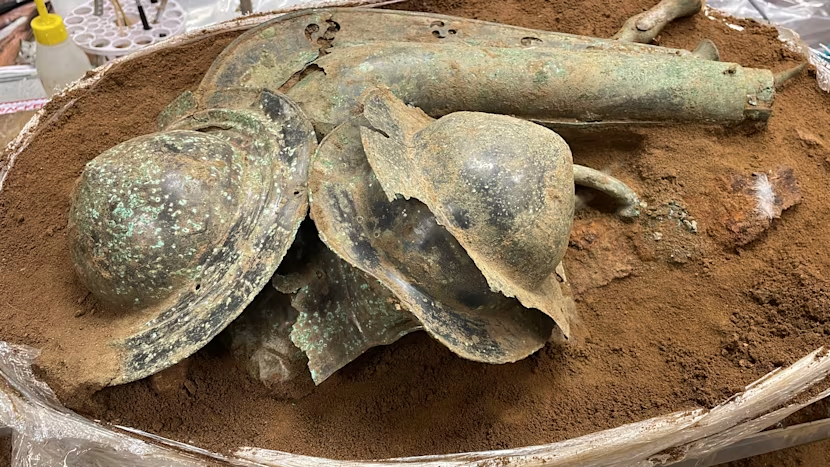
The rare near-complete carnyx which dates back to the Iron Age discovered in West Norfolk.
The hoard also contains a sheet-bronze boar’s head, likely from a military standard, along with five shield bosses and an iron object of unknown purpose.
Mark Hinman, chief executive of Pre-Construct Archaeology, which conducted the excavation, said: “Before this dig began our project manager had a feeling that this site would be special. We are so impressed with the team responsible for this find. They discovered something completely unexpected, paused for breath, then followed best excavation practice to recover these rare and fragile objects.”
To protect the delicate items, experts removed them encased in a block of soil before initial examination. Conservation and further research are being undertaken by Historic England, Norfolk Museums Service, and the National Museum of Scotland, a leading authority on carnyces.
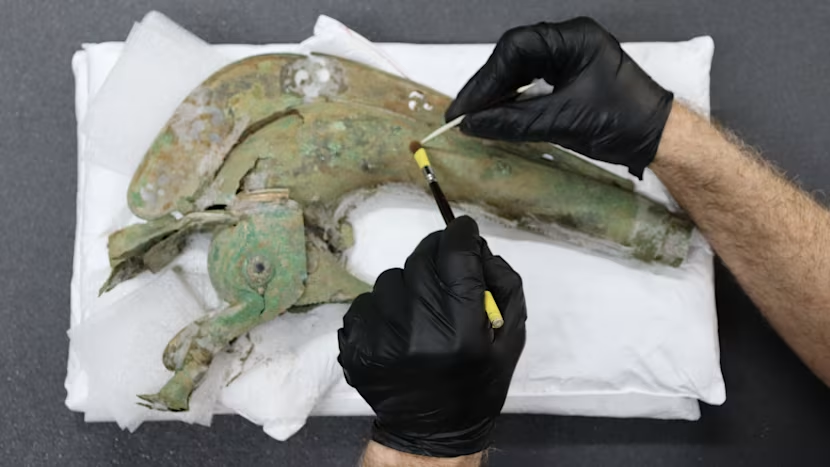
Initial investigation work on the bronze Iron Age trumpet, known as a carny, which was discovered in West Norfolk.
Dr Tim Pestell, senior curator of archaeology at Norfolk Museums Service, said: “This find is a powerful reminder of Norfolk’s Iron Age past which, through the story of Boudica and the Iceni people, still fascinates the British public. The Norfolk Carnyx Hoard will give archaeologists an unparalleled opportunity to study several rare objects and ultimately reveal how they came to be buried in the county 2,000 years ago.”
Claudia Kenyatta and Emma Squire, co-chief executives of Historic England, described the hoard as a “remarkable discovery” and said it would be “hugely significant for our understanding of ancient British culture.”
A coroner is expected to decide the legal status of the hoard early this year, and its long-term location has yet to be determined.
The hoard will be featured in the new series of Digging for Britain on BBC Two, in an episode airing at 9 pm on 14 January.