Introduction
Across human history, observing the sky has helped people understand the passage of time. The changing position of the Sun, the phases of the Moon, and the appearance of seasonal stars can provide information about the timing of migrations, harvests, ceremonies, and other recurring activities.
Rock shelters offer an especially interesting setting for investigating ancient timekeeping. These places may contain engravings, paintings, occupation layers, and openings that frame views of the surrounding landscape or sky. Some researchers have explored whether particular markings or architectural features were associated with lunar observations.
The idea of a rock shelter calendar is compelling, but it requires careful testing. Not every alignment is intentional, and not every repeated symbol represents a celestial event. Establishing that a prehistoric community deliberately used a shelter to track lunar cycles requires archaeological, astronomical, and cultural evidence.
Why the Moon Matters
The Moon provides a visible and recurring measure of time. Its appearance changes through a sequence of phases, from new Moon to crescent, quarter, gibbous, and full Moon before the cycle begins again.
The complete phase cycle, known as the synodic month, lasts approximately 29.5 days. Because the Moon is easy to observe without specialized equipment, lunar cycles can be useful for organizing events over short periods.
However, a lunar month does not correspond exactly to the solar year. Communities relying on lunar observations would need additional methods if they wanted to maintain a calendar aligned with the seasons.
Ancient timekeeping systems could therefore combine lunar observations with solar events, seasonal indicators, ecological knowledge, or local traditions.
Rock Shelters as Observation Points
A rock shelter may provide a stable place from which to observe the surrounding landscape. Its entrance can frame part of the horizon, while overhanging rock offers protection from weather.
The visibility of the sky depends on the shelter's orientation, depth, surrounding terrain, and the position of the observer. A narrow opening might make a particular direction visually prominent, but this does not automatically mean that the opening was designed for astronomical observation.
Researchers need to reconstruct the ancient landscape as accurately as possible. Trees, sediment, erosion, and changes in the shelter itself may have altered what people could see.
How Lunar Alignments Might Work
A lunar alignment could involve a natural opening or a deliberately positioned feature that frames the Moon's appearance near a particular point on the horizon.
The Moon's rising and setting positions change over time. Its extreme positions along the horizon occur through a longer cycle lasting approximately 18.6 years, related to the changing orientation of the Moon's orbital plane.
This means that an apparent lunar alignment may be meaningful only at particular times within that cycle.
To test a proposed alignment, researchers can reconstruct the horizon, calculate the Moon's historical positions, account for the site's age, and determine whether the observed geometry fits a plausible pattern of use.
Markings and Possible Calendrical Symbols
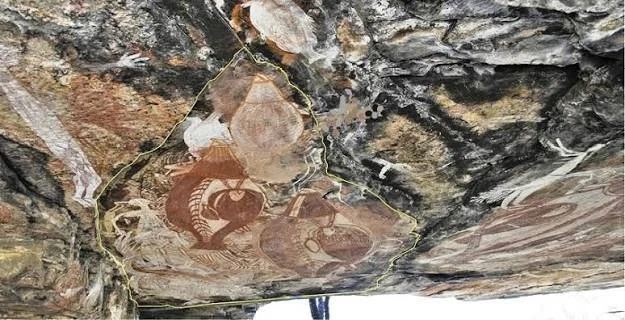
Engravings and paintings inside shelters may include repeated lines, dots, circles, animal forms, or other motifs. Some have been interpreted as counting systems or records of recurring natural events.
However, simple shapes are highly ambiguous. A sequence of marks might represent counting, decoration, ritual activity, ownership, or something that modern researchers cannot confidently identify.
A convincing calendrical interpretation should explain more than one isolated feature. It should account for the arrangement of marks, their repetition, the archaeological context, and any independent evidence for timekeeping.
The Importance of Archaeological Dating
A shelter may have been used repeatedly over thousands of years. Paintings, engravings, hearths, and occupation layers may belong to different periods.
This creates a major problem for alignment studies. A shelter's present-day orientation cannot automatically be connected with a marking that was created much earlier or later.
Researchers need to establish the dates of the relevant features as precisely as possible. Dating may involve associated deposits, pigment analysis, radiocarbon methods where suitable material is available, or other archaeological techniques.
The chronology must be strong enough to support the proposed astronomical interpretation.
Lunar Observation and Seasonal Knowledge
Lunar calendars can help organize recurring activities, but they do not independently predict every seasonal change. The timing of rainfall, plant growth, animal migrations, and food availability depends on local environmental processes.
Communities may have used multiple indicators together. A lunar phase could signal an occasion or mark a period, while observations of plants, animals, temperature, or water levels helped people determine the season.
Such knowledge is often practical and culturally embedded rather than expressed as a formal calendar.
Comparing Sites Worldwide
Rock shelters occur in many parts of the world, but their uses differ substantially. Some were temporary camps, others were repeatedly occupied places, and still others held artistic or ceremonial importance.
Comparing shelters can reveal broad questions about how humans observed the sky. However, similar arrangements of marks or openings do not necessarily indicate a shared tradition. Independent communities may develop similar methods because they observe the same celestial cycles.
Researchers should therefore avoid treating every proposed lunar alignment as evidence of a single worldwide system.
Testing Competing Explanations
An alignment may appear meaningful because researchers select a particular date, direction, or celestial event after examining the site. This creates a risk of finding patterns by chance.
A stronger investigation begins with clearly defined criteria. Researchers can calculate how likely a proposed alignment would be under different assumptions and compare the result with alternative explanations.
They should also consider whether the feature served a practical purpose unrelated to astronomy, such as drainage, shelter construction, or movement through the landscape.
Cultural Responsibility
Some rock shelters remain culturally significant to Indigenous communities and other local groups. Their meanings may include knowledge that is not intended for unrestricted public interpretation.
Research should involve relevant cultural custodians where possible and respect restrictions on access, photography, sampling, and publication.
Scientific investigation is strongest when it recognizes that archaeological sites are not merely technical puzzles but places connected with living histories and cultural responsibilities.
Conclusion
Rock shelter calendars offer a valuable framework for studying the relationship between landscape, observation, and timekeeping. Lunar cycles were visible and recurring, while rock shelters could provide sheltered locations from which to observe the sky and preserve cultural markings.
Yet demonstrating that a particular shelter functioned as a lunar calendar requires more than identifying an apparent alignment. Researchers must establish chronology, reconstruct the ancient horizon, analyze the markings, and test alternative explanations.
The broader lesson is that ancient timekeeping may have involved combinations of celestial observation, environmental knowledge, and social tradition. Carefully documented rock shelters can help illuminate these practices without requiring every mysterious mark or unusual opening to be interpreted as an astronomical instrument.