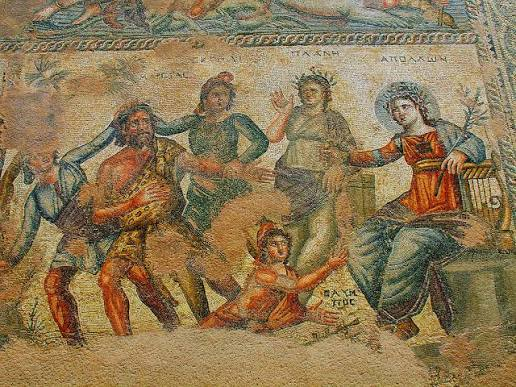
The coastal city of Paphos, located on the southwest coast of Cyprus, was the glittering capital of the island during the Roman period. While the city was home to grand temples, theaters, and administrative palaces, its most spectacular archaeological legacy lies beneath its floors.
Discovered accidentally by a farmer plowing his field in 1962, the House of Dionysos is a sprawling, 2,000-square-meter Roman villa dating from the late 2nd century CE. The villa represents the absolute pinnacle of ancient Mediterranean floor mosaics. Through these intricate stone masterpieces, wealthy Greco-Roman aristocrats transformed their floors into a dynamic canvas of mythological storytelling, theatrical illusion, and political propaganda.
1. The Engineering of Opus Tessellatum
The breathtaking preservation of the Paphos mosaics is a triumph of ancient material engineering. The artists did not use paint or dyes; instead, they utilized a technique known as Opus Tessellatum, constructing images out of thousands of tiny, hand-cut stone cubes called tesserae.
To ensure these floors could withstand centuries of foot traffic and minor earthquakes without cracking or shifting, Roman craftsmen laid down a highly specialized, multi-tiered foundation system:
The Statumen: A baseline layer of large, fist-sized rocks and stones packed tightly into the dirt to provide structural drainage and prevent shifting.
The Rudus: A thick layer of rough concrete made of broken stones and lime mortar, rammed down to form a flat, solid foundation.
The Nucleus: A fine, smoothed layer of mortar containing crushed brick and pottery shards, which absorbed moisture and provided a pristine, level surface.
The Supranucleus (Setting Bed): A final, thin skin of wet lime and marble-dust putty. While this layer was still damp, master artists sketched out their designs (sinopia) and systematically pressed the colored tesserae directly into the cement.
To capture subtle human expressions, muscular anatomy, and the soft textures of animal fur, the Paphos workshops utilized exceptionally tiny tesserae, often measuring only a few millimeters across. They relied primarily on the natural, vibrant geology of Cyprus—using local red, yellow, and white limestone, green and brown jasper, and black manganese shale, occasionally supplementing the palette with bright blue glass paste for a luminous effect.
2. Iconography: The Power and Triumph of Dionysos
The villa is named after the god of wine, theater, and ecstasy, Dionysos, who dominates the home’s central reception rooms. To a wealthy Roman living in Cyprus, decorating a home with Dionysian imagery was an essential social statement. Dionysos was a god of luxury, civilization, and the bountiful earth—qualities the villa owner wished to project onto their guests during lavish banquets.
The Triumph of Dionysos
The artistic centerpiece of the villa is a massive, four-panel mosaic mapping the mythical life of the wine god. The most famous panel illustrates the Triumph of Dionysos, celebrating his return from a legendary conquest of India.
Dionysos sits majestically in a two-wheeled chariot drawn by two fierce panthers. He wears a crown of ivy leaves and holds the thyrsus (a pine-cone topped staff of divine power). Surrounding his chariot is a chaotic, celebratory entourage: Pan, the goat-legged god of the wild; Silenus, Dionysos’s elderly, intoxicated tutor riding a donkey; and a host of ecstatic maenads holding musical instruments. The mosaic beautifully captures a sense of joyful, spinning movement through the fluid arrangement of the colored stones.
The Myth of Icarius: The Warning of Wine
In an adjacent room used for formal dining (triclinium), a highly narrative mosaic tells a darker story regarding the power of wine: the tragedy of Icarius.
According to myth, Dionysos visited earth and taught the Athenian farmer Icarius the secret art of viticulture and winemaking. Excited by this divine gift, Icarius loaded a cart with wine skins and went out to share it with local shepherds.
The mosaic captures the exact moment of impending doom. It depicts Icarius leading his ox-cart, while next to him, two shepherds are slumped on the ground in a state of heavy intoxication. Above the shepherds, a Greek inscription reads "Oi Protoi Oinon Piontes" ("The First Wine Drinkers").
The shepherds, having never experienced alcohol before, mistakenly believed that Icarius had poisoned them or cast a demonic spell. The myth concludes with the shepherds brutally murdering Icarius—serving as a moral warning to the villa's dining guests to enjoy the host's wine with sophistication and self-control.
3. Geometric Illusions and Space Optic Manipulations
While the narrative mythological scenes captured the human imagination, the corridors and courtyards of the House of Dionysos were wrapped in brilliant geometric mosaics. These patterns demonstrate a highly sophisticated understanding of optical mathematics and visual perspective.
Using contrasting light and dark stones, the artists constructed complex patterns of interlocking swastika meanders, braided borders (guilloche), step-triangles, and multi-colored stars.
When a guest walked down the long colonnaded porticos surrounding the villa's central open-air courtyard (atrium), these geometric patterns created an advanced 3D optical illusion. The flat stone floor appeared to ripple, drop down into deep boxes, or rise up in relief carvings. This visual trickery expanded the perception of space, making the hallways feel infinitely wider and more dynamic under the shifting sunlight.
4. Summary of Mosaic Paradigms
Structural Integrity: Multi-layered engineering foundations using a graduated stone and mortar sequence (statumen, rudus, nucleus) capped by a setting bed of lime and marble dust to lock in the tesserae permanently.
Material Palette: Heavy reliance on the natural, vibrant mineral geology of Cyprus (limestone, jasper, shale) combined with manufactured glass paste to generate a highly nuanced range of colors.
Thematic Identity: Dominance of Dionysian narratives serving as a elite symbol of aristocratic hospitality, wealth, and moral balance during Roman banquets.
Visual Mechanics: Utilization of geometric 3D optical patterns along walkways to trick human depth perception and intellectually engage visitors as they moved through the architectural layout.
The mosaics of the House of Dionysos in Paphos stand as a monumental bridge connecting the artistic styles of the Hellenistic Greek East with the engineering precision of the Roman West. By transforming the utilitarian surface of a floor into a highly refined theatrical stage, the master craftsmen of Cyprus proved that stone could be manipulated to mimic the softness of flesh, the wildness of an animal, or the dizzying depth of a geometric void. More than 1,800 years later, these pristine floors continue to perform their original function, inviting modern eyes to step directly into the luxurious world of the ancient Mediterranean.