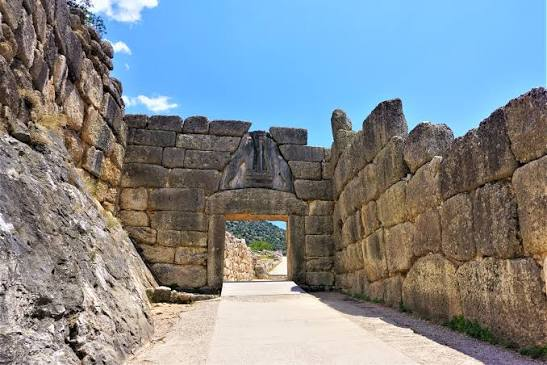
The Mycenaean civilization (c. 1600–1100 BCE) represented the aggressive, militaristic Bronze Age society of mainland Greece immortalized in Homer’s Iliad. Unlike the peaceful, unfortified maritime palaces of the Minoans on Crete, Mycenaean cities were heavily fortified strongholds built atop high, rocky citadels.
The absolute pinnacle of this defensive architecture is the Lion Gate, the monumental main entrance to the citadel of Mycenae. Constructed around 1250 BCE during a massive expansion of the city's fortification walls, the Lion Gate is not just a masterpiece of structural engineering; it is the oldest piece of monumental relief sculpture in Europe and a sophisticated monument of royal propaganda.
1. Cyclopean Masonry: The Walls of Giants
To understand the engineering of the Lion Gate, one must first look at the gargantuan fortification walls that flank it. The Mycenaeans built their citadels using a technique known as Cyclopean Masonry.
The walls were constructed using massive, naturally shaped limestone boulders, some weighing over 20 tons, stacked roughly on top of one another with smaller limestone chunks and clay mortar filling the gaps. The architecture was so impossibly vast that when classical Greeks looked at the ruins centuries later, they refused to believe human beings could have built them. They concluded that Agamemnon’s walls must have been constructed by the Cyclopes, the mythical one-eyed giants of Homeric legend.
2. The Mechanics of the Gate: The Relieving Triangle
The Lion Gate itself faced a massive structural problem. The lintel stone—the horizontal block resting on top of the two vertical doorposts—is a colossal piece of breccia limestone weighing roughly 20 tons. If the heavy Cyclopean wall blocks had been stacked directly on top of this lintel, the sheer downward force would have snapped the stone in half, collapsing the entire gateway.
To solve this weight crisis, Mycenaean engineers invented a brilliant structural device known as the Relieving Triangle.
                 /\
                /  \   ◄──── [ RELIEVING TRIANGLE ]
               /____\        Lightweight limestone relief slab
              ────────        diverts weight outward to the posts.
             │        │
             │        │ ◄──── [ MONUMENTAL LINTEL ]
             │        │        A 20-ton horizontal stone block
             │        │
      ───────┴────────┴───────
     │                        │
     │   [ VERTICAL POSTS ]   │ ◄── Transmit weight down to bedrock
     │                        │
Instead of running the heavy wall blocks straight across, the builders corbelled the stones above the lintel. Each successive layer of wall stone was nudged slightly inward, creating a hollow, inverted "V" shape directly over the gateway.
This triangular gap completely relieved the lintel of the wall's downward weight, shifting the massive structural load outward and pushing it safely down into the vertical jambs and the bedrock below.
3. Iconography: The Power of the Guardians
To fill the hollow space created by the relieving triangle, the Mycenaeans inserted a triangular slab of relatively soft, lightweight grey limestone. Carved directly into this slab is the famous Lion Relief, a powerful emblem of the Mycenaean royal house.
The relief features a highly sophisticated, heraldic composition that reflects deep artistic influences from both the Near East and Minoan Crete:
The Central Column: At the center of the relief stands a single Minoan-style column that flares upward, resting on two sacrificial altars. This column represents the architectural heart of the palace—the king’s megaron—and serves as a symbol of the divine protection of the state.
The Heraldic Lions: Flanking the column are two powerful lions (or potentially lionesses), standing in a heraldic pose with their front paws resting on the altars. Their bodies are caught in a tense, muscular profile, acting as divine guardians of the palace.
The Missing Heads: Visitors today will notice that the lions lack heads. The heads were originally carved separately out of a different material—potentially steatite, bronze, or a contrasting stone—and attached to the bodies using peg holes that are still visible. These heads faced forward, staring directly down at anyone approaching the gate to intimidate enemies and welcome allies.
4. Tactical Design: The Bastion Trap
The Lion Gate was not just built to look beautiful; it was a highly functional, brutal defensive weapon designed to survive a prolonged military siege.
An attacking army could not simply march up to the gate in a straight line. The Mycenaeans built a massive, projecting stone bastion on the right side of the gateway. To reach the doors, an invading army had to channel down a narrow, enclosed stone corridor.
As the attackers rushed forward, this layout forced them to expose their right sides—the side not protected by their handheld shields—to the Mycenaean defenders stationed high above on top of the bastion wall. The approach path was effectively a lethal kill-zone where attackers were bombarded with arrows, spears, and massive boulders from above before they could even touch the heavy wooden doors.
5. Summary of Mycenaean Structural Paradigms
Wall Construction: Utilization of massive, unworked limestone blocks stacked to form thick defensive parameters, later romanticized as "Cyclopean" architecture.
Structural Engineering: Invention of the corbelled Relieving Triangle to divert thousands of pounds of downward masonry weight away from the horizontal lintel stone.
Architectural Semiotics: Placing a lightweight, highly symbolic relief panel inside the structural triangle to visually broadcast the authority, divine protection, and martial power of the ruling dynasty.
Strategic Fortification: Engineering the gateway approach as a narrow flanking corridor (bastion trap) designed to systematically weaponize the vulnerability of an attacker’s shield placement.
The Lion Gate of Mycenae stands as a brilliant architectural bridge between early Bronze Age engineering and the evolution of European sculpture. By seamlessly merging the raw, defensive muscle of Cyclopean masonry with the delicate mathematical physics of the relieving triangle and the artistic sophistication of heraldic sculpture, the master builders of Mycenae created a timeless gateway. For over three thousand years, its stone guardians have stood watch over the ruins of the citadel, serving as an enduring monument to an era when architecture was forged out of an absolute obsession with strength, security, and imperial pride.