The historical and archaeological record does not preserve a prominent Roman estate known as the "Roman Villa of Valernes" in France, nor any celebrated mosaics associated with that specific name.
It is highly likely that this name has been mixed up with another major Gallo-Roman villa site in southern France or a nearby monumental Roman landmark. Given the rich geography of Roman Gaul, three highly famous destinations perfectly match this description and feature world-class Roman mosaics or regional Roman administration:
1. The Villa of Loupian (Gallo-Roman Villa of Prés-Bas)
If you are looking for a massive, hyper-luxurious Roman estate in southern France famed for its breathtaking mosaic floors, you are likely thinking of the Villa of Loupian, situated in the Languedoc region near the Thau lagoon (Gallo-Roman Narbonensis).
The Estate: This site was a sprawling, elite agricultural estate (villa rustica) that specialized in large-scale viticulture and producing amphorae to export wine across the Roman Mediterranean.
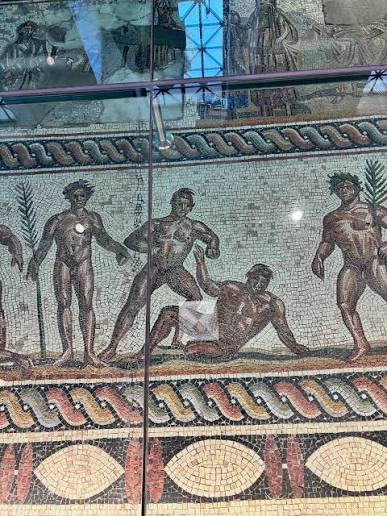
The Mosaics: During Late Antiquity (4th–5th centuries CE), the residential quarters were completely rebuilt into a luxurious palace paved with over 4,300 square feet of spectacular polychrome mosaics.
The Artistry: The floors are a masterclass in geometric and floral patterns, featuring intricate braided borders (guilloche), waves, stylized acanthus leaves, and complex tessellated designs that covered the villa's massive reception halls and private dining rooms.
2. The Great Mosaics of Saint-Romain-en-Gal
Another monumental concentration of Roman villa life and mosaic art in France sits on the banks of the Rhône River at Saint-Romain-en-Gal (near Vienne).
The Context: This site preserves an entire urban neighborhood of sprawling luxury townhouses and suburban villas belonging to the elite of Roman Gaul.
The Iconic Mosaic: This site yielded the world-famous Mosaic of the Seasons (or the Rustic Calendar), now housed in the National Archaeological Museum. The mosaic features 27 surviving panels surrounding depictions of the four seasons (such as Winter personified as a cloaked woman riding a wild boar). The surrounding squares offer an unprecedented look at daily Gallo-Roman country life, illustrating tasks like plowing, sowing, grafting trees, and pressing grapes for wine.
3. The Enigma of Théopolis (Near Valernes)
If the geographic location of Valernes (a commune in the Alpes-de-Haute-Provence department in southeastern France) is the core element, the confusion likely stems from a fascinating, nearby Late Roman historical enigma known as Théopolis.
Just a short distance from Valernes, near the town of Sisteron, sits the famous Pierre Écrite ("Written Stone"). This is a massive, 5th-century CE monumental inscription carved directly into a cliff face by a high-ranking Roman official named Flavius Postumus Dardanus.
The inscription proclaims that Dardanus, a Christian convert and former Praetorian Prefect of Gaul, cleared a path through the rocky gorge to establish a secure, utopian sanctuary called Théopolis ("City of God") to protect the local population as the Western Roman Empire collapsed under barbarian invasions.
While archaeologists believe the core of Théopolis was a massive, fortified estate or villa, the rugged mountain terrain has kept its exact residential quarters—and any potential mosaic floors—hidden from modern view.