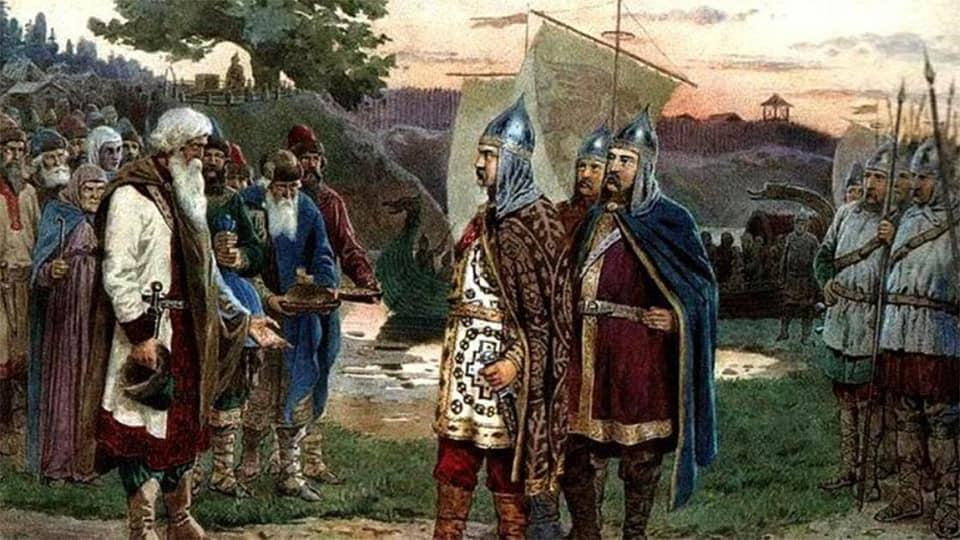
The eastern expansion of the Viking Age did not just produce temporary trading camps; it laid the political and cultural foundations for one of the greatest medieval states in Europe: the Kievan Rus’.
Beginning in the 8th century, Scandinavian Norsemen—primarily from modern-day Sweden, known locally as the Varangians or Rus—penetrated deep into the forested river networks of Eastern Europe. Through a complex process of violent conquest, commercial assimilation, and marital alliances with the indigenous Slavic and Finno-Ugric populations, these Scandinavian elite fused with the local culture to establish a powerful medieval empire.
1. The Invitation of Rurik and the Birth of a Dynasty
The primary historical narrative for the founding of the Rus' state comes from the Russian Primary Chronicle (the Tale of Bygone Years), a 12th-century monastic text.
According to the chronicle, the Slavic and Finno-Ugric tribes of the north had driven the Varangian tax collectors back across the sea, but immediately fell into fierce internal tribal warfare. Realizing they could not govern themselves, they sent a message back to the Scandinavians, declaring: "Our land is great and rich, but there is no order in it. Come to rule and reign over us."
In 862 CE, a Varangian chieftain named Rurik accepted the invitation. He arrived with his brothers and his armed retinue, establishing his seat of power at Novgorod (Holmgard). This event marks the official beginning of the Rurik Dynasty, the royal house that would rule the region for more than seven centuries.
2. Moving South: The Capture of Kiev
Rurik’s successors quickly realized that the true wealth of the region lay further south along the Dnieper River Superhighway, which led directly to the rich markets of the Byzantine Empire.
In 882 CE, Rurik’s kinsman and regent, Oleg (Helgi), launched a military expedition down the river. He captured the hill-fort city of Kiev (Kænugarðr), which was strategically perched on a bluff overlooking the Dnieper. Oleg executed the local Varangian rulers, declared Kiev the "Mother of Rus' Cities," and relocated the capital of the state there.
From this centralized southern base, the grand princes of Kiev could perfectly coordinate the macro-economy of the entire realm, collecting tribute from the surrounding Slavic tribes and launching massive, joint trade fleets down to Constantinople every spring.
3. Archaeological Footprints of the Norse Elite
For over a century, the degree of Scandinavian influence on early Russian history was a subject of intense political and academic debate (known as the Normanist Controversy). Today, modern archaeology has definitively proven a massive, undeniable Norse material presence in the early Rus' settlements.
Gnezdovo: Located near Smolensk along the upper Dnieper, Gnezdovo is the largest Viking Age burial mound site in the world outside of Scandinavia. Excavations have revealed thousands of grave mounds containing classic Scandinavian iron swords, axes, silver Thor’s hammer pendants, and distinctive bronze tortoise brooches used by Norse women to fasten their dresses.
The Chamber Graves: Wealthy Rus' elites were buried in Scandinavian-style "chamber graves"—large, wood-lined subterranean rooms. These graves frequently contained sacrificed horses, luxury textiles imported from the Silk Road, and weapons matching the exact metallurgical formulas used by blacksmiths in central Sweden.
Runic Inscriptions: While rare compared to the thousands of stones found in Sweden, runic inscriptions carved into bone, wood, and stone have been recovered across northern Russia, confirming that the early rulers of these settlements still spoke and wrote in Old Norse.
4. Cultural Assimilation: From Norse to Slavic
The Scandinavian dominance over the Rus' state was characterized by incredibly rapid cultural and linguistic assimilation. Because the Varangian elite were outnumbered by the vast indigenous Slavic populations, they quickly intermarried and adopted local customs to legitimize their rule.
This linguistic and cultural shift is perfectly frozen in the names of the Grand Princes of Kiev across just four generations:
      [ Rurik ] ────────────── (Purely Old Norse: Hrærekr)
          │
      [ Igor ] ─────────────── (Slavicized Norse: Ingvar)
          │
   [ Sviatoslav ] ──────────── (Purely Slavic Name)
          │
    [ Vladimir ] ───────────── (Purely Slavic Name)
By the mid-10th century, Grand Prince Sviatoslav had completely abandoned Scandinavian style. Descriptions by Byzantine historians note that he shaved his head except for a traditional Slavic lock of hair, wore a simple white Slavic tunic, and swore his oaths not by the Norse god Odin, but by Perun, the Slavic god of thunder.
5. The Climax: The Varangian Guard and Christianization
The final, definitive transformation of the Kievan Rus' occurred under Vladimir the Great (Valdimar) in 988 CE.
To secure a prestigious political alliance with the Byzantine Emperor Basil II, Vladimir made a radical geopolitical calculation: he agreed to convert his entire empire to Orthodox Christianity. He ordered the massive wooden idols of Perun and Thor to be hacked down and dragged into the Dnieper River, mandating the mass baptism of the population of Kiev.
As part of this historic alliance, Vladimir sent a massive military contingent of 6,000 elite Varangian warriors down to Constantinople to serve as the emperor's personal army. This unit became the legendary Varangian Guard, the ultimate destination for adventurous mercenaries from Sweden, Norway, and Iceland for the next three centuries.
The legacy of the Norse influence on the Kievan Rus’ represents a fascinating historical synthesis. The Vikings did not erase the existing Slavic cultures; instead, they acted as a structural catalyst. By utilizing their naval technology to unite isolated tribal networks and linking them directly to the global markets of Byzantium and Baghdad, these Swedish merchants transformed a collection of fractured forest settlements into the most powerful, dynamic, and urbanized state in medieval Eastern Europe.