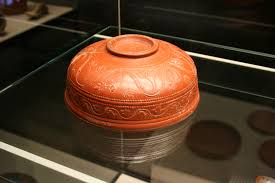
Samian ware, known to archaeologists as terra sigillata ("sealed earth"), represents the pinnacle of mass-produced Roman fine tableware. While it originated in Italy (notably Arretium/Arezzo), the industry shifted its massive production centers to Gaul (modern-day France) by the mid-1st century CE to meet the insatiable demand of the expanding Roman Empire.
I. The Rise of the Gallic "Super-Factories"
The shift from Italy to Gaul was driven by market demand and the availability of high-quality clay and timber for firing. These centers operated on an almost industrial scale, utilizing standardized techniques to produce tens of thousands of vessels per kiln cycle.
La Graufesenque (Southern Gaul): Dominating the industry from approximately 10 CE to 100 CE, this site was the first great Gallic production hub. Its products were exported across the entire Western Empire, establishing the early standard for what Samian ware should look like.
Lezoux and Les Martres-de-Veyre (Central Gaul): As the popularity of La Graufesenque waned, production shifted north to the central region, particularly Lezoux. From about 100 CE to 210 CE, Lezoux became the primary source for Samian ware across the provinces, including Roman Britain.
Eastern Gaul (Rheinzabern and Trier): From around 150 CE, as the central Gallic workshops declined, large-scale centers emerged in the Rhine/Moselle region. These factories continued production well into the 3rd century, though the refined quality of the earlier works often diminished over time.
II. Production and Standardization
The success of these factories relied on a highly standardized "assembly line" process that allowed for consistent output:
Mould-Made Decoration: Decorated bowls were created by pressing wet clay into pre-carved negative moulds. These moulds were themselves produced by pressing individual decorative stamps (leaves, animals, deities, gladiators) into the clay. This allowed factories to quickly swap motifs to follow shifting fashions.
The Signature Gloss: The signature deep, glossy red surface was not a glaze in the modern sense but a "slip"—a mixture of fine-grained clay and iron-rich minerals. When fired at carefully controlled temperatures (around 1,000°C), this slip fused with the vessel, creating the non-porous, glass-like finish that defines the ware.
Potter’s Stamps: Workers stamped the vessels with their names or the names of the workshop (officina). These stamps act as historical timestamps, allowing archaeologists today to date Roman sites with incredible precision by identifying which potter’s work is present in a given layer of soil.
III. Social and Economic Impact
Samian ware was the "branded" luxury of the ancient world. It served as a marker of Romanization and cultural integration.
Market Reach: These factories achieved a level of market penetration that was arguably unmatched until the Industrial Revolution. It is common to find the same stamped vessels in both the sophisticated villas of southern Gaul and the damp, remote military forts on Hadrian’s Wall in Britain.
Status Symbol: While it was mass-produced, it was still considered "fine ware." Owning a matching set of red-gloss bowls for serving wine or meals was a way for individuals in the provinces to emulate Roman urban culture and participate in a shared, empire-wide lifestyle.
Decline: The industry began a steady decline toward the end of the 2nd century. Various factors, including political instability (such as the civil war of 197 CE), supply chain disruptions, and shifting local tastes, eventually led to the cessation of large-scale production by the 3rd century.