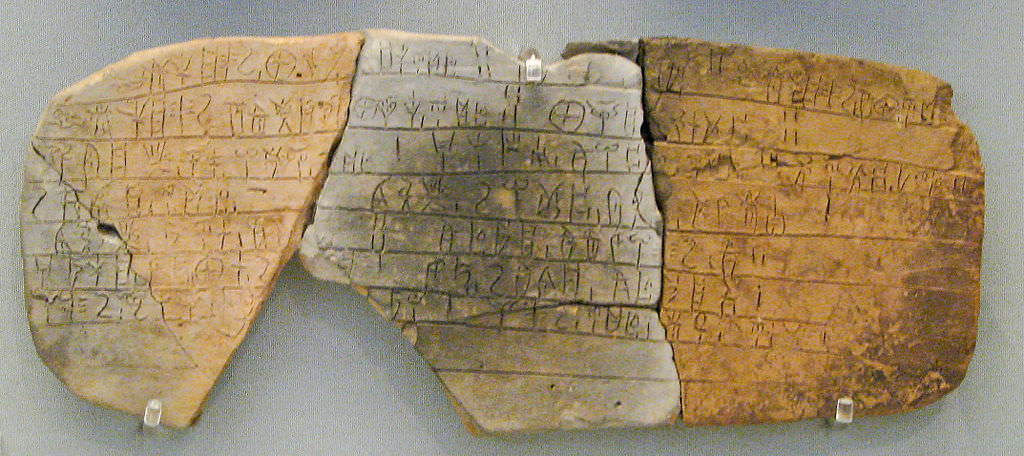
The decipherment of Linear B in 1952 by British architect Michael Ventris is widely considered one of the most significant intellectual breakthroughs in the history of archaeology. It transformed our understanding of the Aegean Bronze Age by proving that the Mycenaean civilization was not a "pre-Greek" culture, but the earliest documented form of Greek society.
I. The "Code-Breaker" Breakthrough
Before Ventris, Linear B—found primarily on clay tablets at palace sites like Knossos (Crete) and Pylos (mainland Greece)—was a total mystery. It was clearly a script, but the language it encoded was unknown.
The Method: Ventris did not have a "Rosetta Stone" to guide him. Instead, he relied on the rigorous analytical work of predecessors like Alice Kober, who had identified grammatical patterns (such as word endings that changed based on usage), and Emmett Bennett, who cataloged the signs into a systematic "grid."
The Hypothesis: Ventris famously applied his background in code-breaking to the signs, testing the hypothesis that the script encoded an archaic form of Greek. In 1952, he confirmed that the syllabic signs spelled out words in Greek, such as to-pe-za (for trapeza, meaning "table").
Confirmation: The discovery was validated in 1953 when Carl Blegen found a new tablet at Pylos containing a drawing of a three-legged vessel accompanied by the word ti-ri-po-de ("two tripods")—a perfect match for the phonetic values Ventris had proposed.
II. What Linear B Revealed
Because the tablets were purely administrative, they do not contain epic poetry, history, or literature. Instead, they act as a "time capsule" of palatial bureaucracy, providing a candid look at Mycenaean life:
The Pantheon: The tablets mention deities that would later dominate the Greek imagination in the works of Homer and Hesiod. Names like Zeus (Di-wo), Poseidon (Po-se-da-o), and Hermes (E-ma-ha) were already being worshipped as central figures over 500 years before the rise of the Greek alphabet.
Social Hierarchy: The records detail a highly stratified society ruled by a wanax (king), followed by a network of officials, landholders, and specialized workers—from bronze smiths to textile laborers.
The Palatial Economy: The texts are essentially giant ledgers. They document the collection of taxes, the allocation of raw materials (like wool and bronze), the movement of labor, and offerings made to shrines. They reveal a civilization obsessed with accounting, inventory, and resource management.
III. Why It Matters
The decipherment changed history for several key reasons:
Linguistic Continuity: It proved that Greek speakers had inhabited the Aegean since at least the mid-second millennium BCE, effectively "rewriting" the history of the Greek language back by five centuries.
Cultural Synthesis: It clarified that the Mycenaeans were not simply Minoans; they were a distinct Indo-European people who had adopted the Minoan administrative form (the script and tablet-keeping) to suit their own Greek language.
The Limits of Knowledge: By confirming that writing was used only for administration and not for literature, scholars could better understand why the script vanished so abruptly around 1200 BCE. When the palatial administrative centers collapsed, the "reason" for writing disappeared, and Greece entered a period of illiteracy until the adaptation of the Phoenician alphabet centuries later.
Linear B remains a fragile link to a vanished world. While it lacks the narrative flair of later Greek literature, its "cold and precise" ledgers provide the most direct, unvarnished look we have at the people who built the world of the Bronze Age palaces.