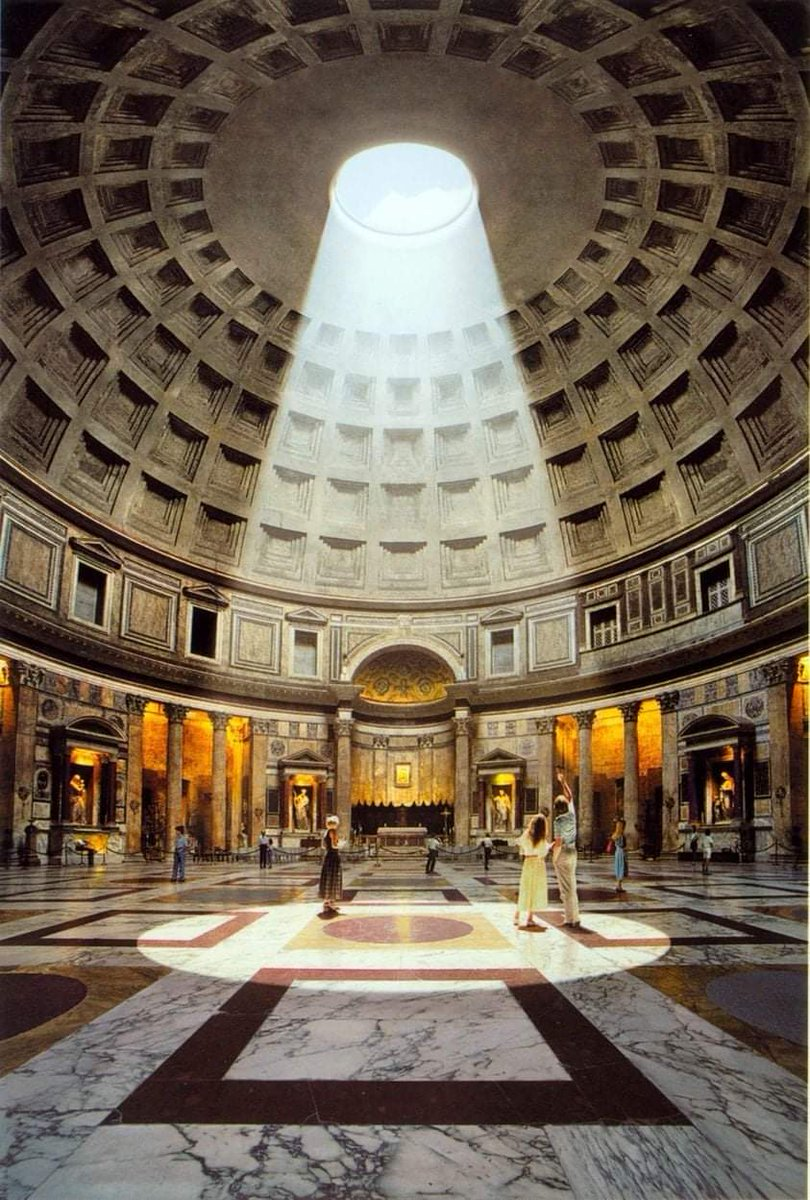
The Oculus (Latin for "eye") of the Pantheon in Rome is not merely a structural necessity to reduce the weight of the massive concrete dome; it is the ultimate expression of Roman architectural theater. Measuring 8.2 meters (27 feet) in diameter, it is the only source of natural light for the vast interior space, creating a dynamic, living relationship between the architecture, the heavens, and the visitor.
I. Engineering the Void
The dome of the Pantheon remains the largest unreinforced concrete dome in the world, a feat achieved through a sophisticated series of engineering choices that begin with the oculus.
Weight Reduction: The dome's thickness decreases from approximately 6 meters (20 feet) at the base to less than 1.2 meters (4 feet) at the rim of the oculus. By using progressively lighter aggregates (such as volcanic tuff and pumice) as the dome rose, Roman engineers minimized the structure's self-weight, allowing it to sustain the massive "hole" at the top without collapsing.
The Compression Ring: The oculus is reinforced by a heavy, rigid ring of brick and stone. This ring acts as a compression hoop, preventing the dome from spreading under its own weight and distributing the structural stress evenly around the circular opening.
II. The "Rain" Factor: Ancient Drainage
The most frequent question about the oculus is: what happens when it rains? Contrary to the idea that the Pantheon is "open," it was designed with an ingenious, invisible drainage system that is still functional today.
The Sloping Floor: If you look closely at the marble floor of the Pantheon, it is not perfectly flat. It is subtly convex, sloping gently toward the perimeter.
The Drain Holes: There are 22 almost-invisible drainage holes integrated into the floor's geometry. Rainwater that enters through the oculus hits the center of the floor, flows outward toward the edges, and is collected by these drains into an underground system, preventing flooding even during heavy Mediterranean storms.
The "Mist" Effect: Because the interior space is so vast and the air inside is often significantly warmer than the air outside, the rain often atomizes into a fine mist as it falls. By the time it reaches the floor, the amount of water is manageable, and the effect is more atmospheric than destructive.
III. The Oculus as a Celestial Clock
The oculus turns the Pantheon into a massive, immobile sundial.
The Sunbeam: As the sun moves across the sky, a brilliant, focused beam of light moves across the interior, slowly tracking across the coffered ceiling and down the walls. On the Spring and Autumn equinoxes, the light strikes the entrance doorway, symbolically connecting the celestial path of the sun with the physical threshold of the temple.
The Living Sky: The oculus provides a direct, unmediated view of the sky. In antiquity, this was deeply symbolic; the Pantheon was dedicated to "all the gods," and the oculus allowed for a direct connection between the earthly space and the heavens. The changing weather, the passing clouds, and the movement of the stars at night are constantly reflected in the changing light quality within the temple, making the building feel less like a static structure and more like a participant in the natural cycle.
IV. The "Eyes" of the Pantheon
The oculus represents a departure from the traditional, windowless interior of earlier Greek and Roman temples. By removing the wall at the highest point and replacing it with pure sky, the Roman architects created a space that was simultaneously enclosed and infinite. It is this specific synthesis—the weight of the concrete and the lightness of the sunbeam—that has made the Pantheon the most influential building in the history of Western architecture.
The oculus is a reminder that Roman engineering was never just about utility; it was about defining the human experience of time and space.