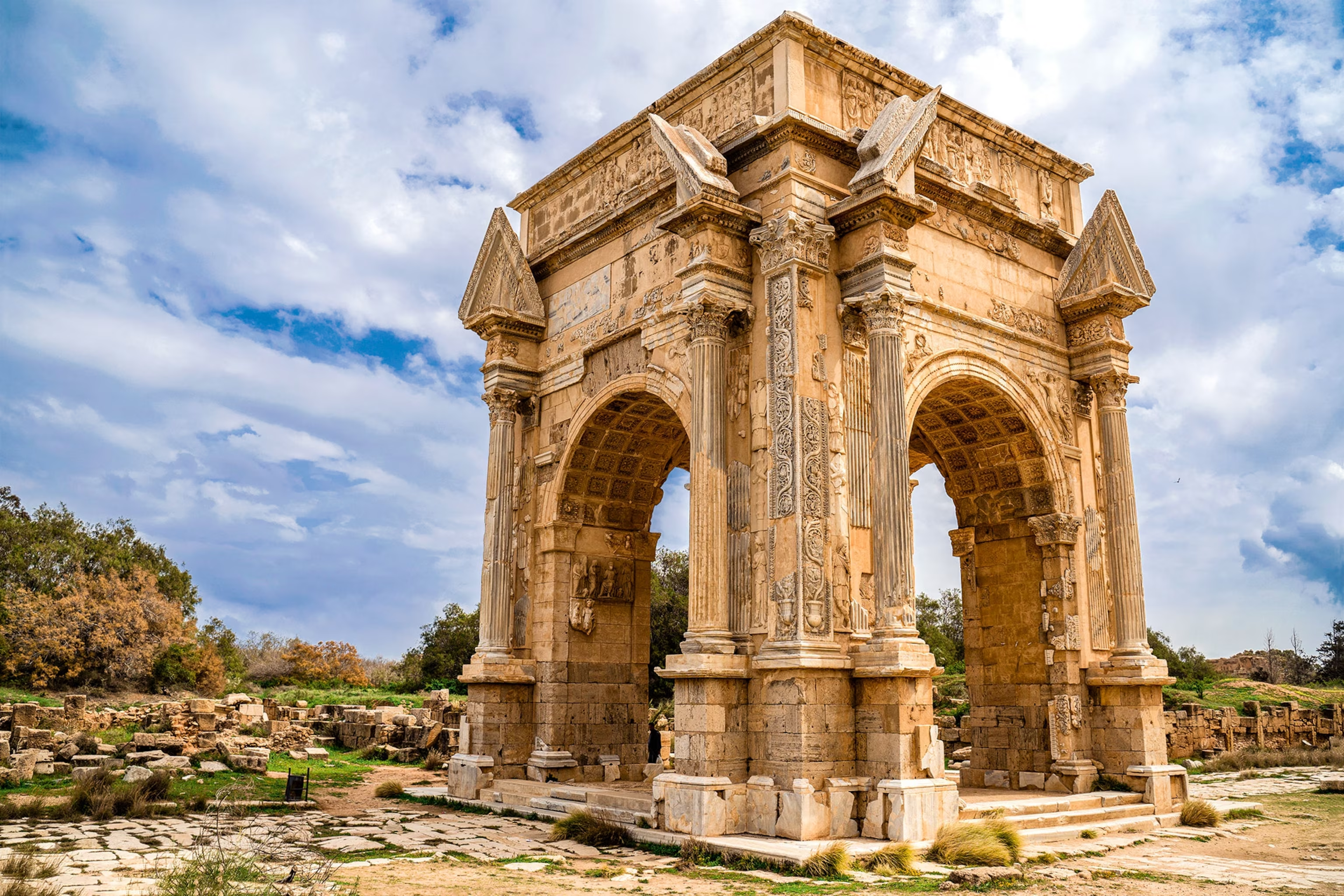
Few monuments capture the sheer, uncompromising ego of the Roman Empire quite like the triumphal arch.
These massive stone structures didn’t support roofs, bridge rivers, or defend city gates. They existed entirely as architectural propaganda—freestanding billboards in marble and limestone designed to immortalize military victories, glorify the ruling emperor, and permanently remind the populace of who held absolute power.
1. The Anatomy of a Triumph
To understand why these arches were built, you have to understand the Roman Triumph (triumphus). It was the ultimate honor a military commander could achieve—a massive, state-sanctioned victory parade that snaked through the crowded streets of Rome.
[ CAPTURED SPOILS ] ──► SHACKLED PRISONERS ──► THE VICTORIOUS ARMY ──► THE EMPEROR (As a God)
The parade was a sensory overload of wealth and conquest: carts piled high with gold, exotic animals, paintings of battles, and captured foreign royals marching in chains. At the climax rode the conquering general or emperor in a four-horse chariot, his face painted red to mimic Jupiter, the king of the gods.
Because these parades lasted only a single day, Roman leaders wanted a way to make the celebration permanent. The triumphal arch was the solution: a physical manifestation of the parade route, capturing the exact moment the victor passed from the chaotic outside world into the sacred boundary of the city.
2. Structural Evolution: Single to Triple Bays
What started in the Roman Republic as temporary wooden gates evolved during the Empire into monumental stone masterpieces. Architects relied heavily on the true arch, utilizing wedge-shaped stones called voussoirs locked together by a central keystone to support immense weight.
As the Empire grew, so did the complexity of the design.
The Evolution of the Form
The Single-Bay Arch: The earliest surviving imperial arches, like the Arch of Titus (built around 81 CE), featured a single grand passageway. It was elegant, compact, and focused entirely on a single narrative—in Titus's case, the brutal sack of Jerusalem.
The Triple-Bay Arch: By the turn of the 300s CE, emperors favored a grander, three-passageway design. The Arch of Constantine (315 CE) represents the peak of this style, featuring a massive central bay for chariots flanked by two smaller bays for pedestrian traffic.
3. Art as Propaganda: Reading the Stones
Every square inch of a triumphal arch was packed with deeply symbolic messaging. They were meant to be "read" by the public like a stone comic strip.
The Attic: The massive stone block at the very top served as the headline. It bore a deeply carved Latin inscription filled with bronze lettering, listing the emperor’s official titles and dedicating the monument to the Senate and People of Rome (SPQR).
The Relief Panels: The inner walls and exterior facades featured vivid, deeply carved relief sculptures. They depicted key historical moments: the emperor addressing his troops, battles in far-off lands, and the gods themselves crowning the emperor with laurel wreaths.
The Crowning Statuary: Though long since lost to time and looters, the flat tops of these arches originally supported massive, gilded bronze statues. Typically, they featured the emperor driving a quadriga (a four-horse chariot), looking down upon the city like a living deity.
4. Architectural Comparison: Three Masterpieces of Victory
The design elements of the arches shifted depending on the specific message the emperor wanted to broadcast to the world.
Bcycling: Built to celebrate victory in a civil war. Strikingly, Constantine's workers pried marble statues off monuments belonging to older, beloved emperors (Trajan, Hadrian, Marcus Aurelius) and re-carved the faces to look like Constantine, instantly linking him to Rome's golden age.
By turning temporary military pageantry into permanent urban architecture, the Romans ensured that their victories would outlive their legions. Long after the empire crumbled, these arches remained standing across Europe, North Africa, and the Middle East, serving as the blueprint for modern monuments from Paris’s Arc de Triomphe to London’s Marble Arch.