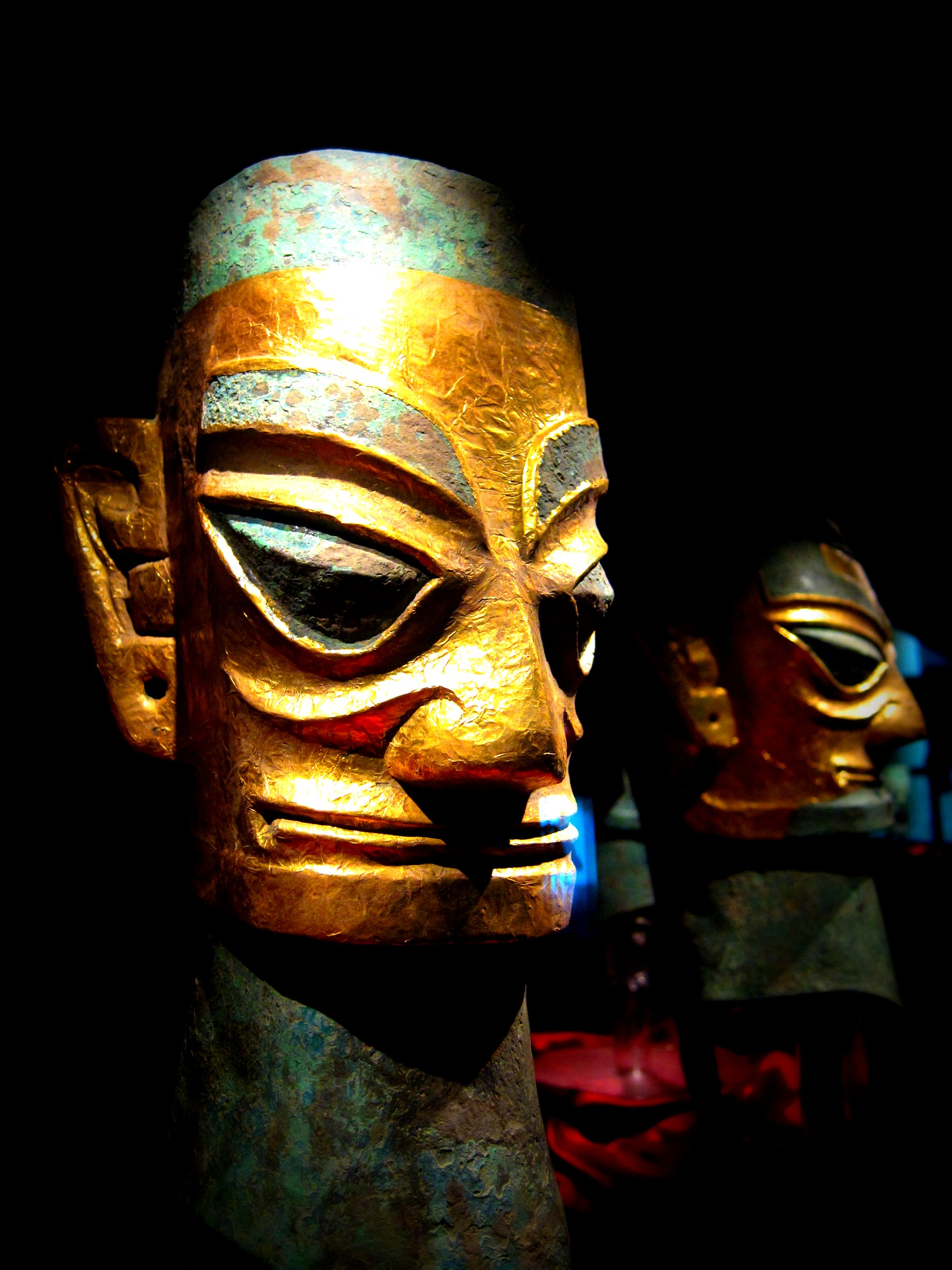
The bronze masks of Sanxingdui are among the most visually striking artifacts ever discovered in China. With their enormous eyes, exaggerated ears, projecting features, and unusual proportions, they have sometimes been described in popular media as resembling “aliens.”
However, these objects are not evidence of extraterrestrial visitors.
Their unusual appearance reflects the artistic traditions, religious beliefs, and cultural identity of an ancient civilization that developed in the Sichuan Basin.
Sanxingdui demonstrates that Bronze Age China was not culturally uniform. While the Shang civilization flourished in the Yellow River region, other powerful societies developed distinctive artistic and technological traditions.
The Discovery of Sanxingdui
The Sanxingdui site is located in Sichuan Province near the modern city of Guanghan.
Archaeological discoveries at the site revealed evidence of an important Bronze Age settlement associated with the ancient Shu cultural region.
The site's importance increased dramatically after the discovery of sacrificial pits containing extraordinary artifacts.
These included:
bronze masks,
bronze heads,
gold objects,
jade,
ivory,
bronze trees,
and other ceremonial items.
The Giant Bronze Masks
The most famous Sanxingdui artifacts are its large bronze masks.
Some possess exaggerated eyes extending outward from the face.
Others have unusually large ears and sharply stylized features.
The artistic style is dramatically different from the better-known bronze traditions of the Shang Dynasty.
This difference demonstrates the diversity of Bronze Age cultural traditions.
Why Do the Masks Look So Unusual?
The exact meaning of the masks remains uncertain.
Several interpretations have been proposed.
They may represent:
deities,
ancestors,
supernatural beings,
ritual figures,
or idealized representations connected with Shu religious traditions.
Some scholars have also compared the imagery with later traditions concerning ancient Shu rulers and religious figures.
However, because the people of Sanxingdui left no known written explanation of the artifacts, archaeologists cannot determine their exact meaning with complete certainty.
The Sacrificial Pits
Many of Sanxingdui's most important objects were discovered in specially prepared pits.
The artifacts appear to have been deliberately deposited rather than simply discarded.
Some objects were damaged or burned before burial.
This suggests that the pits were associated with organized ritual activity.
Possible interpretations include:
religious offerings,
ceremonial disposal of sacred objects,
political transformation,
or responses to major historical events.
The exact reason remains debated.
Bronze Technology
The Sanxingdui artisans possessed remarkable knowledge of bronze casting.
Some artifacts are extremely large and technically complex.
The famous bronze standing figure and bronze sacred trees demonstrate the ability of artisans to produce monumental objects.
This required:
access to raw materials,
specialized workshops,
skilled craftsmen,
fuel for furnaces,
and organized labor.
The Bronze Sacred Trees
Among the most extraordinary artifacts discovered at Sanxingdui are bronze trees.
These complex objects include branches, birds, and symbolic elements.
The trees may have represented concepts related to cosmology, mythology, or communication between different realms.
However, without written records explaining the imagery, interpretation remains uncertain.
Their existence demonstrates the sophistication of Sanxingdui religious art.
Gold and Ivory
Sanxingdui also produced remarkable artifacts made from gold and ivory.
Gold masks and decorative objects demonstrate the importance of prestige materials.
Large quantities of ivory indicate connections with long-distance resource networks.
Elephants did not necessarily live near every Bronze Age settlement where ivory was used.
The acquisition of such materials could therefore involve trade or exchange.
The Ancient Shu Civilization
Sanxingdui is associated with the ancient Shu region of Sichuan.
The Sichuan Basin provided fertile land and supported complex agricultural societies.
Its geographical position also allowed interaction with surrounding regions.
However, Sanxingdui developed distinctive artistic traditions rather than simply copying the cultures of the Yellow River.
This demonstrates that ancient Chinese civilization developed through multiple regional centers.
Sanxingdui and the Shang World
Sanxingdui existed during a period when the Shang Dynasty was powerful in northern China.
The two regions were not culturally identical.
Nevertheless, similarities in bronze technology and the movement of valuable materials suggest that long-distance interaction may have occurred.
The relationship between Sanxingdui and other Bronze Age societies continues to be investigated.
The “Alien” Myth
The description of Sanxingdui masks as “alien” is a modern interpretation based on their appearance.
The artifacts are unusual because they do not fit modern expectations of what ancient Chinese art should look like.
Their exaggerated features are evidence of a distinctive artistic tradition, not proof of extraterrestrial contact.
The temptation to explain unfamiliar ancient art through science-fiction ideas can distract from the real achievements of the people who created it.
The Sanxingdui civilization was fully capable of producing extraordinary and imaginative religious art without outside supernatural assistance.
Why Sanxingdui Changed Archaeology
The discovery of Sanxingdui forced scholars to reconsider simplified ideas about the development of ancient Chinese civilization.
It demonstrated that major Bronze Age centers existed outside the Yellow River heartland.
The ancient past of China included multiple cultural traditions that interacted but maintained distinctive identities.
Conclusion
The bronze masks of Sanxingdui are not evidence of ancient aliens. They are evidence of something more historically important: the creativity and complexity of a Bronze Age civilization whose religious world was dramatically different from that of its neighbors.
The huge eyes, unusual faces, gold masks, sacred trees, and ritual pits reveal a society with advanced technology and a powerful symbolic imagination.
Sanxingdui remains one of the most extraordinary archaeological discoveries in Asia and continues to reshape our understanding of the diversity of ancient Chinese civilization.