Introduction
Located near Lebanon, Tennessee, within the fertile Middle Cumberland River Valley, the Sellars Mounds represent one of the most significant archaeological sites of the Middle Cumberland Mississippian culture. Occupied between approximately 1000 and 1450 CE, the settlement served as a regional political, religious, and economic center that linked smaller farming communities throughout central Tennessee. The site contained several platform mounds, a central ceremonial plaza, residential villages, storage facilities, and burial areas, reflecting a highly organized society influenced by the broader Mississippian tradition while maintaining distinctive local customs. Its strategic position along the Cumberland River allowed the inhabitants to participate in regional trade networks extending across the southeastern United States.
Settlement Layout and Platform Mounds
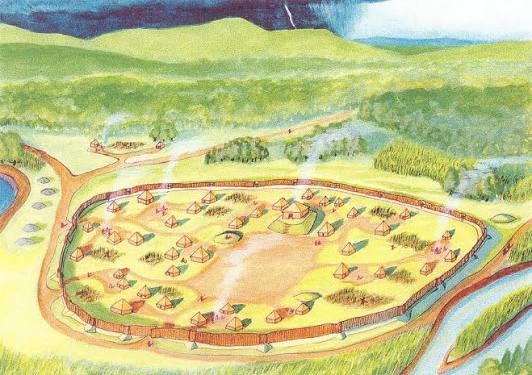
Sellars Mounds was organized around a spacious central plaza, surrounded by earthen platform mounds that supported temples, council houses, and the residences of hereditary chiefs. These mounds were built by transporting thousands of basket loads of compacted clay and soil over multiple generations. Their elevated summits provided protection from seasonal flooding while symbolizing political and spiritual authority.
Residential neighborhoods surrounded the ceremonial precinct. Families lived in rectangular wooden houses constructed with timber frames, woven cane walls, and clay plaster. Storage pits, hearths, and workshops indicate that the community maintained a permanent agricultural settlement capable of supporting a sizable population.
Economy and Daily Life
The people of Sellars Mounds relied primarily on the cultivation of maize, beans, squash, and sunflowers, taking advantage of the fertile river terraces of the Cumberland Valley. Hunting deer, wild turkey, rabbits, and fishing in nearby rivers supplemented their agricultural production.
Craft specialists manufactured shell-tempered pottery, stone projectile points, bone tools, shell ornaments, and woven textiles. Long-distance trade brought marine shells from the Gulf Coast, copper from the Great Lakes region, and high-quality chert for toolmaking, demonstrating the community's participation in extensive Mississippian exchange networks.
Religion and Ceremonial Life
Religion formed the center of community life. Temples atop the platform mounds hosted ceremonies honoring ancestors, agricultural spirits, and celestial forces believed to influence fertility and prosperity. The central plaza accommodated seasonal festivals, ritual dances, communal feasts, athletic contests, and political assemblies that reinforced social unity and the authority of local leaders.
Many ceremonial artifacts recovered from the site reflect participation in the Southeastern Ceremonial Complex, indicating strong cultural connections with other Mississippian centers throughout the Southeast.
Archaeological Importance
Excavations have uncovered platform mound construction phases, house foundations, pottery, stone tools, shell ornaments, food remains, and burial features that provide valuable information about the Middle Cumberland culture. Sellars Mounds remains one of Tennessee's most important archaeological sites for understanding the regional development of Mississippian civilization.
Conclusion
Sellars Mounds stands as an important ceremonial and political center of the Middle Cumberland Mississippian culture, demonstrating advanced mound construction, organized agriculture, extensive trade, and sophisticated religious traditions. Its well-preserved earthworks continue to provide valuable insight into the Indigenous societies that flourished in central Tennessee before European contact.