Introduction
Dairy products were important components of many ancient food economies, but identifying exactly what people made from milk can be difficult. Milk, cream, butter, and cheese often leave few recognizable remains after thousands of years. Archaeologists therefore use chemical analysis to investigate residues preserved inside pottery vessels.
One of the most useful approaches examines lipids, or fats, absorbed into the porous surfaces of ceramic containers. Certain patterns of fatty acids can provide evidence that a vessel held dairy products. Additional analysis may help distinguish ruminant fats from other sources, although identifying a specific animal species or product requires caution.
The study of sheep milk cheeses in Bronze Age pottery brings together food history, animal husbandry, ceramic technology, and biomolecular archaeology. It can reveal how ancient communities processed milk and managed livestock, even when the food itself has long disappeared.
Dairy in Bronze Age Economies
The Bronze Age covered different chronological periods across Europe, the Mediterranean, western Asia, and other regions. Communities practiced a variety of farming systems, and the role of livestock differed by environment and economy.
Sheep and goats were particularly valuable because they could provide milk, meat, wool, hides, and manure. Their ability to graze in varied landscapes made them useful in many pastoral and mixed-farming systems.
Milk could be consumed fresh, but it could also be transformed into products that lasted longer or were easier to transport. Fermentation and cheese-making were especially useful in regions where refrigeration was unavailable.
However, the presence of sheep bones at an archaeological site does not prove that people produced sheep milk cheese. Evidence of dairying requires additional indicators.
Why Cheese Matters Archaeologically
Cheese-making changes the composition and physical properties of milk.
Separating curds from whey removes much of the liquid component and creates a product that can be stored or transported more easily, depending on the method used.
Cheese could therefore help communities manage seasonal milk production. Animals produce milk according to biological cycles, while demand for food continues throughout the year.
Preserving dairy products could reduce waste and create trade goods.
The archaeological challenge is distinguishing cheese from other dairy products because many leave overlapping chemical signatures.
Lipids and Ceramic Residues
Lipids are organic compounds that include fats and oils.
When food is heated or stored in pottery, some lipid molecules can enter the ceramic fabric. Porous pottery can absorb residues into its walls, where they may survive even after the vessel is cleaned or buried.
Researchers extract small samples from pottery and analyze their chemical composition.
The resulting data can reveal whether the vessel held animal fats, plant oils, dairy products, or other substances.
The quality of the evidence depends on preservation, contamination control, the sampling method, and the analytical techniques used.
Fatty Acids and Dairy Identification
Many archaeological lipid studies examine fatty acids such as palmitic acid and stearic acid.
The relative abundance and molecular characteristics of these compounds can help distinguish broad categories of animal fat.
Dairy fats often show patterns that differ from fats associated with adipose tissue, but interpretation is not always straightforward. Heating, degradation, and environmental processes can alter the residues.
Researchers compare archaeological samples with modern reference materials and experimentally produced residues.
A dairy signature can support the conclusion that milk products were processed in a vessel. It does not automatically identify a particular cheese recipe.
Identifying Ruminant Milk
Sheep, goats, and cattle are all ruminants, and their milk fats can share important chemical characteristics.
Distinguishing among them may be possible in some circumstances through specialized analytical approaches, but it is not always reliable.
Compound-specific isotope analysis can examine differences in the isotopic composition of particular fatty acids. Such measurements can help distinguish some animal-fat sources when suitable reference data are available.
However, the result depends on the environmental conditions in which animals were raised, including climate, vegetation, and feeding practices.
Researchers should not identify sheep milk solely from a generic dairy residue unless the evidence supports that level of specificity.
What Counts as Evidence for Cheese?
Cheese-making can involve specialized processing equipment, but the presence of a particular vessel type does not automatically prove its function.
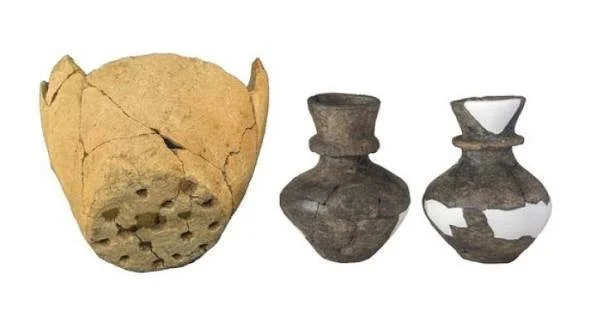
Some perforated vessels may have been used to drain curds, yet similar objects can serve other purposes. Their interpretation depends on form, residue analysis, wear, and archaeological context.
Evidence becomes stronger when several indicators agree: dairy lipids, vessel designs suitable for straining, relevant animal remains, and other signs of milk processing.
Even then, it may be difficult to determine whether the product was fresh cheese, fermented dairy, or another preparation.
Sheep Husbandry and Seasonal Mobility
Sheep are well suited to many forms of pastoralism.
Herds can graze on vegetation unsuitable for intensive crop cultivation, and their products can support both household consumption and exchange.
Bronze Age communities may have moved herds seasonally to access pasture, water, and shelter. Such movement could influence when milk was available and where dairy processing occurred.
Archaeologists investigate these patterns through animal-bone analysis, age profiles, settlement locations, environmental data, and evidence of mobility.
However, not every sheep-keeping community practiced long-distance transhumance. Herd management varied according to local conditions.
Pottery and Food Processing
Ceramic vessels shaped food preparation in many Bronze Age societies.
Different forms supported cooking, storage, serving, and transport.
A vessel's capacity, surface treatment, and construction could influence how it was used. Some ceramics may have been designed for repeated heating, while others were more suitable for storing liquids or solids.
Lipid analysis can connect these forms with actual use rather than relying solely on shape.
A pot classified typologically as a cooking vessel may have held dairy products, while a storage vessel might have been used for several substances during its lifetime.
Cheese and Trade
Dairy products can be important exchange goods because some forms are more durable than fresh milk.
If cheese was produced in one location and transported to another, it could connect pastoral communities with settlements, markets, or specialized centers.
Archaeological evidence for such trade is difficult to establish directly. A dairy residue at a settlement demonstrates use of the product, not necessarily importation.
Researchers need to consider local livestock, pottery provenance, settlement organization, and other evidence before concluding that cheese moved through a commercial network.
Biomolecular Archaeology and Contamination
Organic residues can be contaminated by modern handling, soil chemistry, conservation materials, or later use of the vessel.
Researchers therefore collect samples from appropriate parts of the pottery and use controls to assess potential contamination.
They also compare results across multiple vessels and contexts.
A single unusual chemical result should be interpreted cautiously, especially when it supports a specific claim about species or food processing.
The Limits of Reconstructing Ancient Recipes
Chemical analysis can reveal categories of substances more reliably than exact recipes.
A dairy signature cannot usually tell us how salty a cheese was, which herbs were added, how long it aged, or what it tasted like.
Those details require different evidence, and many may remain unknown.
Modern traditional cheeses can provide useful comparisons, but they should not be treated as unchanged survivals of Bronze Age practices.
Food traditions evolve as ingredients, technology, trade, and consumer preferences change.
Conclusion
Lipid biomarkers in Bronze Age pottery provide an important means of investigating ancient dairying. They can reveal that vessels were used for dairy products and, in suitable cases, help distinguish broad categories of animal fat.
Establishing that a particular vessel held sheep milk cheese requires more specific evidence than the presence of dairy lipids alone. Researchers must consider isotope data, ceramic form, animal remains, archaeological context, and the limits of current analytical methods.
When these sources are combined, pottery residues can reveal how Bronze Age communities transformed milk into more durable foods, managed their herds, and organized production. The study of ancient cheese is therefore not merely about identifying a lost food; it is about reconstructing the agricultural systems, technical knowledge, and everyday choices that sustained past societies.