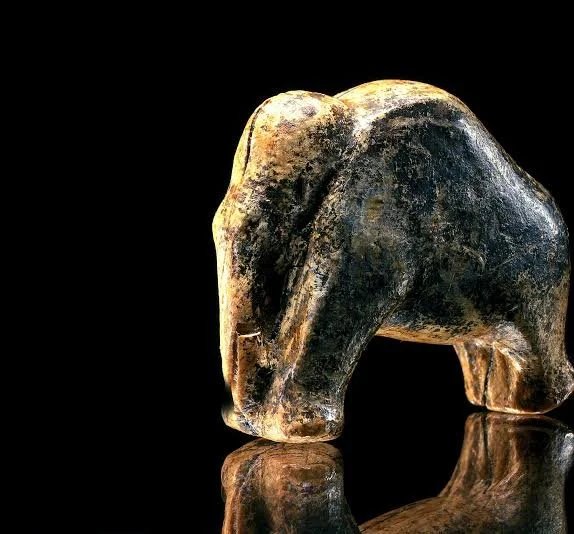
Vogelherd Cave in southwestern Germany has produced some of the most astonishing examples of Ice Age art ever discovered. Among its famous finds are delicately carved animal figurines, including mammoths, horses, cave lions, and other creatures that inhabited the Paleolithic landscape.
These objects are small enough to fit in a human hand, yet their historical significance is enormous.
Some date to roughly 40,000 years ago, placing them among the earliest known examples of figurative art. They demonstrate that early modern humans in Europe were not merely capable of producing abstract marks. They could observe animals closely, transform ivory into recognizable forms, and create portable works of art with no obvious practical purpose.
The Cave of Birds
Vogelherd Cave is located in the Lone Valley of the Swabian Jura in Baden-Württemberg, Germany. The region is internationally renowned for its Paleolithic caves and their exceptional archaeological record.
The cave was discovered and excavated in the twentieth century, and later archaeological work recovered additional material from sediments associated with earlier excavations.
Vogelherd became particularly famous because of its small ivory sculptures.
The cave's archaeological deposits belong primarily to the Upper Paleolithic and include evidence connected with the Aurignacian, a period associated with some of the earliest Homo sapiens populations in Europe.
A Landscape Filled With Ice Age Animals
To understand Vogelherd’s art, it is necessary to imagine the world in which its creators lived.
Upper Paleolithic Europe was home to animals that are now extinct or no longer found in the region. These included mammoths, woolly rhinoceroses, cave lions, reindeer, wild horses, and other species adapted to Ice Age environments.
These animals were not distant symbols. They were part of everyday survival.
Some were hunted.
Others were dangerous competitors or predators.
Their movements shaped hunting strategies, seasonal travel, and human knowledge of the landscape.
It is therefore unsurprising that animals became central subjects of Paleolithic art.
What is remarkable is the technical sophistication with which the artists represented them.
The Famous Mammoth Figurines
The mammoth carvings from Vogelherd are among the site's most celebrated artifacts.
Mammoth ivory was a valuable but challenging material. A craftsperson had to obtain the material, select an appropriate piece, and gradually shape it through cutting, scraping, carving, and polishing.
The final sculptures are not random pieces of modified ivory.
They contain recognizable anatomical features.
Even at a small scale, the artists were able to suggest the distinctive form of the mammoth: its body, head, trunk, and overall proportions.
The creation of such an object required the artist to translate observation into three-dimensional form.
How Were the Figurines Made?
Paleolithic artists did not possess metal tools.
Their technological world was based largely on carefully manufactured stone tools, bone implements, antler, wood, and other available materials.
Flint blades and burins could be used to cut and engrave surfaces. Repeated scraping and carving gradually transformed raw ivory into an animal figure.
The process was slow.
A mistake could damage valuable material.
This means that each figurine represents a significant investment of labor.
The maker also needed a mental image of the desired object before it was complete.
Three-dimensional carving therefore required planning.
Portable Art and the Birth of Figurative Representation
The Vogelherd figurines are examples of portable art, meaning artistic objects small enough to be carried from one location to another.
Portable art differs from cave paintings fixed to walls and ceilings.
An ivory figurine could travel with its owner or community.
It could potentially be displayed, exchanged, carried during seasonal movements, or used in social or ritual contexts.
Because we cannot observe the original cultural setting directly, the exact purpose of each figurine remains uncertain.
They may have represented:
Animals of economic importance
Spiritual beings
Clan identities
Mythological narratives
Personal objects
Symbols of status
Ritual items
Artistic expression without a single practical function
The safest conclusion is that the objects possessed meaning—but archaeology cannot always recover that meaning completely.
Why the Vogelherd Animals Matter
The figurines demonstrate sophisticated visual cognition.
To create a recognizable animal, an artist must identify the features that distinguish one species from another.
A mammoth must look different from a horse.
A lion must look different from a bison.
The artist therefore selected visual characteristics that could communicate identity even at a miniature scale.
This suggests an ability to categorize, remember, and manipulate mental representations of the natural world.
The Aurignacian Artistic Explosion
Vogelherd is part of a broader pattern of early Upper Paleolithic symbolic production.
Across parts of Europe, archaeologists have discovered ornaments, engravings, paintings, carvings, and musical instruments associated with early modern human populations.
The Swabian Jura is especially important because of the age and concentration of its discoveries.
The region has produced:
Ivory animal figures
Human and animal composite figures
Musical instruments
Personal ornaments
Other examples of symbolic material culture
Together, these discoveries demonstrate that the early Upper Paleolithic was a period of remarkable cultural innovation.
Were These the First Works of Art?
The answer depends on what is meant by “art.”
Humans were creating pigments, engravings, symbolic markings, and decorative objects long before the Aurignacian.
Other species, including Neanderthals, may also have engaged in symbolic behavior.
Therefore, it would be inaccurate to claim that Vogelherd represents the absolute beginning of artistic thought.
Its importance lies elsewhere.
The figurines are among the earliest surviving examples of clearly recognizable three-dimensional figurative art produced on an extraordinary level of craftsmanship.
Excavation and Rediscovery
The archaeological history of Vogelherd is also important.
Early excavations recovered famous sculptures, but later research demonstrated that archaeological sites can continue to produce new information long after their initial discovery.
Re-examination of excavated sediments and renewed archaeological work recovered additional artifacts and fragments.
This illustrates a fundamental principle of archaeology: excavation does not simply “find objects.” Methods improve, questions change, and material once overlooked can become scientifically valuable.
Art in a Dangerous World
There is something striking about the contrast between the beauty of the Vogelherd figurines and the environment in which they were created.
Ice Age Europe could be dangerous.
Human groups had to secure food, survive cold temperatures, navigate changing environments, and coexist with large predators.
Yet within that world, people devoted time to carving tiny representations of animals.
This challenges the assumption that art emerges only after societies become wealthy or technologically advanced.
The makers of the Vogelherd figurines lived as mobile hunter-gatherers.
Their survival depended on intimate knowledge of animals and landscapes.
But they were also capable of creating objects that existed beyond immediate necessity.
The Legacy of Vogelherd Cave
Today, Vogelherd Cave is one of the key sites for understanding the development of symbolic culture in prehistoric Europe.
Its mammoths and other figurines have transformed discussions about the intellectual abilities of early Homo sapiens.
They reveal individuals capable of observation, imagination, planning, craftsmanship, and cultural expression.
A tiny mammoth carved from ivory may not appear powerful at first.
But when archaeologists realize that it was created around forty thousand years ago, its meaning changes.
It becomes evidence of an ancient mind looking at the natural world and deciding that the world was worth recreating in art.