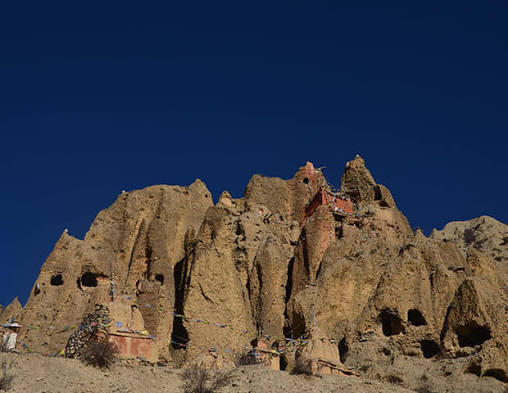
The Sky Caves of Mustang are among the most mysterious archaeological landscapes in the Himalayas. Thousands of artificial caves have been carved into the steep cliffs of Upper Mustang, often at heights that appear almost impossible to reach without modern climbing equipment.
These caves have served different purposes during different periods.
Some were used as:
homes;
storage spaces;
defensive refuges;
monasteries;
meditation chambers;
and burial sites.
Their history extends across thousands of years, making the Mustang cave landscape one of the most important long-term archaeological records in the Himalayan region. Investigations have identified human remains and other evidence dating back more than two thousand years, while later caves contain Buddhist art, manuscripts, and artifacts from medieval periods.
A Landscape of Thousands of Caves
Estimates commonly describe the Mustang region as containing roughly ten thousand man-made caves distributed across cliff faces and valleys.
The caves were created by cutting into relatively soft rock formations.
Some form isolated chambers, while others are organized into complex, multi-level systems.
The sheer scale of this artificial landscape raises important questions.
Who created these caves?
How were they originally accessed?
Why were some constructed so high above the valley floor?
Archaeologists continue to investigate these questions.
Why Were the Caves Built So High?
The extreme location of many caves is one of their greatest mysteries.
Several explanations have been proposed depending on the specific site.
High caves could offer:
protection from enemies;
secure storage;
isolation for religious activity;
protection from flooding or animals;
or special locations for burial.
Access may originally have been provided by:
wooden ladders;
scaffolding;
platforms;
rope systems;
or routes that have since disappeared.
Erosion and the collapse of surrounding rock can make ancient access routes impossible to reconstruct.
The Earliest Burials
Some Mustang caves contain human remains dating back thousands of years.
One of the most important discoveries occurred at Mebrak, where archaeologists found naturally mummified bodies preserved in the dry and cold conditions of a high-altitude burial cave.
Radiocarbon dating showed that the burial chamber was used over several centuries, beginning around the middle of the first millennium BCE.
The dry climate preserved not only human remains but also wooden coffins, textiles, animal remains, and everyday objects.
These discoveries demonstrate that Mustang's caves formed part of organized prehistoric mortuary traditions.
Naturally Preserved Himalayan Mummies
Mummification in Mustang was often a natural process rather than an intentional artificial procedure like the embalming traditions of ancient Egypt.
Cold temperatures, dry air, and limited moisture slowed the decomposition of bodies.
This allowed skin, hair, textiles, and other organic materials to survive.
The preservation of such materials provides archaeologists with unusually detailed evidence about prehistoric life.
Researchers can study:
clothing;
burial objects;
woodworking;
food remains;
physical health;
and community structure.
The Problem of Looting
Unfortunately, many archaeological sites in Mustang have been disturbed.
Looting can cause permanent damage because the value of an archaeological object depends heavily on its context.
A gold ornament removed from a tomb may be visually impressive, but archaeologists lose important information when they do not know:
where it was found;
what it was placed beside;
which burial it belonged to;
and how it was originally arranged.
Research into Himalayan archaeological sites has documented cases in which caves and burial contexts were disturbed by looting, erosion, construction, and other processes.
What Makes a Tomb Important?
An ancient tomb is not simply a container filled with valuable objects.
Its importance lies in the relationships between all of its components.
Archaeologists examine:
the position of the body;
the arrangement of grave goods;
the architecture of the chamber;
the sequence of burials;
and evidence of later disturbance.
This context can reveal information about religion, family relationships, social status, and attitudes toward death.
Looting destroys many of these relationships.
From Tombs to Homes
The remarkable feature of the Mustang cave landscape is that caves could change their purpose over time.
A space originally created for one activity could later be reused.
For example, a cave might have served as:
a burial chamber;
later a refuge;
and eventually a religious retreat or storage area.
This reuse makes interpretation complicated but also fascinating.
The cave landscape is a record of changing human relationships with the environment.
Buddhist Caves and Medieval Art
By the medieval period, some caves in Mustang were associated with Buddhist religious activity.
Explorations have uncovered:
wall paintings;
sculptures;
manuscripts;
pottery;
and other religious objects.
These discoveries demonstrate that the cave landscape remained important long after the earliest prehistoric burials.
Some sites preserve evidence of artistic traditions connected with the wider Tibetan Buddhist world.
Archaeology in an Extreme Environment
Investigating the Sky Caves is physically demanding.
Many chambers can only be reached using ropes and climbing equipment.
Archaeologists must transport:
excavation equipment;
cameras;
recording devices;
conservation materials;
and scientific samples
into difficult locations.
The danger of falling rocks and unstable cliff faces adds another challenge.
Why the Sky Caves Matter
The Sky Caves provide evidence for an extraordinarily long history of human activity in Mustang.
They allow researchers to study:
prehistoric burial traditions;
natural mummification;
high-altitude settlement;
defensive architecture;
religious transformation;
medieval Buddhist art;
and long-distance cultural interaction.
Few archaeological landscapes contain such a long sequence of changing human activity within the same dramatic environment.
Conclusion
The Sky Caves of Mustang are far more than mysterious holes carved into Himalayan cliffs.
They preserve the traces of thousands of years of human history.
Within their chambers, archaeologists have found the dead, the objects of daily life, religious paintings, manuscripts, and evidence of communities that learned to survive in one of the world's most difficult environments.
Looting and natural erosion remain serious threats, but continuing archaeological research is gradually revealing the remarkable history hidden within the cliffs of Upper Mustang.