Introduction
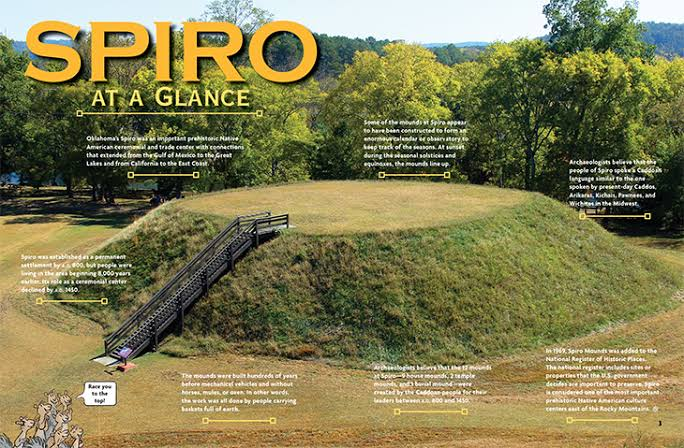
Located along the Arkansas River near present-day Spiro, Oklahoma, the Spiro Mounds represent one of the most important archaeological sites of the Caddoan Mississippian culture. Occupied from approximately 850 to 1450 CE, the site served as a major political, religious, and commercial center connecting the Great Plains, the Mississippi Valley, and the American Southwest. Covering nearly 150 acres (61 hectares), the complex originally consisted of twelve earthen mounds surrounding a large central plaza. Unlike many Mississippian centers, Spiro became renowned for its extraordinary ceremonial wealth, long-distance trade, and elaborate mortuary practices. Although salt production existed in parts of the Caddoan region, Spiro's primary importance was as a ceremonial and trade center rather than a salt-production site.
Settlement Layout and Monumental Architecture
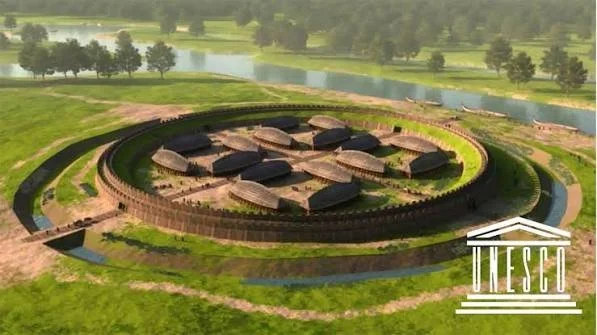
The settlement was organized around a broad rectangular central plaza bordered by twelve platform and burial mounds. The largest platform mound supported the residence of the ruling chief or an important temple where political and religious ceremonies were conducted. Smaller mounds housed council buildings, elite residences, and sacred structures used during seasonal festivals.
The plaza functioned as the center of civic life, accommodating public ceremonies, ritual dances, athletic competitions, diplomatic meetings, and communal feasts. Residential neighborhoods surrounded the ceremonial precinct, with houses constructed from wooden posts covered by woven cane and clay plaster.
The Craig Mound and Sacred Burials
Spiro is particularly famous for the Craig Mound, one of the richest prehistoric burial mounds ever discovered in North America. Over several centuries, priests and elites placed ceremonial offerings within a sacred mortuary chamber constructed from cedar logs.
Archaeologists uncovered thousands of remarkable artifacts, including engraved marine shell cups, copper plates, carved wooden sculptures, woven textiles, pearl beads, stone pipes, and ceremonial masks. Many of these objects originated hundreds or even thousands of kilometers away, demonstrating Spiro's participation in one of North America's largest prehistoric trade networks.
Trade Networks and Economy
The inhabitants cultivated maize, beans, squash, and sunflowers, while hunting bison, deer, turkey, and fishing in the Arkansas River. Agriculture provided the surplus necessary to support priests, artisans, merchants, and political leaders.
Trade connected Spiro with communities throughout the Mississippi Valley, the Great Lakes, the Gulf Coast, the Rocky Mountains, and the American Southwest. Marine shells arrived from the Gulf of Mexico, copper from the Great Lakes, obsidian from the western United States, and turquoise from the Southwest. These imported materials were transformed into elaborate ceremonial objects by highly skilled artisans.
Religion and Ceremonial Life
Religion dominated life at Spiro. Priests conducted rituals atop the platform mounds while sacred ceremonies took place within the central plaza. Many artifacts display imagery associated with the Southeastern Ceremonial Complex, including falcons, serpents, sun symbols, and mythological beings that represented warfare, fertility, and the supernatural world.
The Craig Mound functioned as both a burial monument and a sacred repository for ritual objects, emphasizing the close relationship between ancestor worship, political authority, and religious belief.
Archaeological Importance
Excavations have revealed temples, houses, workshops, storage pits, plazas, burial chambers, and one of the richest collections of Mississippian ceremonial artifacts ever discovered. These findings have made Spiro indispensable for understanding Caddoan civilization, long-distance trade, and prehistoric religious traditions throughout eastern North America.
Conclusion
Spiro Mounds stands as the greatest ceremonial center of the Caddoan Mississippian culture, demonstrating advanced mound construction, extensive trade networks, remarkable artistic achievements, and sophisticated religious practices. Its monumental earthworks and extraordinary archaeological discoveries continue to provide invaluable insight into one of North America's most influential Indigenous civilizations.