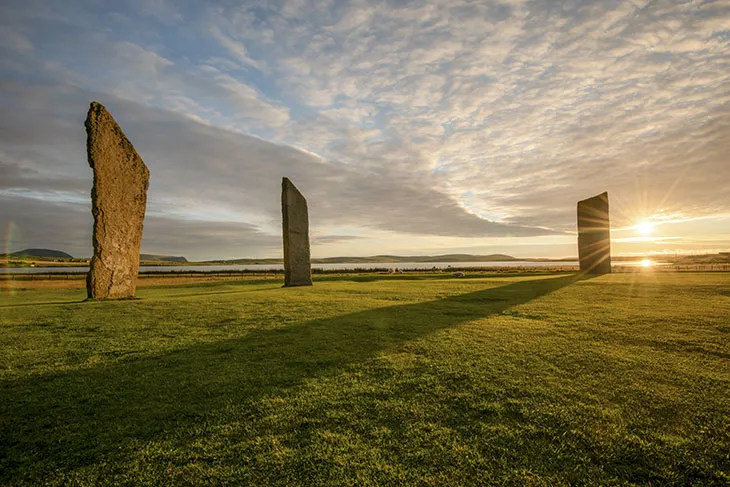
Stennis, more commonly associated with the Stones of Stenness, is one of the most extraordinary prehistoric monuments in Orkney.
The standing stones form part of a wider ceremonial landscape that includes the Ring of Brodgar, the Ness of Brodgar, and numerous Neolithic settlements and burial monuments.
One of Britain's Oldest Stone Circles
The Stones of Stenness date to the Neolithic period.
The surviving stones are enormous slabs arranged within a ceremonial enclosure.
The original monument was considerably more extensive than what survives today.
The Henge
The monument was constructed as part of a henge.
A henge typically consists of:
an enclosed area;
an external ditch;
and an embankment.
The Stenness monument was therefore not simply a circle of stones.
It was a carefully planned ceremonial complex.
The Standing Stones
The surviving stones are exceptionally tall and thin.
Their appearance creates a dramatic vertical landscape.
The builders selected and transported enormous slabs before setting them upright.
Engineering
Moving the stones would have required substantial cooperation.
Possible methods included:
wooden sledges;
ropes;
timber structures;
and large groups of workers.
The construction therefore reveals sophisticated collective organization.
Ritual Activity
The precise ceremonies performed at Stenness remain unknown.
However, the monument's scale and relationship with other ceremonial structures demonstrate that it was an important communal gathering place.
Possible activities may have included:
feasting;
ritual processions;
funerary ceremonies;
seasonal gatherings;
and religious performances.
Relationship With the Ring of Brodgar
Stenness forms part of a remarkable ceremonial complex with the Ring of Brodgar.
The two stone circles are connected through the surrounding landscape.
People moving between these monuments would have experienced them as parts of a larger ceremonial environment.
The Ness of Brodgar
The nearby Ness of Brodgar provides additional evidence for major Neolithic ceremonial activity.
Its monumental buildings demonstrate that the surrounding area was an important center of social and ritual life.
Astronomy
The monument's orientation has attracted considerable interest.
Some prehistoric monuments in Orkney appear to incorporate relationships with the sun, moon, and seasonal cycles.
However, individual astronomical interpretations should be evaluated carefully rather than assuming that every alignment was deliberately astronomical.
UNESCO World Heritage
The Stones of Stenness form part of the Heart of Neolithic Orkney, a UNESCO World Heritage Site.
This group includes some of the most important surviving Neolithic monuments in Europe.
Conclusion
Stennis: Orkney's Standing Stone Circle represents one of the defining achievements of Neolithic Orkney.
Its monumental stones, henge architecture, and relationship with nearby ceremonial sites demonstrate that prehistoric communities were capable of organizing enormous collective projects.
The Stones of Stenness were not simply isolated stones in a field.
They were part of a carefully constructed ceremonial landscape where architecture, community, ritual, ancestry, and the natural environment came together.