• MAIN PAGE
  • LATEST NEWS
    • Lost Cities
    • Archaeology's Greatest Finds
    • Underwater Discoveries
    • Greatest Inventions
    • Studies
    • Blog
  • PHILOSOPHY
  • HISTORY
  • RELIGIONS
    • Africa
    • Anatolia
    • Arabian Peninsula
    • Balkan Region
    • China - East Asia
    • Europe
    • Eurasian Steppe
    • Levant
    • Mesopotamia
    • Oceania - SE Asia
    • Pre-Columbian Civilizations of America
    • Iranian Plateau - Central Asia
    • Indus Valley - South Asia
    • Japan
    • The Archaeologist Editor Group
    • Scientific Studies
    • Aegean Prehistory
    • Historical Period
    • Byzantine Middle Ages
    • Predynastic Period
    • Dynastic Period
    • Greco-Roman Egypt
  • Rome
  • PALEONTOLOGY
  • About us
Menu

The Archaeologist

  • MAIN PAGE
  • LATEST NEWS
  • DISCOVERIES
    • Lost Cities
    • Archaeology's Greatest Finds
    • Underwater Discoveries
    • Greatest Inventions
    • Studies
    • Blog
  • PHILOSOPHY
  • HISTORY
  • RELIGIONS
  • World Civilizations
    • Africa
    • Anatolia
    • Arabian Peninsula
    • Balkan Region
    • China - East Asia
    • Europe
    • Eurasian Steppe
    • Levant
    • Mesopotamia
    • Oceania - SE Asia
    • Pre-Columbian Civilizations of America
    • Iranian Plateau - Central Asia
    • Indus Valley - South Asia
    • Japan
    • The Archaeologist Editor Group
    • Scientific Studies
  • GREECE
    • Aegean Prehistory
    • Historical Period
    • Byzantine Middle Ages
  • Egypt
    • Predynastic Period
    • Dynastic Period
    • Greco-Roman Egypt
  • Rome
  • PALEONTOLOGY
  • About us
No results found

Strathnaver Clearances Sites: Sutherland's Deserted Villages

September 9, 2026

The Strathnaver Clearances Sites preserve some of the most important archaeological evidence for the social consequences of the Highland Clearances.

Across northern Sutherland, former settlements were abandoned as traditional communities were displaced during a period of profound economic and social transformation.

What Were the Highland Clearances?

The Highland Clearances were a series of processes, particularly prominent from the late eighteenth into the nineteenth centuries, in which Highland tenants were removed from traditional agricultural settlements.

Landowners increasingly sought to reorganize estates.

Large areas were converted to sheep farming.

Strathnaver

Strathnaver lies in northern Sutherland.

Before the Clearances, the valley contained numerous settlements where families practiced forms of mixed agriculture and pastoralism.

People cultivated crops while raising livestock.

Clearance and Displacement

Clearance operations resulted in the abandonment of many settlements.

Families were:

  • relocated;

  • forced toward coastal areas;

  • encouraged to emigrate;

  • or otherwise displaced from their traditional homes.

Archaeological Evidence

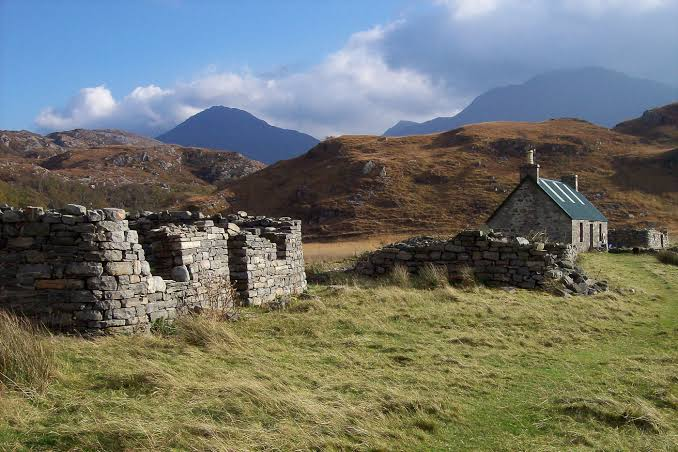
Today, abandoned settlement remains may include:

  • stone walls;

  • house foundations;

  • field boundaries;

  • enclosures;

  • clearance cairns;

  • and roads.

These apparently ordinary features provide direct evidence of former communities.

The Human Cost

The Clearances were not simply an agricultural modernization project.

For displaced families, removal could mean losing:

  • homes;

  • farmland;

  • community networks;

  • burial connections;

  • and ancestral landscapes.

Archaeology of Abandonment

Archaeologists can study deserted villages to reconstruct everyday life.

House dimensions reveal household organization.

Field systems reveal agricultural practices.

Animal remains can indicate diet and livestock management.

Artifacts can reveal household consumption.

Emigration

Many Highland families eventually emigrated.

Destinations included:

  • Canada;

  • the United States;

  • Australia;

  • New Zealand;

  • and other parts of the British Empire.

The Clearances therefore contributed to the transformation of Highland society both locally and globally.

Memory and Heritage

Clearance sites remain emotionally significant.

They represent not only archaeological remains but also the memories of communities whose descendants may live far beyond Sutherland.

Conclusion

Strathnaver Clearances Sites: Sutherland's Deserted Villages preserve the physical remains of communities transformed by the Highland Clearances.

Their ruined houses and fields demonstrate that historical change is not merely a political process.

It can reshape entire landscapes, families, economies, and patterns of settlement.
← Smoo Cave: Sutherland's Viking Age UseBadbea: Caithness's Clearance Village →
Featured
image_2026-09-01_150407961.png
September 9, 2026
Dunadd Fort: Argyll's Inauguration Rock Carvings
September 9, 2026
Read more →
September 9, 2026
image_2026-09-01_150445885.png
September 9, 2026
Kilmartin Glen: Argyll's 5,000-Year Megalithic Landscape
September 9, 2026
Read more →
September 9, 2026
image_2026-09-01_150523753.png
September 9, 2026
Nether Largie: Argyll's Clyde Tomb Alignment
September 9, 2026
Read more →
September 9, 2026
image_2026-09-01_150612586.png
September 9, 2026
Ri Cruin: Argyll's Bronze Age Cairn Circle
September 9, 2026
Read more →
September 9, 2026
image_2026-09-01_150753980.png
September 9, 2026
Barnaluasgan: Argyll's Standing Stones
September 9, 2026
Read more →
September 9, 2026
image_2026-09-01_150644895.png
September 9, 2026
Ballymeanoch: Argyll's Kerbed Cairn
September 9, 2026
Read more →
September 9, 2026
read more

Powered by The archaeologist