Introduction
Ancient performance spaces were important centers of entertainment, political expression, religious celebration, and public identity.
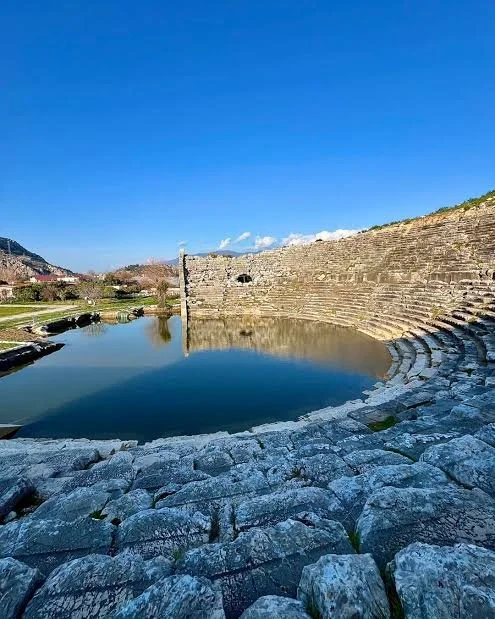
Theaters and amphitheaters were often built in prominent locations, sometimes near coastlines, harbors, or river valleys. Changes in sea level, earthquakes, coastal subsidence, erosion, and sediment movement can eventually place parts of these structures underwater.
The concept of submerged amphitheaters therefore connects classical architecture with underwater archaeology and coastal environmental change.
However, not every submerged circular structure is an amphitheater. Identifying an ancient performance space requires architectural evidence, comparison with known building types, and a reliable reconstruction of the ancient shoreline.
The Difference Between Theaters and Amphitheaters
Ancient theaters and amphitheaters were designed for different forms of performance.
Greek theaters commonly featured a semicircular arrangement of seating around a performance area. They were associated with dramatic performances, music, festivals, and civic events.
Roman amphitheaters generally had an oval or elliptical arena surrounded by seating. They hosted spectacles such as gladiatorial contests and animal displays.
The architectural distinction matters because the terms are not interchangeable.
A submerged structure should be identified according to its original design rather than its modern appearance.
Why Ancient Performance Spaces Became Submerged
Several geological and environmental processes can place coastal architecture underwater.
Relative sea-level rise can gradually inundate low-lying land.
Tectonic activity may cause coastal subsidence, lowering buildings relative to the sea.
Earthquakes can also damage foundations and alter local topography.
Erosion and sediment movement may remove supporting ground or expose structures previously buried beneath coastal deposits.
In some cases, a structure may have been built beside a lagoon or harbor that later expanded.
These processes can occur together, making it difficult to reconstruct the original landscape.
Architectural Features Underwater
Underwater archaeologists search for recognizable construction features.
Seating tiers may survive as curved stone rows.
Foundations may reveal the geometry of the building.
A performance area could be identified through its relationship with surrounding seating and architectural entrances.
Other features might include retaining walls, drainage channels, corridors, and decorative architectural fragments.
A collection of curved masonry alone is not sufficient to identify an amphitheater. Natural rock formations, harbor structures, and other buildings can produce similar patterns.
The Importance of Ancient Shorelines
Reconstructing the ancient shoreline is essential.
Researchers examine sediment cores, geological formations, historical maps, and archaeological evidence.
Changes in sea level can be estimated through coastal indicators, including submerged shore platforms, ancient harbor structures, and dated biological remains.
The elevation of a submerged building must be interpreted in relation to local tectonic history.
A structure submerged in one region may reflect sea-level rise, while another may have been lowered by local geological movement.
Underwater Archaeological Methods
Modern underwater archaeology uses several techniques to investigate submerged architecture.
Diver surveys allow direct examination where conditions permit.
Photogrammetry creates detailed three-dimensional models from overlapping photographs.
Side-scan sonar can identify structures and anomalies across the seabed.
Multibeam bathymetry records underwater topography and helps map the extent of archaeological remains.
Sub-bottom profiling can sometimes reveal buried foundations beneath sediment.
These technologies allow researchers to document structures without immediately excavating them.
Performance and Civic Life
Ancient theaters and amphitheaters were more than entertainment venues.
They were places where communities gathered and expressed shared identities.
Performances could reinforce religious traditions, political authority, civic pride, and social hierarchy.
Large structures also required substantial investment.
Their construction may indicate the economic resources and organizational capacity of a city or regional authority.
If a performance space is found in a coastal settlement, it may provide evidence for the importance of that settlement within regional networks.
Earthquakes and Coastal Destruction
Earthquakes have affected many ancient Mediterranean settlements.
Seismic activity can crack walls, damage seating, destabilize foundations, and alter coastal elevations.
Tsunamis and storm surges may introduce sediment and debris into structures.
A submerged building may therefore preserve evidence of several separate episodes of damage and inundation.
Researchers must establish whether the structure was gradually submerged, suddenly damaged, deliberately abandoned, or affected by a combination of processes.
Preservation Challenges
Marine environments can preserve stone architecture while damaging other materials.
Wood, textiles, and organic decorative elements may survive only under specific conditions.
Marine organisms can colonize stone surfaces.
Salt crystallization and chemical processes may weaken some materials, especially after recovery.
Underwater archaeological sites are also vulnerable to anchoring, fishing activity, construction, looting, and uncontrolled diving.
Documentation and protection are therefore essential.
Distinguishing Archaeology from Legend
Stories of sunken cities and theaters are common in coastal folklore.
Some may preserve memories of real landscape changes, while others are later inventions.
A submerged structure should not be identified as a theater simply because local tradition describes a lost performance venue.
Archaeological interpretation requires measurable architectural evidence, dating, and environmental reconstruction.
Conclusion
Submerged amphitheaters and theaters offer an opportunity to study the relationship between ancient public architecture and changing coastal landscapes.
Their remains can reveal how communities built spaces for performance, organized civic life, and adapted to maritime environments.
Identifying such structures requires careful architectural analysis and geological reconstruction.
When supported by reliable evidence, underwater performance spaces provide a remarkable record of ancient cities whose public monuments now lie beneath the sea.