Introduction
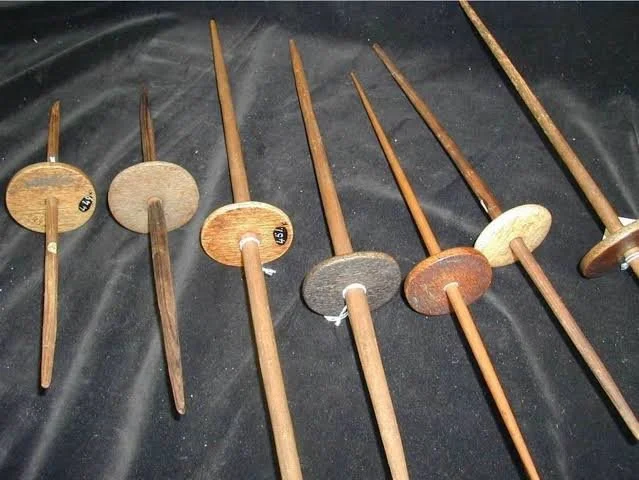
Spindle whorls are small objects that played an important role in ancient textile production. Often made from clay, stone, bone, or other durable materials, they were attached to spindles to provide rotational momentum during the spinning of fibers.
Their size can make them appear insignificant compared with larger archaeological objects. Yet spindle whorls offer valuable evidence about household production, gendered labor, exchange, craft specialization, and village economies.
Small spindle whorls are especially interesting because their dimensions may reflect particular spinning techniques, fiber types, and production requirements. Their distribution across domestic spaces can reveal how textile work was organized within a community.
What Is a Spindle Whorl?
A spindle whorl is a weighted component attached to a spindle.
When the spindle rotates, the whorl helps maintain momentum and supports the twisting of fibers into yarn.
The spinner draws out fibers and allows the rotating spindle to twist them together.
This process creates a continuous thread that can later be woven into fabric.
The basic principle is simple, but the technique requires practice and coordination.
Materials and Manufacture
Spindle whorls were produced from materials available in different regions.
Clay was especially common because it could be shaped and fired.
Stone offered durability, while bone and other materials could be carved into compact forms.
Some whorls were plain, while others carried incised patterns, painted decoration, or distinctive shapes.
Their manufacturing quality may reveal whether they were produced by specialized craftspeople or made within households.
Why Small Whorls Matter
The weight and diameter of a spindle whorl influence how it behaves during spinning.
Different fibers and yarn thicknesses may require different combinations of spindle speed and rotational momentum.
A smaller, lighter whorl may be suitable for particular fine-spinning techniques, while heavier examples may be used for other fibers and yarn types.
However, size alone cannot identify the exact material spun.
Researchers must compare whorl dimensions with experimental spinning, fiber remains, and other archaeological evidence.
Textile Production in Village Households
Textile production was an important part of many preindustrial economies.
Households needed cloth for clothing, bedding, storage, trade, and ritual activities.
Spinning could be carried out alongside other domestic work.
In some communities, textile production was primarily organized at the household level. In others, specialists produced yarn and cloth for wider markets.
The number and distribution of spindle whorls within a settlement can help researchers investigate these differences.
Social Organization and Labor
Spinning required time and skill.
The task could be performed by individuals of different ages and social positions, although its organization varied across societies.
Historical sources sometimes associate textile work strongly with women, but archaeologists should avoid assuming that every spindle whorl represents female labor.
Objects alone rarely establish the identity of the person who used them.
A more reliable interpretation examines household organization, burial evidence, workshop spaces, and written or ethnographic comparisons where available.
Whorls as Objects of Identity
Spindle whorls could also carry symbolic or personal significance.
Decorated examples may have communicated aesthetic preferences or local traditions.
Differences in shape and ornamentation could reflect community identity, individual craftsmanship, or exchange between settlements.
A spindle whorl might also have been a personal possession passed between family members.
However, decorative variation does not automatically indicate a specific social group.
Exchange and Village Economies
Textiles were valuable goods.
Even when spinning took place inside households, finished yarn and cloth could enter wider exchange networks.
A village producing surplus textiles might trade them for food, tools, pottery, or other materials.
Standardized whorl forms across several settlements may indicate shared techniques or contact between communities.
Imported materials could also reveal connections beyond the immediate region.
Archaeological Distribution
Researchers examine where spindle whorls are found.
Concentrations inside houses may indicate domestic textile production.
Groups recovered from storage areas or workshop deposits may suggest organized craft activity.
Whorls found in graves can provide information about burial customs and symbolic associations, although grave goods do not always represent the deceased person's occupation.
Spatial analysis is therefore essential.
Experimental Archaeology and Use-Wear
Experimental archaeology allows researchers to reproduce ancient spinning techniques.
Replicas can be made using comparable materials and dimensions.
By testing different fibers and spindle configurations, researchers can investigate how whorl weight and shape affect spinning performance.
Microscopic analysis may reveal wear caused by repeated handling or contact with spindle components.
Such evidence can help distinguish objects that were used regularly from those that were decorative, unfinished, or deposited without extensive use.
Conclusion
Small spindle whorls provide an important record of village economies and household production.
Their dimensions, materials, decoration, and distribution can reveal aspects of textile technology, social organization, and exchange.
Although their size may seem modest, they represent the time and skill required to transform raw fibers into usable yarn.
By studying spindle whorls alongside other archaeological evidence, researchers can better understand the economic and social importance of textile work in ancient communities.