Introduction
Water has held an important place in burial traditions across many societies. Rivers, lakes, coastal waters, and wetlands have served as boundaries between communities, routes of travel, sources of livelihood, and landscapes associated with spiritual beliefs.
In some archaeological contexts, boats were incorporated into funerary practices. Watercraft could function as coffins, burial containers, symbolic vehicles, or objects accompanying the deceased. Canoe interments are particularly interesting because they connect the practical technology of water travel with the social and ceremonial treatment of the dead.
Shallow lagoons offer a potentially important environment for investigating such practices. Their sediments may preserve wooden remains under favorable conditions, although preservation varies considerably.
This article examines the archaeological evidence, possible meanings, preservation conditions, and research challenges associated with submerged canoe burials.
1. Boats as Burial Containers
A boat used in a burial could serve several different purposes. In some traditions, the vessel functioned as a container for the body, while in others it formed part of a larger funerary arrangement.
The deceased might have been placed directly inside the hull, accompanied by personal belongings, tools, ornaments, or other objects. The vessel could then be buried on land, deposited in water, or placed in a location that later became submerged.
The distinction is important because a boat-shaped burial container is not necessarily evidence of a deliberate underwater interment.
2. The Archaeological Significance of Canoes
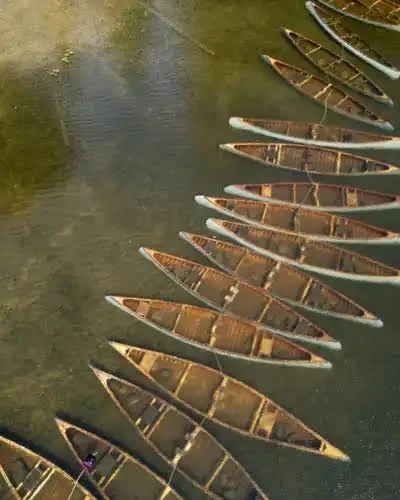
Canoes are generally lightweight watercraft constructed from materials such as hollowed tree trunks, bark, or assembled wooden components.
Their construction reflects specialized knowledge of timber selection, shaping, balance, and water movement. In communities dependent on waterways, canoes could be essential for fishing, transport, trade, and communication.
When a canoe is used in a funerary context, its practical significance may also contribute to its symbolic importance. It could represent the deceased's livelihood, social identity, journey through life, or imagined passage into another realm.
These interpretations must be evaluated within the cultural and archaeological context of each burial tradition.
3. Why Shallow Lagoons May Preserve Burial Evidence
Shallow lagoons can contain fine sediments, organic deposits, and waterlogged environments that sometimes preserve wooden objects.
When timber remains continuously submerged in oxygen-poor sediment, the microorganisms responsible for rapid decay may be restricted. This can improve the survival of wooden structures.
However, preservation is not guaranteed. Changes in salinity, oxygen levels, temperature, water movement, and microbial activity can cause significant deterioration.
Storms, dredging, shoreline development, and changes in water levels may also disturb submerged archaeological deposits.
4. Identifying a Canoe Interment
The identification of a canoe burial requires careful examination of the vessel and its surrounding deposits.
Researchers look for evidence that a human body or funerary materials were intentionally placed within the craft. This may include skeletal remains, grave goods, deliberate positioning, and sediment layers associated with a burial event.
The vessel's orientation and condition can also provide useful information. A canoe resting in a stable position within a burial deposit may suggest deliberate placement, although natural deposition must be ruled out.
A wooden boat discovered in a lagoon should not automatically be classified as a burial vessel. It may instead represent an abandoned craft, a lost fishing boat, or ordinary transport equipment.
5. Human Remains and Funerary Objects
Human remains can provide important evidence of the burial process. Their position, preservation, and relationship to the canoe may help establish whether the vessel served as a funerary container.
Grave goods can include ornaments, tools, pottery, weapons, fishing equipment, or personal objects. Their presence and arrangement may reveal social distinctions or beliefs associated with death.
Archaeologists must also consider whether objects were deposited together or accumulated at different times. A mixed deposit could contain materials from multiple activities rather than one burial event.
Where human remains are present, excavation and analysis should follow appropriate ethical, legal, and cultural protocols, including consultation with relevant descendant communities.
6. The Symbolism of Water Travel
Boats have often carried meanings beyond transportation. In some cultures, watercraft appear in myths, ceremonies, funerary art, and religious traditions.
A canoe burial might have represented the continuation of a journey after death. It could also reflect the importance of waterways as routes connecting settlements, ancestors, and distant communities.
However, there is no universal meaning for boat burials. Similar practices may emerge independently in societies with very different religious traditions.
The symbolism of a particular burial must therefore be reconstructed using local evidence rather than assumptions based on unrelated cultures.
7. Scientific Methods for Investigating Submerged Canoes
Underwater archaeology combines visual recording, sediment analysis, controlled excavation, and conservation science.
Photogrammetry can create detailed three-dimensional records of submerged vessels and surrounding features. Measurements of wood anatomy may help identify the tree species used in construction.
Radiocarbon dating can establish the approximate age of organic materials, while dendrochronology may provide more precise dates when suitable timber and reference chronologies are available.
Sediment samples can reveal environmental conditions and help reconstruct whether the lagoon was freshwater, brackish, or marine when the burial occurred.
8. Distinguishing Intentional Burial from Accidental Submergence
A major challenge is determining why a boat ended up underwater.
Natural flooding, shoreline changes, storms, erosion, and rising water levels can submerge objects that were originally deposited on dry land.
Evidence for deliberate burial may include a prepared pit, a consistent arrangement of human remains, grave goods, and sediment layers showing intentional placement.
By contrast, a vessel with scattered cargo, damage from movement, or no associated funerary evidence may be better interpreted as a lost or abandoned boat.
9. Conservation of Waterlogged Wood
Waterlogged archaeological wood is often extremely fragile. After centuries underwater, its internal structure may be weakened even when its external shape appears intact.
Removing it from water without proper treatment can cause rapid shrinkage, cracking, and deformation.
Conservation specialists therefore use controlled drying, stabilization treatments, and carefully monitored storage conditions. Large vessels may require extensive resources to preserve.
In some cases, leaving a submerged canoe in place may be safer than recovering it, particularly when the site can be protected and monitored.
Conclusion
Submerged canoe interments offer an important opportunity to investigate the relationship between watercraft, identity, and funerary traditions. Shallow lagoons may preserve wooden vessels and associated burial materials under favorable environmental conditions.
Yet the identification of an underwater canoe burial requires more than discovering an old boat. Researchers must demonstrate a meaningful association between the vessel, human remains, funerary objects, and the surrounding archaeological deposit.
Through underwater survey, scientific dating, sediment analysis, and careful conservation, archaeologists can better understand how communities incorporated boats and waterways into their treatment of the dead.