Introduction
Medieval pilgrimage routes connected religious centers, monasteries, churches, healing sites, and places associated with sacred figures. Pilgrims traveled across landscapes carrying food, personal belongings, religious objects, and sometimes small items used for private devotion.
Not all religious practices depended on permanent buildings. Portable shrines allowed people to carry sacred images, relics, or devotional objects between settlements and pilgrimage destinations.
These objects are archaeologically significant because they reveal how religious activity extended beyond churches and monasteries. A small shrine could accompany a traveler, serve a temporary gathering, or provide a focal point for prayer in a domestic or roadside setting.
This article examines the possible forms, archaeological traces, social functions, and interpretive challenges associated with portable shrines along medieval pilgrimage paths.
1. Understanding Portable Shrines
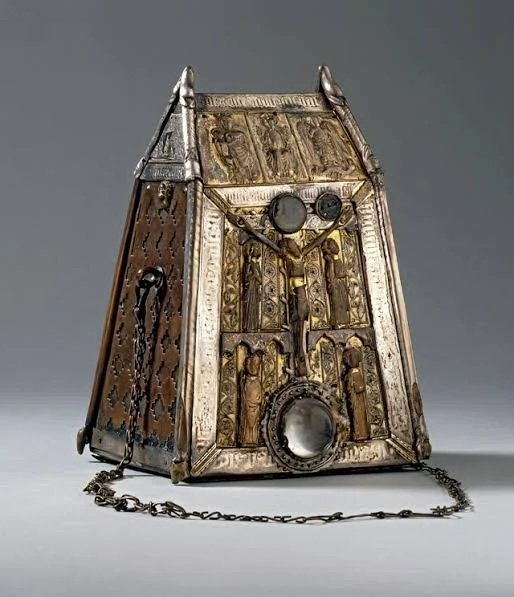
A portable shrine is a compact devotional structure designed to be moved or transported. It may contain a religious image, relic, inscription, or other sacred object.
Examples of portable religious objects from medieval traditions include reliquaries, folding devotional panels, small icon containers, metalwork enclosures, and miniature altars.
Not every portable devotional object is technically a shrine. A distinction should be made between a container for sacred material, an image intended for private devotion, and a structure designed to serve as a temporary sacred space.
The form and function of these objects varied across regions and religious traditions.
2. Pilgrimage Routes as Archaeological Landscapes
Pilgrimage paths were not simply roads leading from one religious destination to another. They were complex landscapes containing bridges, wells, inns, chapels, monasteries, roadside crosses, markets, and temporary resting places.
Religious travelers might stop at several locations during a journey. Some places offered shelter and practical assistance, while others were associated with prayer, healing, or the commemoration of religious events.
Portable shrines could have been used at these stopping points, allowing devotional practices to take place outside permanent religious buildings.
Archaeologists investigate these routes through historical maps, excavated structures, artifacts, and landscape surveys.
3. Materials and Construction
Portable shrines could be made from wood, metal, ivory, bone, stone, or combinations of different materials.
Wooden examples may have included hinged panels, small boxes, or carved enclosures. Metal shrines could feature decorative surfaces, inscriptions, and spaces designed to hold relics.
The choice of material influenced portability, durability, cost, and social meaning. Precious metals and elaborate decoration might indicate access to considerable resources, while simpler wooden objects could have served more modest devotional needs.
Preservation is uneven. Wooden objects are particularly vulnerable to decay, meaning that surviving archaeological examples may not represent the full range of portable shrine traditions.
4. Evidence Along Medieval Travel Routes
Portable shrines are difficult to identify archaeologically because they are small, movable, and often removed from the locations where they were originally used.
Researchers may encounter fragments of decorated metalwork, miniature religious images, hinged fittings, small reliquary containers, or inscriptions associated with devotional practices.
Such objects can appear in settlement deposits, burial contexts, abandoned buildings, and pilgrimage-related sites.
Their interpretation depends on their archaeological context. A metal fitting resembling part of a small shrine might also belong to a box, book cover, or another type of container.
5. The Relationship Between Shrines and Relics
Relics were important elements of medieval Christian devotion, although their significance and treatment varied across time and place.
Portable reliquaries provided secure containers for sacred remains or objects associated with revered religious figures. Some were designed to be displayed, carried in processions, or brought to particular gatherings.
A reliquary could therefore function as part of a portable shrine, but the two terms are not interchangeable.
Archaeologists examine inscriptions, compartments, decorative programs, and historical records to determine whether an object was intended to hold relics or serve another devotional purpose.
6. Private Devotion and Everyday Religious Practice
Portable religious objects could support personal prayer during travel. Pilgrims might carry small icons, crosses, devotional images, or containers associated with a particular sacred place.
Such objects could also provide a means of expressing religious identity in unfamiliar environments.
A traveler might use a portable shrine during an overnight stop, at a temporary shelter, or during a gathering with other pilgrims. However, direct evidence for these specific activities is often limited.
The broader archaeological significance lies in showing that medieval religious practice was not confined to monumental institutions.
7. Social Status and Access to Portable Shrines
The size, material, and decoration of a portable shrine could reflect the wealth or status of its owner.
Elaborate metalwork might have belonged to a monastery, religious official, wealthy patron, or organized pilgrimage group. More modest objects may have been accessible to ordinary travelers.
Portable shrines could also serve communal functions. A religious group might carry a shared devotional object during processions or journeys between sacred sites.
Their ownership and use therefore need to be considered in relation to the wider social organization of medieval pilgrimage.
8. Scientific and Historical Research Methods
Archaeologists combine artifact analysis with documentary and spatial evidence to investigate portable shrines.
Metal composition can be examined using scientific techniques to identify alloys and possible manufacturing traditions. Tool marks and decorative styles may help establish workshop connections.
Inscriptions can provide information about religious dedication, ownership, or the place where an object was produced. Historical inventories and pilgrimage accounts may also mention portable reliquaries or devotional equipment.
GIS mapping can help investigate the distribution of religious artifacts along known pilgrimage routes, although researchers must account for modern collection histories and uncertain find locations.
9. Problems of Attribution and Authenticity
Small religious objects can be difficult to date and identify. A miniature image may belong to a shrine, personal devotional item, or decorative fitting.
Objects discovered outside their original archaeological context may also have been transported long distances, traded, reused, or collected in later periods.
Researchers must therefore avoid assuming that every medieval religious artifact found near a pilgrimage route was used by a pilgrim.
Secure excavation records, material analysis, inscriptions, and comparisons with documented examples provide stronger foundations for interpretation.
Conclusion
Portable shrines offer a valuable perspective on medieval religious life beyond permanent churches and monasteries. They demonstrate how sacred objects could accompany travelers, support private devotion, and contribute to communal religious activities along pilgrimage routes.
Although their small size and mobility make them challenging archaeological subjects, surviving fragments and historical references can reveal important information about craftsmanship, religious identity, ownership, and movement.
Studying portable shrines alongside roads, chapels, inns, and other pilgrimage infrastructure helps reconstruct the everyday religious experiences of medieval travelers.