Introduction
Fire was essential to prehistoric life. It provided warmth, light, protection, and a means of cooking food. In some settings, people also used fire for pottery production, heat treatment of stone, and other technical activities.
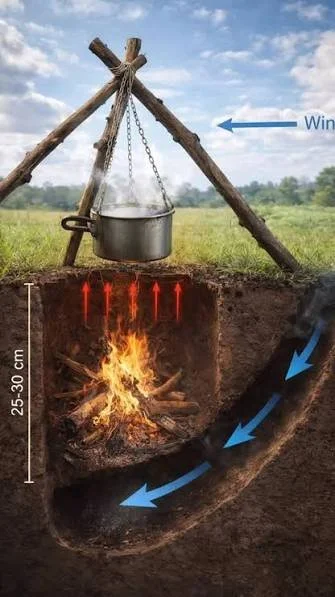
A fire pit located partly or entirely below ground can preserve clues about how people controlled heat and airflow. Some prehistoric cooking methods used heated stones and insulated pits, while other installations incorporated channels, openings, or chambers that influenced combustion.
The phrase "airflow engineering" raises an important research question: how did ancient builders shape fire installations to manage oxygen, temperature, smoke, and heat retention? Such systems may demonstrate practical experimentation, but their precise operation must be reconstructed from archaeological evidence rather than assumed from the feature's shape.
Fire Pits and Prehistoric Cooking
A fire pit is a feature in which fire was maintained within a prepared or naturally formed depression. The simplest pits could be used for cooking, warmth, or other short-term activities.
Some cooking methods involved heating stones in a fire, placing food in a pit, and covering it with heated material and earth. This could retain heat and cook food slowly.
Other pits may have been used for roasting, boiling with heated stones, or preparing large quantities of food.
The function depends on the feature's construction, associated remains, and evidence of repeated use. Not every burned pit was a specialized oven.
Why Airflow Matters
Combustion depends on fuel, heat, and oxygen. If airflow is restricted, a fire may burn less efficiently or produce more smoke. If airflow is too strong, fuel can burn rapidly and heat may be lost.
Ancient builders could influence airflow through the placement of openings, the depth of a pit, the arrangement of fuel, and the use of covers or chambers.
However, a below-ground fire pit does not necessarily contain a designed ventilation system. Many pits rely on natural airflow from an open surface.
Researchers must identify features that could have controlled air movement before describing a pit as an engineered oven.
Subterranean Ovens and Heat Retention
A pit can retain heat by limiting exposure to wind and reducing direct heat loss. Soil surrounding the chamber may also provide insulation.
In some oven designs, heated walls or stones store thermal energy and release it gradually during cooking. The food can continue to cook after the main fire has diminished.
These techniques require practical knowledge of fuel, stone behavior, moisture, and cooking time.
Yet the exact design of a prehistoric oven cannot always be reconstructed from its surviving outline. The original cover, lining, and superstructure may have been made from perishable materials that did not survive.
Archaeological Evidence for Airflow Features
Researchers examine the shape and dimensions of a pit, the presence of channels or openings, heat-altered surfaces, ash deposits, and the relationship between the feature and nearby structures.
A channel leading into a fire chamber might have supplied air, but it could also have served as drainage or resulted from later disturbance.
Microscopic soil analysis can help determine whether the walls experienced repeated heating. The distribution of charcoal and ash may indicate how the fire was maintained.
Evidence of intense or repeated heating can support an interpretation of specialized use, but it does not independently reveal the exact airflow pattern.
Fuel and Temperature
Different fuels burn in different ways. Dry wood, damp wood, grasses, and other combustible materials vary in how quickly they ignite, how much heat they produce, and how much smoke they release.
Charcoal analysis can help identify the wood species used at a site. However, charcoal in a pit may come from several episodes of burning and may not represent the full range of fuel used.
The temperature achieved in an ancient oven can sometimes be estimated through heat-altered materials, mineral changes, or experimental comparison. Such estimates are uncertain because temperature varies within a fire chamber.
Cooking Residues and Food Remains
Animal bones, plant remains, charred seeds, and food residues can help researchers identify what was prepared near a fire pit.
Bone surfaces may show heat alteration, while charred plant material may reveal the use of particular foods. However, food remains can be introduced through later activity or natural processes.
The presence of animal bones near a pit does not prove that the animals were cooked inside it. Researchers must examine burning patterns, depositional context, and spatial relationships.
Where several forms of evidence agree, it may be possible to identify a cooking installation more confidently.
From Cooking to Technical Production
Not all subterranean fire features were used for food. Some may have supported pottery firing, heat treatment, or other technical activities.
A pottery kiln, for example, requires a particular relationship between the fire chamber, fuel, airflow, and the materials being heated. The resulting temperatures and atmosphere influence the properties of the finished pottery.
Researchers distinguish kilns from cooking pits through structural evidence, firing residues, wasters, and associated workshop materials.
A feature that appears to be an oven may have served several purposes over time, so changes in its use should also be considered.
Experimental Reconstruction
Experimental archaeology can test how a reconstructed pit performs under different conditions. Researchers may vary the depth, opening size, fuel type, cover, and arrangement of stones.
They can measure temperature, oxygen availability, heat retention, and cooking outcomes.
These experiments help establish whether a proposed design is technically plausible. However, modern experiments cannot prove that prehistoric people used exactly the same method.
The strongest conclusions emerge when experimental results match archaeological evidence, including heat alteration, construction features, and associated residues.
Community Knowledge and Labor
Building and operating a specialized oven may require cooperation and practical experience. People must understand how to select fuel, prepare the chamber, control the fire, and determine when the food or material is ready.
This knowledge may be transmitted through observation and repeated practice rather than formal instruction.
A large oven could support communal food preparation or specialized production, but its size does not automatically indicate centralized control. Small household installations can also reflect sophisticated knowledge.
Conclusion
Subterranean fire pits provide valuable evidence of prehistoric cooking, heating, and technical production. Their construction can reveal how people used soil, stone, fuel, and airflow to manage heat.
The idea of airflow engineering is useful when a feature contains evidence of deliberately controlled ventilation, but not every underground pit should be treated as a sophisticated oven. Channels, chambers, and burned surfaces must be interpreted within their archaeological context.
By combining excavation, soil analysis, residue study, and experimental reconstruction, researchers can investigate how prehistoric communities adapted fire to different tasks. These installations demonstrate that practical knowledge of heat and combustion could develop through repeated experimentation long before the principles were expressed in modern scientific terms.