Introduction
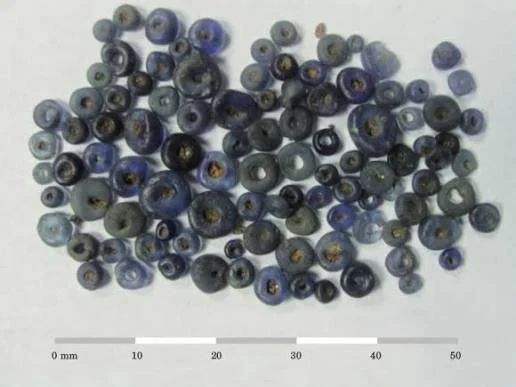
Glass beads have played important roles in personal adornment, exchange, identity, and artistic expression across many African societies. Small beads can be deceptively informative: their composition, shape, color, and manufacturing marks may reveal specialized knowledge, trade connections, and the movement of materials between communities.
The archaeology of small-scale glass bead production investigates how beads were manufactured, repaired, circulated, and used. Africa's bead-making traditions are diverse, extending across different periods and regions. Some communities produced beads from locally available materials, while others used imported glass or recycled glass objects.
It is important, however, to distinguish bead production from bead consumption. Finding glass beads at a settlement does not prove that they were made there. Evidence such as unfinished beads, glass-working waste, furnaces, crucibles, and production tools is needed to identify manufacturing sites confidently.
Glass Beads and Their Cultural Importance
Glass beads can be produced in a wide variety of colors, shapes, and sizes. Their appearance depends on the raw materials, manufacturing process, and skill of the craftsperson.
People may use beads for necklaces, bracelets, clothing decoration, ceremonial objects, and other forms of adornment. Beads can also be exchanged as gifts, used in trade, or associated with social relationships and cultural traditions.
Their significance varies between communities. In some settings, particular colors or bead arrangements may be associated with life stages, marriage, status, or spiritual practice. These meanings should be established through local historical and cultural evidence rather than assumed from appearance alone.
How Glass Beads Are Made
Glass is generally produced by heating silica-rich material with other ingredients that help create a workable substance. Color can be influenced by mineral additives, while the properties of the finished glass depend on composition and firing conditions.
Bead-making methods vary. Glass may be shaped around a rod, drawn into a long tube and cut into segments, wound into a form, or processed through other techniques. The selected method influences the bead's shape, hole, surface texture, and manufacturing marks.
Some beads may be produced in specialized workshops, while others are made in smaller settings using equipment adapted to local conditions.
Identifying Production Sites
Archaeologists need more than finished beads to establish that production occurred at a particular location. Important evidence may include:
Unfinished beads and rejected pieces.
Glass fragments with manufacturing characteristics.
Crucibles or other heat-resistant equipment.
Furnaces or hearths suitable for glassworking.
Waste from cutting, shaping, or reheating beads.
Concentrations of raw glass or recycled glass fragments.
The relationship between these materials matters. A single bead found near a hearth could have been lost or discarded after use, while a concentration of unfinished pieces and production waste is more suggestive of manufacturing.
Researchers must also consider whether a workshop produced beads or worked with glass for other purposes.
Local Production and Imported Materials
Glass bead production does not always require the local manufacture of glass from its original raw ingredients. Craftspeople may work with imported glass, recycled fragments, or partially prepared material.
This distinction is important when reconstructing economic networks. A community might have specialized in bead shaping without controlling the production of the glass itself.
Chemical analysis can help compare glass compositions and investigate possible sources. Yet similar compositions may occur in several production regions, and recycled glass can combine materials from different origins.
A chemical match therefore does not always identify a single workshop or direct trade route.
Small Workshops and Specialized Knowledge
Small-scale production may have taken place in household settings, craft quarters, or specialized work areas. The scale of production can be difficult to determine because furnaces and tools may have been reused for different tasks.
Bead-making requires control over temperature, timing, material selection, and shaping. Consistent production may depend on experience and the transmission of technical knowledge.
The presence of specialized equipment suggests that people understood how to work with glass, but it does not automatically reveal whether the craft was a full-time occupation or one activity among several.
Researchers can investigate production scale through the quantity of waste, the range of bead types, workshop organization, and evidence of repeated use.
African Bead Traditions and Regional Diversity
African bead traditions should not be treated as a single uniform system. Different societies developed distinct uses for beads, and the relationship between local production and imported materials changed over time.
In some regions, beads were produced locally from glass or other materials. Elsewhere, imported beads became important components of exchange networks and personal adornment.
The archaeological record also reflects unequal preservation and research coverage. Some areas have been studied extensively, while others remain less well documented.
A responsible interpretation recognizes regional diversity and avoids attributing one community's bead traditions to an entire continent.
Beads, Trade, and Exchange
Beads are portable and durable, making them useful objects for studying the movement of goods. They can travel through markets, gift exchanges, migration, pilgrimage, and long-distance trade.
A bead discovered far from a likely production region may indicate that materials or finished products moved through an exchange network. However, it does not necessarily show that the bead traveled directly from the manufacturer to the final user.
Goods may pass through several intermediaries, and beads can be retained for long periods before being deposited.
Researchers can compare bead composition, manufacturing style, and distribution patterns to investigate possible connections between communities.
Chemical Analysis and Technological Change
Scientific methods can identify elements and compounds within glass. Techniques such as X-ray fluorescence, scanning electron microscopy with elemental analysis, and other laboratory methods may help researchers compare different groups of beads.
These analyses can investigate colorants, glass composition, and possible manufacturing traditions.
However, a chemical composition is not a direct record of a craftsperson's identity or intention. Similar materials can be used by different workshops, while recycling can blur the distinction between production sources.
The strongest conclusions combine chemistry with manufacturing evidence, chronology, and archaeological context.
Conservation and Ethical Research
Glass beads are often durable, but they can still be damaged by corrosion, salt deposits, impact, and inappropriate cleaning. Excavation and handling should be planned carefully, especially when beads are extremely small or attached to fragile materials.
Research should also consider the cultural significance of beadwork to descendant and local communities. Objects may retain meanings that extend beyond their archaeological classification.
Collaborative interpretation can help prevent culturally important artifacts from being reduced to trade indicators alone.
Conclusion
The archaeology of small-scale glass bead production in Africa provides valuable evidence for craft technology, material sourcing, economic exchange, and cultural expression. Unfinished beads, production waste, furnaces, and chemical analysis can help distinguish manufacturing centers from places where finished beads were simply used or traded.
Yet the evidence must be interpreted within its regional and historical context. Imported glass, recycled materials, and the movement of finished beads complicate attempts to identify a single source or route.
By combining scientific analysis with archaeological context and community knowledge, researchers can reconstruct how bead-making skills developed and how beads connected people across different landscapes. These small objects can reveal extensive networks of craftsmanship and exchange while preserving the diversity of African cultural histories.