The mummies of the Tarim Basin are among the most extraordinary archaeological discoveries in Central Asia. Found in the extremely dry deserts of present-day Xinjiang, northwestern China, some of these individuals survived for nearly four millennia because of the region's exceptionally arid environment. Unlike the deliberately embalmed mummies of ancient Egypt, many of the Tarim Basin mummies were naturally preserved. Dry air, salty soils, and other environmental conditions slowed the decomposition of soft tissues, allowing archaeologists to recover remarkably detailed evidence of prehistoric and early historic populations.
The discovery of these mummies transformed the study of ancient Xinjiang. Their preservation allows researchers to investigate not only skeletal remains but also hair, clothing, textiles, food residues, burial objects, and, increasingly, ancient DNA. Together, these sources have revealed a complex history of human communities living at the intersection of eastern Eurasia, the Eurasian steppe, and the routes that would eventually become associated with the Silk Road.
The Tarim Basin and Its Extreme Environment
The Tarim Basin is a vast geographical region surrounded by some of Asia's most dramatic mountain systems. At its center lies the Taklamakan Desert, one of the world's largest sandy deserts.
For prehistoric communities, this was a demanding environment. Permanent settlement depended heavily on access to water, particularly around rivers, oases, and the edges of the basin.
Yet the same dry environment that made life challenging also created exceptional conditions for archaeological preservation. Organic materials that would normally decay—including wood, leather, wool, and human tissue—could survive for thousands of years.
This preservation has made the Tarim Basin an archaeological archive unlike almost any other.
Natural Mummification
The Tarim Basin mummies were generally not preserved through artificial embalming in the Egyptian sense.
Instead, environmental conditions played the primary role.
The process of natural mummification was aided by factors such as:
extremely low humidity,
dry desert air,
saline soils,
rapid dehydration of bodies,
and limited biological activity capable of causing decomposition.
As moisture disappeared from the body, the tissues dried and became naturally preserved.
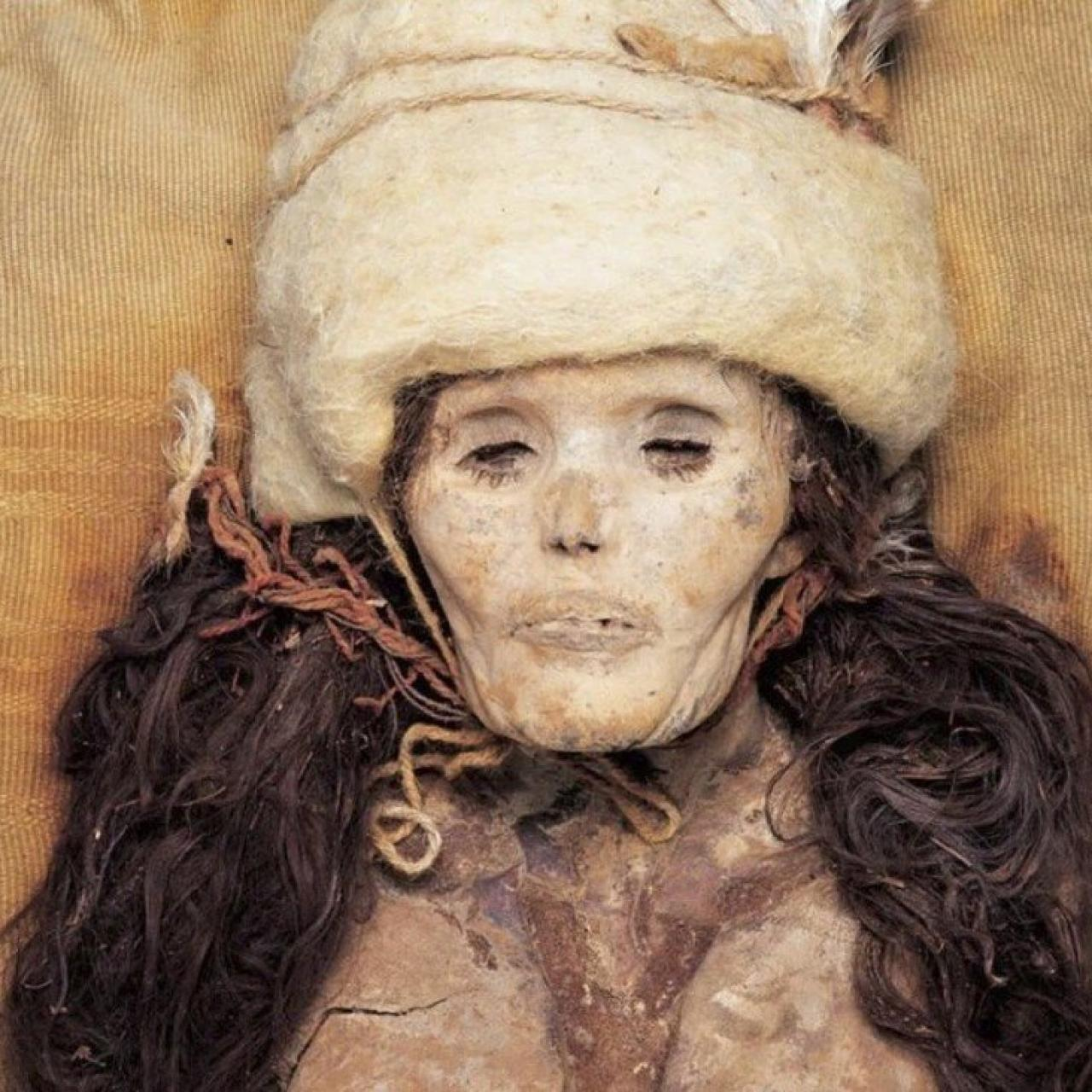
In some cases, facial features, hair, and clothing remained recognizable after thousands of years.
What Did the Mummies Look Like?
The physical appearance of some early Tarim Basin mummies attracted enormous attention because several individuals possessed features that earlier observers associated with western Eurasian populations, including light or brown hair and particular facial characteristics.
For many years, these observations led to theories suggesting that the earliest inhabitants of the region were recent migrants from western Eurasia.
However, appearance alone cannot reliably determine ancestry.
Modern ancient-DNA research has significantly changed the discussion by showing that the genetic history of the Tarim Basin's ancient populations was more complex than earlier interpretations suggested.
Ancient DNA and the Tarim Basin
Genetic studies of ancient individuals from the Tarim Basin have provided important evidence about their ancestry.
Research has indicated that some Early Bronze Age populations of the region were genetically distinctive and carried substantial ancestry connected to deeply ancient northern Eurasian populations rather than representing a simple recent migration from western Europe or the Eurasian steppe.
This finding is important because it demonstrates the difference between cultural connections and biological ancestry.
A population may adopt technologies, clothing styles, agricultural practices, or trade relationships from neighboring societies without being directly descended from those groups.
The Tarim Basin therefore illustrates the danger of making historical conclusions based solely on physical appearance or material culture.
Clothing and Textile Technology
One of the most remarkable aspects of the Tarim Basin mummies is the preservation of clothing.
Archaeologists have recovered materials including:
wool textiles,
felt,
leather,
fur,
woven garments,
and carefully constructed footwear.
These materials reveal advanced knowledge of textile production.
The creation of woven cloth required access to raw fibers, knowledge of spinning, and techniques for producing durable fabrics.
Clothing was essential in the extreme climate of Central Asia, where temperatures could vary dramatically between seasons.
At the same time, clothing could also communicate cultural identity.
Patterns, colors, and styles may have reflected community traditions or social practices.
Agriculture and Animal Husbandry
The ancient communities of the Tarim Basin were not isolated from broader developments in Eurasian food production.
Archaeological evidence indicates the use of domesticated crops and animals.
Different populations interacted with agricultural traditions originating in both eastern and western parts of Eurasia.
Important food resources included grains such as:
wheat,
barley,
and millet in various regional and chronological contexts.
The spread of crops across Eurasia represents one of the most important processes of prehistoric cultural exchange.
Plants that originated in one part of the continent could eventually be cultivated thousands of kilometers away.
Dairy and Animal Resources
Some archaeological evidence from the Tarim Basin also indicates the importance of domesticated animals and dairy-related practices.
Herding could provide communities with:
meat,
milk,
hides,
wool,
and transportation.
The relationship between agriculture and pastoralism allowed ancient communities to adapt to the difficult environmental conditions of Central Asia.
Rather than relying on a single economic strategy, populations could combine different methods of obtaining food.
Burial Practices
The Tarim Basin mummies were often buried with carefully selected objects.
Burial goods can include:
clothing,
baskets,
food,
wooden objects,
animal materials,
and other personal or symbolic items.
These objects provide evidence about how communities responded to death.
However, archaeologists must be cautious when interpreting burial goods. An object placed beside a deceased individual may have held practical, social, ritual, or symbolic significance.
Without written records from the earliest periods, the precise meaning cannot always be recovered.
The Importance of the Tarim Basin Mummies
The Tarim Basin mummies are important because they preserve multiple forms of evidence in one archaeological context.
Researchers can study:
human biology,
genetics,
clothing,
technology,
agriculture,
diet,
and burial customs.
Few prehistoric discoveries provide such a detailed picture of ancient daily life.
The mummies also demonstrate that ancient Central Asia was not an empty space between major civilizations.
It was home to communities with their own histories, technologies, and cultural traditions long before the development of the famous Silk Road networks.
Conclusion
The Tarim Basin mummies provide an extraordinary window into life in prehistoric Xinjiang. Naturally preserved by the extreme environment of the Taklamakan region, these individuals have survived for thousands of years alongside the objects and clothing associated with their lives and burials.
Modern archaeological and genetic research has shown that their history cannot be explained through simple assumptions about appearance or migration. Instead, the ancient Tarim Basin was shaped by distinctive local populations and long-distance cultural connections.
These remarkably preserved individuals continue to reshape our understanding of prehistoric Eurasia, revealing that even one of the world's harshest deserts was home to complex and resilient human communities.