Introduction
Central Asia contains a wide range of environments, including mountain valleys, open grasslands, deserts, river systems, and high plateaus. These landscapes have supported mobile communities for thousands of years. In different periods, people moved to exploit seasonal resources, follow animal herds, exchange goods, and reach water or sheltered areas.
The archaeology of seasonal hunting corridors investigates how people may have used recurring routes to reach hunting grounds or move between ecological zones. Such corridors could be shaped by animal migration, terrain, water availability, vegetation, and human knowledge passed between generations.
However, an archaeological route is not automatically a hunting corridor. Establishing its purpose requires evidence of movement and hunting, along with a reliable understanding of the landscape and its changing conditions.
Why Seasonal Movement Matters
Many animals change their location according to season. They may move toward higher elevations during warmer months, descend to lower valleys in winter, or travel between feeding and breeding areas.
Human communities can respond to these patterns by organizing hunting activities around predictable movements. Rather than searching randomly for animals, hunters may travel to locations where herds are more likely to pass.
Seasonal mobility can also help people balance different resources. A community might hunt in one area during part of the year and gather plants, fish, or other resources elsewhere.
The timing and distance of these movements vary considerably. Not every community moved over long distances, and some hunting took place close to residential settlements.
Central Asia's Diverse Landscapes
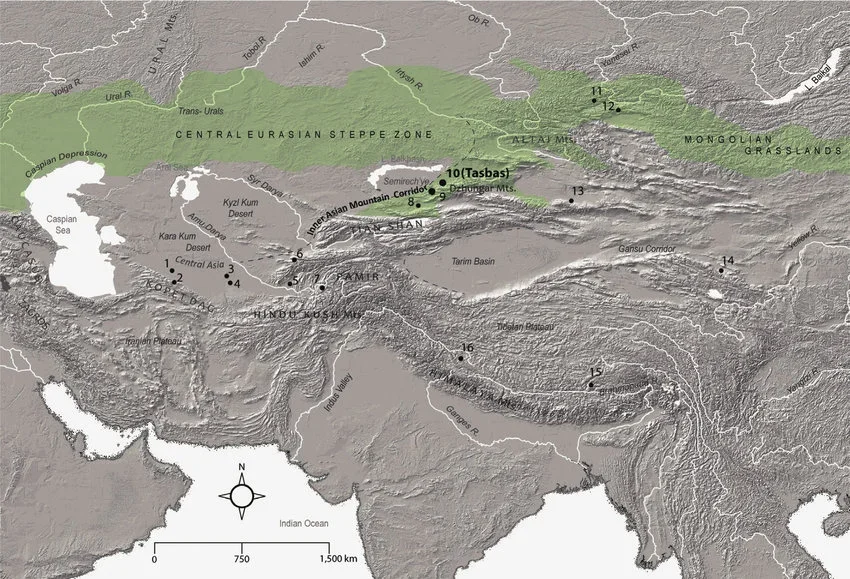
Central Asia is not a single ecological region. Its mountain systems, steppe zones, desert margins, and river valleys differ in climate, vegetation, and water availability.
Mountain passes can channel movement through narrow routes. River valleys may provide water and grazing. Open plains can support large herds but may offer limited shelter. Desert environments impose particular constraints on travel and require detailed knowledge of reliable water sources.
These differences shape where hunting corridors might develop. A route that works in one region may be unsuitable elsewhere.
Researchers must therefore reconstruct local environmental conditions rather than treating all Central Asian hunting practices as part of one uniform tradition.
How Archaeologists Identify Possible Corridors
Evidence for ancient movement can come from several sources. Archaeologists may map concentrations of stone tools, animal bones, hunting structures, temporary shelters, and repeated activity sites across a landscape.
A sequence of sites along a valley could suggest regular movement. If these locations also contain evidence of animal processing or hunting equipment, the interpretation may become stronger.
However, spatial patterns have alternative explanations. Sites may cluster near water, raw-material sources, or naturally sheltered places even when no formal corridor existed.
A convincing interpretation requires the relationship between the sites, the landscape, and the archaeological materials to be examined together.
Stone Tools and Hunting Technology
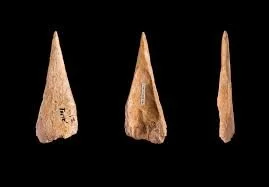
Stone tools can reveal how people processed animals and maintained hunting equipment. Projectile points, cutting tools, scrapers, and other implements may be associated with hunting and carcass processing.
The precise function of a tool is not always obvious. Similar forms can be used for different tasks, and a tool's shape may change as it is resharpened.
Researchers can examine wear patterns, residues, manufacturing methods, and the location of tools within a site. When combined with animal remains, this evidence can help reconstruct hunting activities.
Nevertheless, the presence of projectile points alone does not establish that a site was a seasonal hunting camp. The objects may have been carried there for other reasons or deposited during a later occupation.
Animal Remains and Hunting Practices
Animal bones can provide important information about the species hunted, the age and condition of animals, and the way carcasses were processed.
Patterns in the age or sex of animals may sometimes suggest selective hunting, although natural mortality and preservation biases must be considered. Cut marks, impact damage, and the distribution of skeletal parts can help researchers understand butchery and transport.
If particular species appear at multiple sites along a possible corridor, the pattern may support a connection with animal movement. Yet changes in species abundance can also reflect climate, habitat, or differences in preservation.
Zooarchaeological evidence must therefore be interpreted alongside environmental data.
Temporary Camps and Repeated Visits
Seasonal hunting sites may have been occupied briefly and repeatedly. Their remains can be sparse compared with those of permanent settlements.
Evidence may include small hearths, lightweight structures, tool-maintenance areas, food-processing remains, and localized concentrations of artifacts.
Repeated visits can sometimes be identified through overlapping occupation layers or patterns of deposition. However, several episodes of activity may be difficult to separate, especially when erosion or later disturbance has mixed the deposits.
Researchers should avoid assuming that every small site was temporary or that every temporary site was associated with hunting.
Environmental Reconstruction
The ancient environment may have differed substantially from the modern landscape. Climate shifts, changes in vegetation, river movement, and human land use can alter the routes available to both people and animals.
Researchers can investigate these changes through pollen, charcoal, sediment cores, animal remains, and other environmental indicators.
Digital terrain models and geographic information systems can help analyze slopes, passes, water sources, and possible travel routes. Such tools can identify plausible corridors, but they do not independently prove that people used them.
The models must be tested against archaeological evidence.
Hunting Corridors and Social Knowledge
Successful hunting often depends on shared knowledge. People may know when animals are likely to move, which passes they use, where water is available, and how weather affects travel.
This information can be passed between generations through storytelling, instruction, repeated journeys, and practical experience.
A corridor may therefore represent more than a physical route. It can also reflect a body of knowledge about animals, seasons, and landscape.
Yet archaeologists cannot directly recover the complete content of that knowledge. They can investigate its possible material consequences while acknowledging the limits of the evidence.
Corridors as Routes of Exchange
Movement for hunting may overlap with routes used for other purposes. People traveling between valleys could also exchange tools, raw materials, food, and information.
This does not mean that every hunting corridor functioned as a major trade route. The importance of a route may have changed over time, and different groups may have used the same passage for different reasons.
Comparing artifacts across sites can help researchers investigate these possibilities. Similar materials may suggest interaction, but they do not necessarily demonstrate direct contact between the people who deposited them.
Conclusion
The archaeology of seasonal hunting corridors in Central Asia provides a way to explore how people adapted to varied environments and coordinated their activities with animal movement. Stone tools, animal remains, temporary camps, and landscape analysis can help identify possible routes and patterns of seasonal use.
However, a corridor must be demonstrated rather than assumed. Environmental conditions can change, and archaeological site distributions may reflect several different activities.
The strongest reconstructions combine material evidence with environmental history and careful spatial analysis. They reveal how mobility could support survival, how landscape knowledge accumulated over generations, and how the same routes might connect hunting grounds with wider networks of human interaction.