Introduction
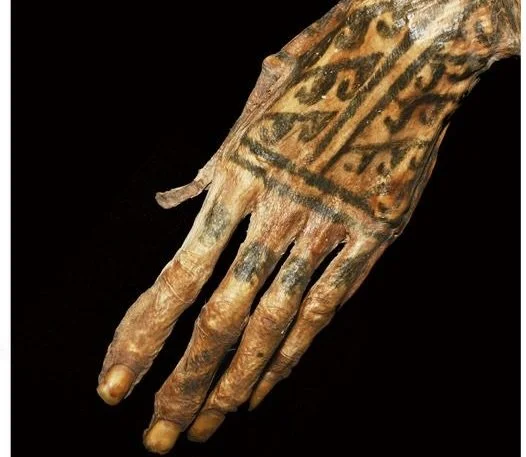
Tattooing is one of the oldest known forms of permanent body modification. Across different societies, tattoos have been used to express identity, social position, spiritual beliefs, personal achievement, healing practices, or aesthetic preferences. When tattooed skin survives through natural or deliberate mummification, researchers gain a rare opportunity to investigate the materials and techniques used to create these markings.
The bioarchaeology of tattoo pigments combines the study of human remains with chemistry, microscopy, conservation science, and cultural interpretation. It can reveal how pigments entered the skin, what materials were used, and how tattooing practices varied across time and place.
However, pigment identification alone rarely establishes what a tattoo meant to its wearer. Scientific evidence must be interpreted alongside archaeological context and the cultural history of the individual or community.
How Tattoo Pigments Become Preserved
Tattooing generally involves introducing pigment into the skin so that particles remain within deeper layers after the surface heals. The original material may be mineral-based, carbon-based, or derived from other substances available to the tattooist.
Ordinary burial conditions often destroy skin before tattoos can be studied. Preservation is more likely when environmental conditions slow decomposition. These may include extreme cold, dryness, oxygen-poor environments, or deliberate mummification.
Different preservation environments create different research challenges. Frozen skin may retain fine anatomical details, while dry skin can become fragile and shrink. Chemical treatment during mummification may also alter the appearance or composition of pigments.
Consequently, the material visible on a preserved body may not perfectly represent the tattoo's original appearance.
Identifying Pigments Through Scientific Analysis
Researchers can use several methods to investigate tattoo materials. Microscopy may reveal the distribution of particles within preserved skin. Chemical analysis can help identify elements or compounds associated with particular pigments.
Potential methods include:
Optical microscopy: Examines the placement and appearance of pigment particles.
Scanning electron microscopy: Provides detailed images of skin structure and pigment distribution.
Energy-dispersive X-ray spectroscopy: Identifies elements present in analyzed areas.
Raman spectroscopy: Can help distinguish certain molecular and mineral compounds.
X-ray fluorescence: Detects elements in a sample, although it may not independently identify a specific pigment compound.
No single technique answers every question. For example, detecting carbon does not necessarily establish the exact source of a black pigment. Carbon could come from soot, charcoal, or another carbon-rich material.
Reliable identification often requires multiple analytical techniques and careful comparison with known materials.
Mineral, Carbon, and Organic Pigments
Ancient tattooists could use materials obtained from their local environments. Carbon-rich substances were possible sources of dark pigment, while certain mineral compounds could produce different colors.
The exact palette depended on geography, trade, available technology, and cultural preference. Some materials might have been collected directly from the landscape, while others could have required processing.
Organic pigments present particular difficulties because many degrade over time. Even when a tattoo survives, its original color may have changed through exposure to moisture, oxygen, temperature fluctuations, or conservation treatments.
Researchers must therefore avoid assuming that a modern visual examination reveals the full original color range.
Tattooing Techniques and Skin Structure
Tattooing techniques vary. Pigment may be introduced through repeated punctures, cuts, or other forms of controlled skin penetration. Archaeological interpretations sometimes compare tattoo patterns with known tools, but a tool's shape alone rarely proves its exact purpose.
Microscopic examination may help distinguish pigment embedded within the skin from material deposited on the surface after death. This distinction is crucial because burial substances, conservation chemicals, and environmental contaminants can produce misleading results.
Researchers must also take care when sampling mummified skin. Sampling can damage an exceptionally rare specimen, so non-destructive methods are generally preferable whenever they can answer the research question.
What Tattoos Can Reveal About Identity
Tattoos can provide clues about the ways people represented themselves and their relationships with others. Repeated designs might be associated with shared cultural practices, while individual markings could reflect personal choices.
However, the meaning of a design cannot be inferred confidently from appearance alone. Geometric shapes, animals, lines, and dots may have different meanings in different societies. Similar patterns can also arise independently.
Interpretation becomes stronger when tattoo designs are considered alongside burial practices, clothing, jewelry, written accounts, and evidence from other individuals within the same cultural context.
Even then, the distinction between an individual's personal meaning and a community-wide convention may remain difficult to establish.
Tattoos, Healing, and Ritual
Some historical and ethnographic accounts describe tattooing in connection with healing, protection, rites of passage, or religious identity. These comparisons can generate useful research questions, but they cannot automatically explain ancient tattoos.
A tattoo located near a joint, for example, does not by itself demonstrate a therapeutic purpose. The location might reflect aesthetic preference, symbolic meaning, or a cultural convention that is no longer understood.
Evidence for healing-related tattooing would need to come from a combination of anatomical placement, relevant historical or ethnographic documentation, and broader contextual analysis.
Researchers should also avoid treating all tattooed individuals within one region or period as members of a single ritual tradition.
The Importance of the Individual
Bioarchaeological research is most meaningful when human remains are treated as evidence of individual lives rather than merely as scientific specimens.
Age, sex estimation where appropriate, health indicators, burial context, and associated objects may help researchers understand the circumstances of a person's life. These details should be interpreted cautiously, especially when preservation is incomplete.
Where descendant communities or cultural custodians can be identified, their perspectives should be included in decisions about analysis, display, sampling, and publication.
Scientific interest does not eliminate ethical responsibilities toward human remains.
Contamination and Conservation
Mummified skin can contain materials introduced after death. Soil minerals, conservation chemicals, handling residues, and substances used during embalming may complicate pigment analysis.
Before attributing a chemical signature to a tattoo, researchers must consider whether the substance could have come from another source.
Conservation is equally important. Repeated sampling, exposure to unsuitable lighting, changes in humidity, and poorly chosen cleaning methods may damage the remains.
A good research program therefore establishes preservation conditions, documents all interventions, and uses the least destructive analytical methods possible.
Limits of Bioarchaeological Interpretation
Pigment analysis can answer questions about material composition, but it cannot independently reconstruct an entire tattooing tradition.
It may identify a pigment consistent with a particular mineral, but this does not necessarily reveal where the material was collected. The pigment could have been traded, mixed with other ingredients, or obtained from several sources.
Likewise, a chemically distinctive pigment does not prove that tattooing was restricted to an elite group or used exclusively for ritual purposes.
The strongest conclusions are those that distinguish direct observations from interpretations and acknowledge where evidence remains incomplete.
Conclusion
The bioarchaeology of ancient tattoo pigments in mummified skin opens a rare window into body modification, material technology, and personal expression in the past. Scientific analysis can reveal pigment composition, its distribution within preserved tissue, and possible methods of application.
Yet chemistry is only one part of the story. Understanding tattoos also requires archaeological context, careful study of human remains, and respect for the cultural identities associated with them.
When these forms of evidence are combined responsibly, ancient tattoos can help researchers investigate how people marked their bodies, expressed belonging, and carried meaningful designs through life. Their exact significance may remain uncertain, but the surviving pigments offer valuable evidence of human creativity and the enduring importance of the body as a medium of expression.