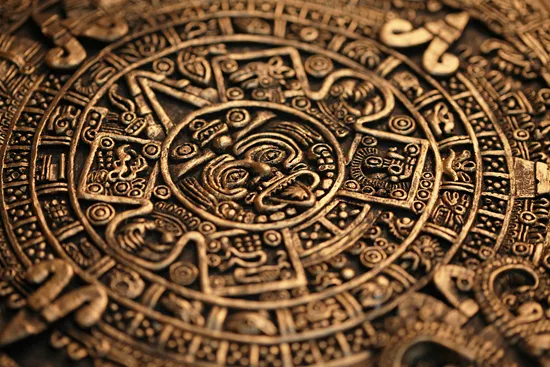
The Maya developed one of the most complex and accurate calendar systems in the ancient world, reflecting their advanced understanding of astronomy and mathematics. Their timekeeping was not used merely for counting days but was deeply connected to religion, agriculture, and political authority. The Maya believed time was cyclical rather than linear, meaning events repeated themselves in predictable cosmic patterns. This belief shaped how they interpreted history and future events.
The Maya calendar system consisted of several interlocking cycles. The Tzolk’in, a 260-day ritual calendar, was used for religious ceremonies and divination. The Haab’, a 365-day solar calendar, governed agricultural activities such as planting and harvesting. These two calendars worked together in a 52-Haab’ cycle known as the Calendar Round, after which dates repeated. For longer historical records, the Maya used the Long Count calendar, which tracked time across vast periods using a base-20 mathematical system.
Astronomical observations were central to Maya timekeeping. They closely tracked the movements of the sun, moon, Venus, and other celestial bodies. Many temples and pyramids were aligned with solstices, equinoxes, and planetary cycles. The calendar reinforced royal power, as rulers used important dates to legitimize their reigns through ritual and monument inscriptions. The Maya calendar stands as a remarkable achievement, demonstrating how science, religion, and governance were deeply intertwined.