Introduction
Salt has been essential to human societies for thousands of years. It played a major role in food preservation, animal husbandry, trade, domestic activities, and various forms of manufacturing.
Before modern industrial production, communities obtained salt through different methods depending on their environments. Some collected salt from coastal evaporation areas, while others extracted it from underground deposits, saline springs, salt lakes, or mineral-rich soils.
One method involved the use of extraction pits, where people collected, processed, or concentrated salt-bearing materials. These installations can be difficult to interpret because similar pits may have served other purposes, including food preparation, storage, or the extraction of different minerals.
The forensic study of ancient salt extraction pits combines archaeological excavation, soil chemistry, microscopic analysis, and environmental reconstruction to identify how these installations functioned.
The Importance of Ancient Salt Production
Salt was valuable because it served multiple purposes.
It could preserve meat and fish, improve the storage life of certain foods, and support the management of livestock. It was also used in particular craft and industrial processes.
In regions without abundant natural salt sources, communities might have traveled considerable distances to obtain it.
Salt production could therefore become an important economic activity. Some communities specialized in extraction, while others participated through transportation, exchange, or the processing of salt-bearing materials.
The scale of production varied considerably, from household-level activities to organized operations serving wider markets.
Understanding Extraction Pits
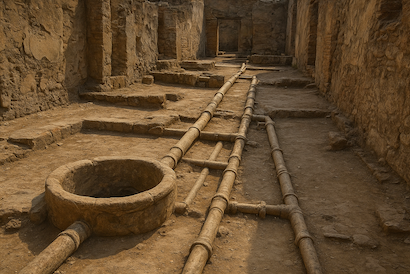
An extraction pit is a hollow or excavated feature associated with obtaining or processing a resource.
In salt production, pits may have been used to collect saline water, expose salt-bearing deposits, concentrate brine, or temporarily hold materials during processing.
Their design depended on the geological setting and the production method.
Some pits may have been relatively shallow, while others could have required substantial excavation. Their walls might have been reinforced with clay, stone, timber, or other materials.
However, a pit's shape alone cannot establish that it was used for salt extraction.
Archaeologists need evidence connecting the feature with salt-bearing materials and the activities associated with production.
Geological Sources of Salt
Salt occurs in several natural environments.
Underground deposits may form through the evaporation of ancient bodies of seawater. These deposits can sometimes be accessed through mining or extraction.
Saline springs provide another source. Water passing through salt-bearing geological layers may dissolve minerals and emerge as brine.
Coastal areas and salt lakes can also contain concentrated saline water or salt-rich sediment.
Each source requires different extraction techniques.
A pit used to collect spring water would differ from a feature excavated into a geological salt deposit.
Identifying Salt-Related Residues
Chemical analysis can help determine whether a pit was associated with salt production.
Researchers may examine concentrations of sodium and chloride, as well as other elements that could reflect the local geological environment.
However, sodium and chloride are common in many natural settings. Their presence alone does not prove ancient salt extraction.
Seawater intrusion, modern pollution, groundwater movement, and natural evaporation can all introduce salts into archaeological deposits.
The strongest interpretation combines chemical evidence with pit construction, surrounding deposits, and associated artifacts.
Microscopic Evidence
Microscopic analysis can reveal details that are difficult to observe during ordinary excavation.
Thin sections of sediment may show changes in grain structure, compacted surfaces, ash layers, or mineral crystals.
Micromorphology allows researchers to examine the arrangement of microscopic components within an undisturbed soil sample.
This can help identify whether a pit was repeatedly heated, filled with sediment, exposed to water, or used for different activities over time.
In some cases, microscopic evidence may distinguish deliberate construction from natural erosion.
Evidence of Heating and Evaporation
Some salt production methods rely on evaporating brine through heating.
If an extraction pit was part of such a process, nearby deposits may contain ash, charcoal, heat-altered sediment, or fragments of heating installations.
However, not every salt-producing community used fuel-intensive evaporation.
Solar evaporation may have been practical in hot, dry environments, while other regions relied on boiling brine.
The archaeological evidence must therefore be interpreted according to local environmental conditions.
Associated Tools and Containers
Salt production may involve baskets, pottery vessels, wooden containers, grinding tools, or implements used to collect and transport raw materials.
Fragments of ceramic vessels can be particularly informative.
Repeated heating may produce distinctive patterns of discoloration, cracking, or residue accumulation.
Yet ordinary cooking pots can show similar damage.
Researchers compare vessel residues, shapes, and archaeological contexts to investigate whether particular containers were used in salt processing.
Reconstructing the Production Sequence
A salt extraction site may contain evidence for several stages of production.
These could include collecting saline water or sediment, separating unwanted material, concentrating brine, evaporating water, and collecting the resulting salt.
Different activities might take place in separate areas.
For example, an extraction pit could be located near a spring, while evaporation and storage occurred elsewhere.
Researchers therefore examine the wider site rather than interpreting each pit independently.
Spatial analysis can reveal relationships between pits, hearths, work surfaces, storage features, and transportation routes.
Dating Salt Extraction Pits
Dating these installations can be challenging.
Organic materials such as charcoal, seeds, or wood fragments may be recovered from secure deposits within or around a pit.
Radiocarbon dating can provide chronological information when the material is directly associated with the feature.
Pottery and other artifacts may also help establish a relative date.
However, later activity can introduce younger or older material into an archaeological deposit. Researchers must therefore establish the stratigraphic relationship between samples and the original construction or use of the pit.
Economic and Social Organization
Salt extraction could involve different forms of labor organization.
A household might collect salt for its own needs, while a larger community could coordinate seasonal production.
More extensive operations may have required specialized workers, fuel collection, transport, and storage.
The distribution of salt-producing sites can reveal patterns of economic interaction.
If salt from one region appears in settlements far away, it may indicate trade or exchange networks.
Chemical analysis can sometimes help investigate the origin of salt residues, although identifying an exact source is often difficult.
Conclusion
The forensics of ancient salt extraction pits offers a way to reconstruct an important but often overlooked aspect of prehistoric and historical economies.
Through chemical testing, microscopic analysis, excavation, and environmental reconstruction, archaeologists can investigate how communities obtained and processed salt.
The presence of saline residue is not enough to identify a salt-production site. Reliable conclusions require multiple lines of evidence, including the structure of the pits, associated installations, artifacts, and geological context.
These investigations help reveal how communities transformed natural resources into valuable commodities and how salt production contributed to household economies, specialized labor, and long-distance exchange.