Roman Togas and Tunics: The Social Significance of Ancient Clothing
In ancient Rome, clothing was far more than a matter of fashion or comfort; it was a visual shorthand for a person’s rank, citizenship, and moral standing. To look at a Roman was to immediately understand their place in the complex social hierarchy.
1. The Tunic: The Universal Base Layer
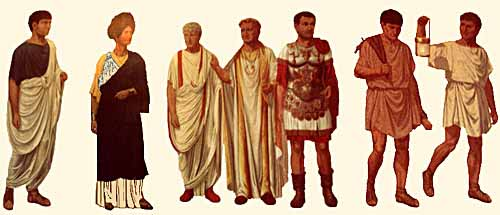
The tunic (tunica) was the basic garment for all levels of society, from slaves to the Emperor. It was a simple, T-shaped garment made of two wool panels sewn together.
The Working Class: Laborers and slaves wore shorter tunics, often belted, to allow for freedom of movement. They were typically made of coarse, dark wool.
The Senatorial Stripes: High-ranking Romans wore tunics with vertical purple stripes called clavi.
Laticlavus: A broad purple stripe indicated a member of the Senatorial class.
Angusticlavus: Narrower stripes indicated the Equestrian (knightly) class.
2. The Toga: The Badge of Citizenship
The toga was the most iconic Roman garment, but it was strictly reserved for male Roman citizens. To wear one was a privilege; to be forbidden from wearing one was a sign of exile or loss of status.
Design and Difficulty: A toga was a massive semi-circular piece of fine wool, roughly 18 feet wide. It was not pinned or buttoned but meticulously draped over the body. It was heavy, hot, and required the wearer to keep their left arm partially tucked to hold the folds in place—a physical manifestation of the "dignity" expected of a citizen.
The Toga as a Political Tool:
Toga Virilis: A plain off-white wool toga worn by adult citizens.
Toga Praetexta: Featuring a purple border, worn by magistrates and young boys (to protect them with its "sacred" color).
Toga Candida: A toga rubbed with chalk to make it brilliantly white, worn by those running for office (hence the word "candidate").
Toga Pulla: A dark wool toga worn for mourning.
3. Women’s Attire: The Stola and Palla
Just as the toga signaled citizenship for men, clothing for Roman women signaled their marital status and modesty (pudicitia).
The Stola: The equivalent of the toga for respectable married women (matronae). It was a long, pleated dress worn over a tunic, often featuring shoulder straps (instita). It served as a visual "shield," marking the woman as off-limits to anyone but her husband.
The Palla: A rectangular shawl or wrap worn over the stola when outdoors. A modest woman would use the palla to veil her head in public.
4. The Color Purple: A Royal Monopoly
Color was perhaps the most expensive and regulated aspect of Roman dress.
Tyrian Purple: Extracted from thousands of tiny Murex sea snails, this dye was worth its weight in silver.
Sumptuary Laws: Over time, the state enacted laws to restrict the use of certain colors. Eventually, the Toga Picta—a solid purple toga embroidered with gold—was reserved exclusively for victorious generals during a Triumph and, later, only for the Emperor.