Viking Ship Burials: The Oseberg and Gokstad Discoveries
For the Vikings, a ship was not merely a tool for trade or war; it was a vessel for the soul's final journey. The discovery of the Oseberg and Gokstad ships in the late 19th and early 20th centuries transformed our understanding of the Viking Age, revealing a culture of immense wealth, sophisticated engineering, and a deep obsession with the afterlife.
These ships weren't replicas or models—they were actual seaworthy vessels that were dragged ashore to serve as the eternal homes for the Viking elite.
1. The Oseberg Ship: A Queen’s Masterpiece (834 CE)
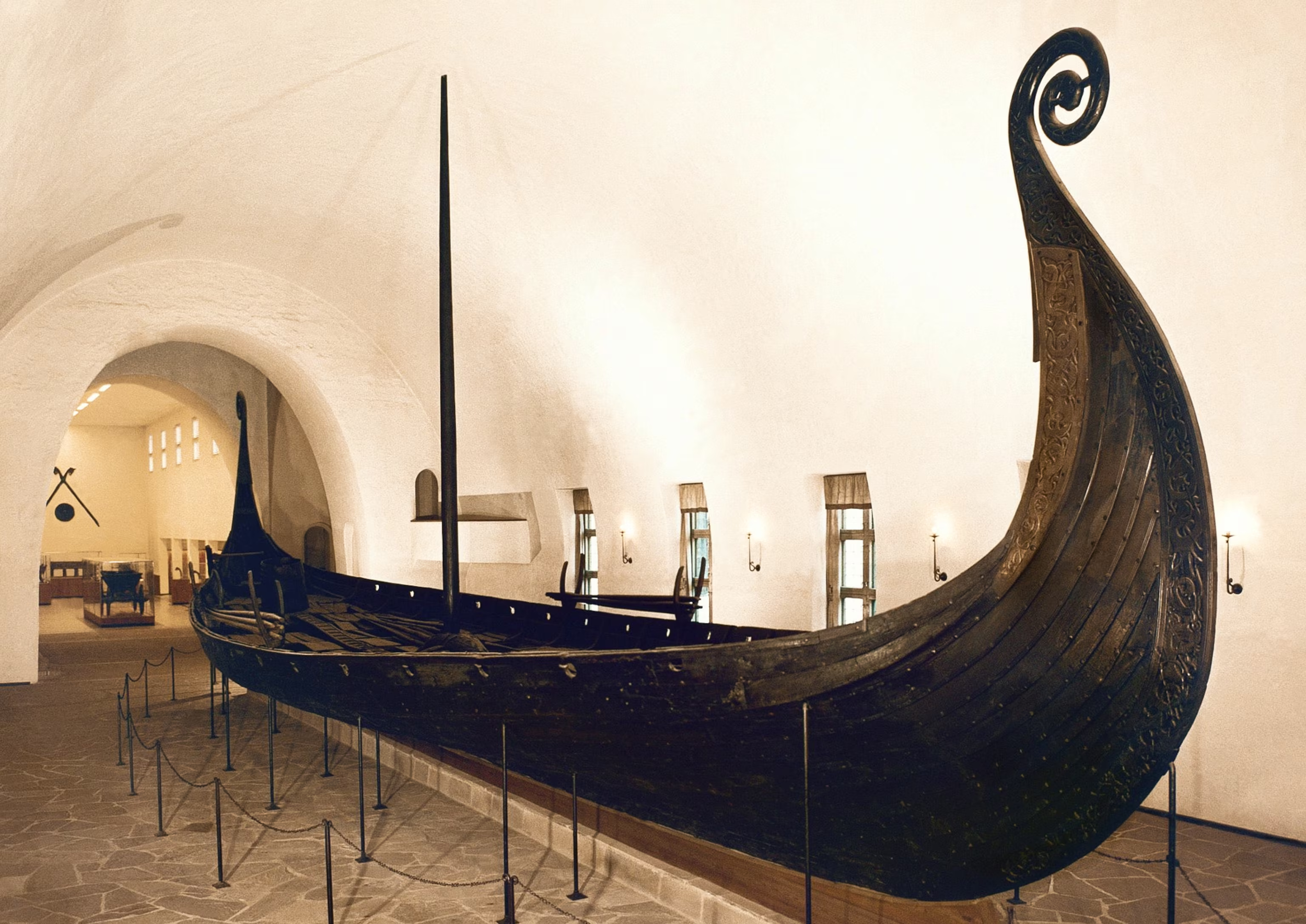
Discovered in a large burial mound at the Oseberg farm in Norway, this is widely considered one of the most beautiful artifacts to survive from antiquity.
The Passengers: The burial contained two women—one elderly (likely a powerful queen or priestess) and one younger. DNA and isotopic analysis suggest they were of high status, though their exact identities remain a mystery.
The "Oseberg Style": The ship is famous for its intricate wood carvings. The "Serpent's Head" prow and the "Carolingian" style animal motifs represent a peak of Viking artistry.
The Grave Goods: The ship was packed with everything a noblewoman would need in the afterlife: four elaborately carved sledges, a working loom with exquisite textiles, a wooden cart, and even the remains of 15 horses and several dogs.
2. The Gokstad Ship: The Warrior’s Vessel (c. 890 CE)
Found in 1880, the Gokstad ship offers a more "functional" look at Viking naval power. It was built during the height of the Viking expansion.
The Warrior King: The burial belonged to a tall, powerful man in his 50s. His bones show clear signs of battle trauma, including deep sword cuts to his legs, suggesting he died in combat.
Seaworthiness: Unlike the more decorative Oseberg ship, the Gokstad is a robust, ocean-going vessel made of oak. In 1893, a replica called the Viking sailed across the Atlantic to prove that such a ship could easily reach North America.
The Shields: Along the sides of the ship, archaeologists found 64 yellow and black painted shields, alternating in color to create a striking visual pattern that would have been visible as the ship moved through the water.
3. The Clinker Technique: The Secret of Viking Success
The archaeology of these ships reveals the "Clinker" (or lapstrake) construction method that allowed Vikings to dominate the seas.
Overlapping Planks: Instead of fitting planks side-by-side, they overlapped them and fastened them with iron rivets. This made the hull incredibly flexible, allowing the ship to "bend" with the waves rather than breaking against them.
The Keel: Both ships feature a heavy, solid oak keel. This acted like a spine, allowing for a large sail and providing the stability needed to cross open oceans while maintaining a shallow enough draft to navigate rivers and land on beaches.
4. The Ritual of the Burial Mound
The process of burying a ship was a massive community undertaking that served both a religious and political purpose.
Dragging the Ship: The ships, weighing several tons, had to be hauled from the sea to the burial site, often over significant distances.
The Burial Chamber: A wooden tent-like structure was built on the deck of the ship to house the deceased and their most precious belongings.
The Blue Clay Seal: One reason these ships survived so well is that they were buried in blue clay. This dense, anaerobic (oxygen-free) soil prevented the wood from rotting, effectively "pickling" the ships for over a thousand years.
5. New Technology: The Gjellestad Discovery
Ship burial archaeology isn't a dead science. In 2018, using Ground Penetrating Radar (GPR), archaeologists in Norway discovered the Gjellestad ship, the first new ship burial found in over a century.
The Invisible Ship: Because the wood is in poor condition, archaeologists are using 3D scanning and chemical analysis to reconstruct the ship's "ghost" in the soil, proving that there are likely many more of these "soul-ships" hidden beneath the Norwegian countryside.
The Oseberg and Gokstad ships are more than just graves; they are the ultimate symbols of a culture that refused to be anchored by the horizon. They show us that for a Viking, the end of life was simply the beginning of a new voyage.