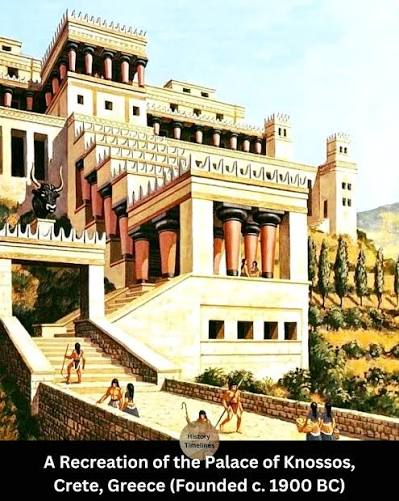
The palaces of Bronze Age Crete—most famously Knossos, Phaistos, Malia, and Zakros—stand as the ultimate monuments to Minoan architectural genius. Flourishing during the Protopalatial and Neopalatial periods (c. 1900–1450 BCE), these structures were completely different from the heavily fortified, defensive citadels of the Mycenaean Greeks or the rigid, symmetrical temples of ancient Egypt.
Instead, Minoan palaces were sprawling, multi-story, open-air complexes designed without a single defensive wall. They operated as the beating hearts of their communities, seamlessly blending royal residences, religious sanctuaries, administrative offices, and industrial storehouses into an organic, labyrinthine layout.
1. The Central Court: The Architectural Anchor
Despite their complex, maze-like designs, every Minoan palace was organized around a single, massive structural feature: the Central Court.
The Central Court was a huge, open-air rectangular plaza paved with stone, always oriented precisely north-south. Rather than building a uniform exterior facade and working inward, Minoan architects built from the inside out.
The Central Court acted as the anchor from which the four massive wings of the palace radiated. It served multiple vital societal functions:
Public Gatherings: It was the grand public arena where the community gathered for state festivals and political assemblies.
Ritual Spaces: It hosted high-stakes religious spectacles, including the famous bull-leaping ceremonies, where acrobats vaulted over charging bulls right before the eyes of the palace elite.
Light and Air: In a massive, multi-story complex, this open courtyard acted as the primary engine for natural light and ventilation, pulling fresh air into the deep interior corridors.
2. Master of the Maze: The Labyrinthine Layout
To an outsider, navigating a Minoan palace would have been an intimidating, disorienting experience. The interior was characterized by a dense, organic network of winding corridors, sharp sharp turns, blind alleys, and sudden staircases. This highly complex layout is the direct historical origin of the classical Greek myth of King Minos and the Labyrinth.
Rather than indicating chaotic planning, this layout was a highly deliberate design choice known as agglutinative architecture. As the administrative and economic needs of the palace grew over centuries, architects simply tacked new rooms, workshops, and shrines onto the existing structure like cells dividing.
To manage access and security without resorting to military walls, the architects used the maze-like corridors as a natural crowd-control mechanism, forcing visitors through specific, easily guarded checkpoints before they could reach the sensitive royal or religious quarters.
3. Engineering for Luxury: Lightwells and Minoan Columns
Minoan architects were masters of micro-climate engineering, creating palaces that remained cool, bright, and airy during the scorching Mediterranean summers. They achieved this through two iconic structural innovations:
Pier-and-Door Partitions (Polythyra) and Lightwells
To maximize space and environmental control, the Minoans invented the polythyraron—a wall made of a series of double-doors set between stone pillars.
During the winter, the wooden doors could be tightly shut to seal out cold winds and rain. In the summer, the doors were folded completely back into the walls, instantly transforming a private, enclosed room into an open-air pavilion.
These partitions usually opened directly onto a lightwell—a small, vertical shaft cutting straight through multiple floors to the roof, allowing natural sunlight and cool breezes to penetrate deep into the subterranean levels of the palace.
The Inverted Minoan Column
The columns that supported these massive multi-story structures were completely unique in antiquity. Unlike Greek or Roman columns, which are wide at the base and taper toward the top, Minoan columns are inverted—they are noticeably thinner at the bottom and flare outward at the top.
Carved from massive single tree trunks (usually cypress) and mounted on round stone bases, this downward tapering served a brilliant structural purpose:
Maximizing Space: By keeping the base of the column narrow, it took up significantly less floor space, allowing for easier foot traffic through tight doorways and corridors.
Seismic Resilience: Crete sits on a major tectonic fault line and suffers frequent, violent earthquakes. The flexible wood of the inverted columns acted as a shock absorber, swaying with the seismic waves rather than snapping under the rigid, top-heavy weight of the stone ceilings.
4. The Magazine System: Palaces as Economic Engines
A Minoan palace was not just a luxury royal villa; it was a massive state-run warehouse and distribution hub. The entire Western Wing of almost every palace was dedicated to the West Magazines—long, narrow, windowless storage corridors.
Inside these magazines sat rows of gargantuan ceramic storage jars called pithoi (singular: pithos), some standing over six feet tall. These jars were filled to the brim with the agricultural wealth of Crete: olive oil, wine, grain, honey, and dried fruits.
Beneath the stone floors of these corridors, architects excavated deep, lead-lined stone chests called kaselles. These secure, fireproof subterranean vaults were used to store the palace's most precious luxury commodities, including raw copper ingots imported from Cyprus, ivory from Egypt, and thousands of Linear A clay administrative tablets tracking the state finances.
5. Advanced Hydrology: The World's First Flush Toilets
Perhaps the most staggering achievement of Minoan palatial architecture was its highly advanced hydraulic engineering. Millennia before the Roman aqueducts, the architects of Knossos engineered a complex, dual-channeled water system that completely separated fresh incoming water from dirty waste.
Fresh Water Delivery: Clean water was brought down from mountain springs via sloped, interlocking terracotta pipes (tubuli). These pipes were specially tapered—narrower at one end than the other—which created a natural constriction that accelerated the water flow, preventing sediment from settling and blocking the lines.
The Drainage System: Beneath the palace floors sat a massive network of stone-lined, stone-capped drainage channels. Rainwater from the roofs and lightwells was funneled directly into these drains, creating a permanent, high-velocity current that flushed out the palace waste.
The Royal Bathrooms: In the Queen’s Megaron at Knossos, archaeologists discovered the remains of the world's earliest known flush toilet. It featured a beautifully carved ceramic sit-down basin connected directly to the subterranean drainage system, allowing water poured from a pitcher to instantly carry waste away outside the palace walls.
Minoan palatial architecture stands as a testament to a civilization that prioritized harmony over hegemony, and engineering over fortification. By centering their world around open-air courts, manipulating light and air through brilliant structural geometry, and pioneering advanced subterranean sanitation, the Minoan builders created living spaces that were deeply synchronized with both the natural environment and the complex socioeconomic needs of the Bronze Age Aegean.