The Mycenaean Civilization: The Legend of the Trojan War
Introduction
The Mycenaean civilization was one of the earliest advanced civilizations in mainland Greece. It is closely linked to the legendary stories of the Trojan War, a conflict immortalized in Greek epic poetry, especially the Iliad attributed to Homer. While the war itself blends myth and possible historical memory, it reflects the culture, warfare, and power structures of Mycenaean Greece.
The Mycenaean World
The Mycenaeans flourished during the Late Bronze Age and built fortified palace centers across Greece.
Major Centers
Mycenae
Tiryns
Pylos
Thebes
These cities were ruled by warrior-kings known as wanaktes.
Characteristics of Mycenaean Society
Strong military aristocracy
Palace-based economy
Advanced trade networks across the Mediterranean
Use of Linear B writing for administration
Heavy emphasis on warfare and prestige goods
Mycenaean Warfare
Mycenaean warriors were heavily armed and highly organized.
Common Features
Bronze armor and weapons
Chariots used in battle
Fortified citadels with massive “cyclopean” walls
Elite warrior class controlling political power
This militarized society forms the historical backdrop of later Greek heroic legends.
The Trojan War Tradition
The Trojan War centers on the legendary city of Troy, located in western Anatolia (modern-day Turkey).
The Story in Myth
According to Greek mythology:
Paris of Troy abducted Helen of Sparta
Greek kings formed a coalition to recover her
A long siege followed at Troy
Heroes such as Achilles, Hector, and Odysseus fought in the conflict
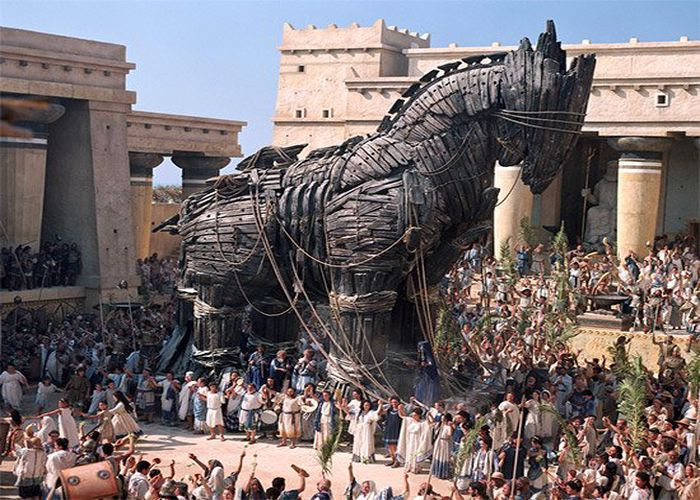
The war ended with the Greeks using the “Trojan Horse” to enter the city
Possible Historical Basis
While the myth is legendary, many scholars believe it may reflect real Late Bronze Age conflicts.
Possible historical elements:
Trade rivalry between Mycenaean Greeks and Anatolian cities
Regional warfare in western Anatolia
The collapse of Bronze Age civilizations around 1200 BCE
Archaeological evidence of destruction layers at Troy
Archaeology of Troy
Excavations at Troy have revealed multiple settlement layers, showing the city was rebuilt many times.
Key findings:
Fortified walls and gates
Evidence of destruction by fire in some layers
Artifacts suggesting trade with Mycenaean Greece
A wealthy and strategically located city
These findings support the idea that Troy was a real and significant Bronze Age settlement.
The Legacy of the Trojan War
The story of the Trojan War became central to Greek identity and literature.
Cultural Impact
Foundation of Homeric epics (Iliad and Odyssey)
Influence on Greek ideas of heroism and honor
Inspiration for later Roman literature (Aeneid)
Continued use in art, drama, and storytelling
Decline of the Mycenaeans
Around 1200 BCE, Mycenaean civilization collapsed due to a combination of:
Possible invasions or internal conflict
Natural disasters such as earthquakes
Economic breakdown and loss of trade networks
Widespread instability in the eastern Mediterranean
This collapse led to the Greek “Dark Age.”
Conclusion
The Mycenaean civilization forms the historical foundation of many Greek myths, including the legendary Trojan War. Whether viewed as history, legend, or a blend of both, the story reflects a world of warrior-kings, fortified cities, and epic struggles that shaped the cultural memory of ancient Greece for centuries.