Ancient Greek Pottery: The Proto-Geometric and Geometric Styles
Introduction
Ancient Greek pottery is one of the most important sources of information about early Greek society. After the collapse of the Mycenaean civilization, pottery styles changed significantly. Two key phases in this development are the Proto-Geometric and Geometric styles, which mark the cultural recovery and growth of Greece during the early Iron Age (c. 1050–700 BCE).
Proto-Geometric Style (c. 1050–900 BCE)
The Proto-Geometric period represents the earliest phase of post-Mycenaean artistic revival.
Characteristics
Simple geometric shapes (circles, semicircles, arcs)
Use of compasses and multiple brushes for precision
Dark painted bands on light clay backgrounds
Highly symmetrical designs
Limited decoration focused mainly on vessel shape
Techniques and Innovation
Potters introduced improved firing techniques that allowed:
More consistent black glaze
Cleaner and more refined surfaces
Greater control over decorative patterns
Function of Pottery
Proto-Geometric pottery was used for:
Storage of food and liquids
Funerary urns
Everyday domestic use
It reflects a society rebuilding after the collapse of the Bronze Age world.
Geometric Style (c. 900–700 BCE)
The Geometric period marks a major artistic expansion and increasing social complexity in ancient Greece.
Characteristics
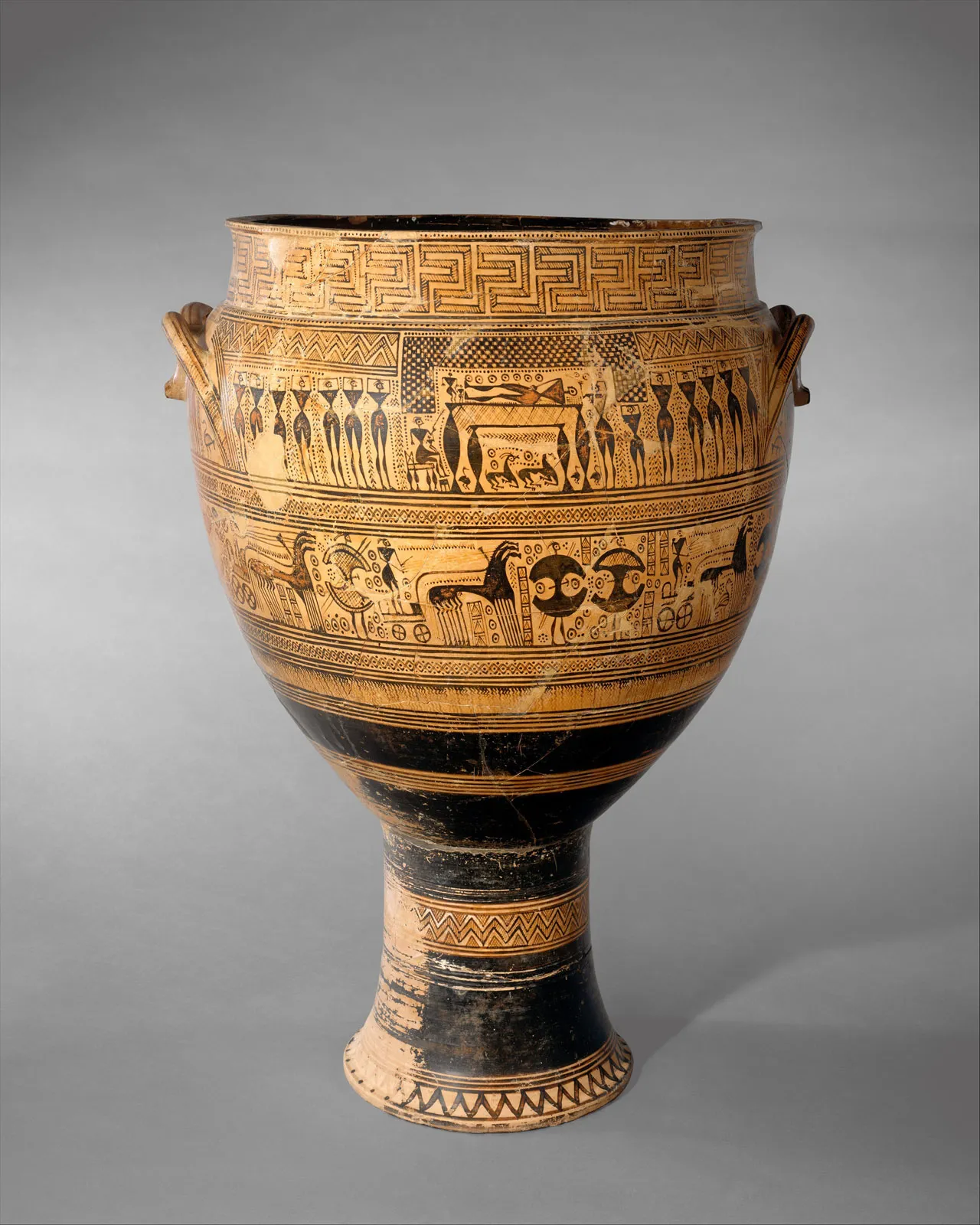
Elaborate geometric patterns covering the entire surface
Repeating motifs such as meanders (Greek key patterns)
Zigzags, triangles, and checkerboard designs
Increased complexity and symmetry
Human and Animal Figures
Later in the Geometric period, artists began to include:
Stylized human figures
Horses, birds, and mythological scenes
Funeral processions and battles
These figures were highly abstract, often composed of simple geometric shapes.
Cultural Meaning of Geometric Pottery
Geometric pottery reflects major changes in Greek society:
Social Structure
Growth of aristocratic elites
Increased importance of burial rituals
Rise of competitive status display
Religious and Funerary Use
Many large Geometric vases were used as grave markers or funerary offerings. Scenes often depicted:
Mourning rituals
Chariot processions
Heroic imagery related to emerging Greek identity
Artistic Development
The Geometric style shows the beginning of narrative art in Greece:
Movement from purely abstract designs to storytelling
Early visual representation of myth and society
Foundation for later Classical Greek art
Transition to Orientalizing Period
By the late 8th century BCE, Greek pottery began to shift into the Orientalizing period, influenced by contact with the Near East. This led to:
Introduction of new animal motifs (sphinxes, lions)
More naturalistic figures
Increased complexity in storytelling imagery
Conclusion
The Proto-Geometric and Geometric pottery styles represent a crucial transformation in ancient Greek art and society. From simple post-collapse designs to complex narrative scenes, these ceramics reflect the rebirth of Greek civilization and the foundations of its artistic identity.