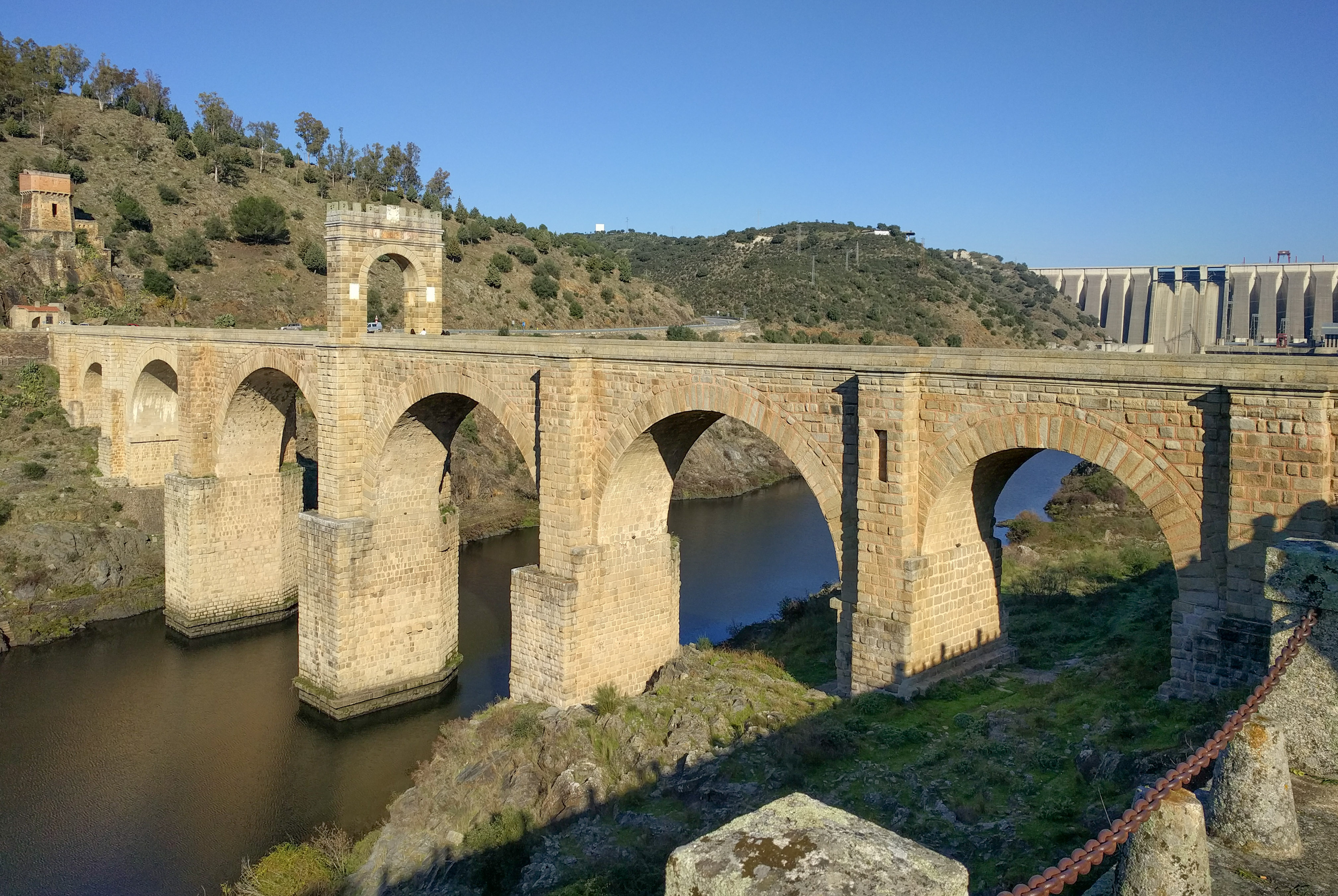
The Bridge of Alcántara, spanning the Tagus River in Spain, is perhaps the most enduring monument to Roman civil engineering. Completed in 106 CE during the reign of Emperor Trajan, it stands as a structural masterclass that has survived nearly two millennia of floods, warfare, and heavy transit, remaining essentially intact to this day.
Engineering and Architectural Features
Dry-Stone Precision: Like the arena of Nîmes, the bridge was constructed using massive granite blocks fitted together without the use of mortar. This gravity-defying accuracy allowed the structure to withstand the natural expansion and contraction caused by the extreme temperature fluctuations of the Spanish plateau.
Load Distribution: The bridge consists of six central arches that support a total length of 194 meters. These arches are of unequal height and width, a deliberate design choice that allowed the builders to anchor the bridge into the solid bedrock of the riverbank, ensuring maximum stability against the force of the river’s currents.
The Triumphal Arch: At the center of the bridge stands a dedicated triumphal arch, a powerful symbol of Roman authority. It served as a gateway for the Via Norbensis, the imperial road that linked the region of Lusitania to the rest of the empire, signaling to all travelers that they were under the protection and law of Rome.
Foundation Integrity: The bridge's piers were built directly into the riverbed on massive, deep-set foundations. This involved sophisticated underwater engineering, likely using cofferdams—watertight enclosures that were pumped dry—to allow the stonemasons to work on the bedrock, a technique that demonstrates the Roman mastery of hydraulics.
Historical Context and Strategic Value
Imperial Infrastructure: The bridge was not merely a convenience; it was a critical component of a wider imperial strategy to integrate the Iberian Peninsula. By facilitating the rapid movement of legions, government officials, and trade goods, it cemented the economic and political stability of the Roman provinces.
Symbolic Continuity: The Latin inscription on the bridge declares that it was "built to last forever" (perpetui mansuram in saecula). This was a deliberate piece of architectural propaganda, emphasizing the eternity and immutability of the Roman state, a claim that 1,900 years of survival have largely validated.
Resilience through Conflict: The bridge’s survival is all the more impressive given its strategic importance. Throughout the Middle Ages and into the early 19th century, it was frequently targeted during conflicts, including the Reconquista and the Peninsular War. While the central and end arches were occasionally blown up or damaged to impede military advancement, they were always repaired using the original Roman techniques, maintaining the structural integrity of the entire crossing.
Archaeological and Cultural Legacy
A Living Monument: Unlike ruins that are fenced off and preserved as "static" history, the Bridge of Alcántara served as an active vehicular crossing well into the 20th century. Its transition from an imperial transit artery to a heritage site highlights the bridge's role as a continuous thread in the history of the region.
The "Trajanic" Style: The bridge is a prime example of the architectural classicism that flourished under Trajan, a period characterized by a return to monumentality, precision, and the use of enduring stone materials. It reflects the peak of Roman ability to reshape the natural landscape to serve human expansion.
Engineering Model: Today, the bridge remains a site of intense study for civil engineers and archaeologists alike. It serves as a benchmark for structural longevity, offering a clear view of how Roman planners prioritized durability, site-specific design, and the use of local natural resources to create architecture capable of defying the passage of time.