The Roman Bridge of Mérida: A Feat of Roman Civil Engineering
Introduction
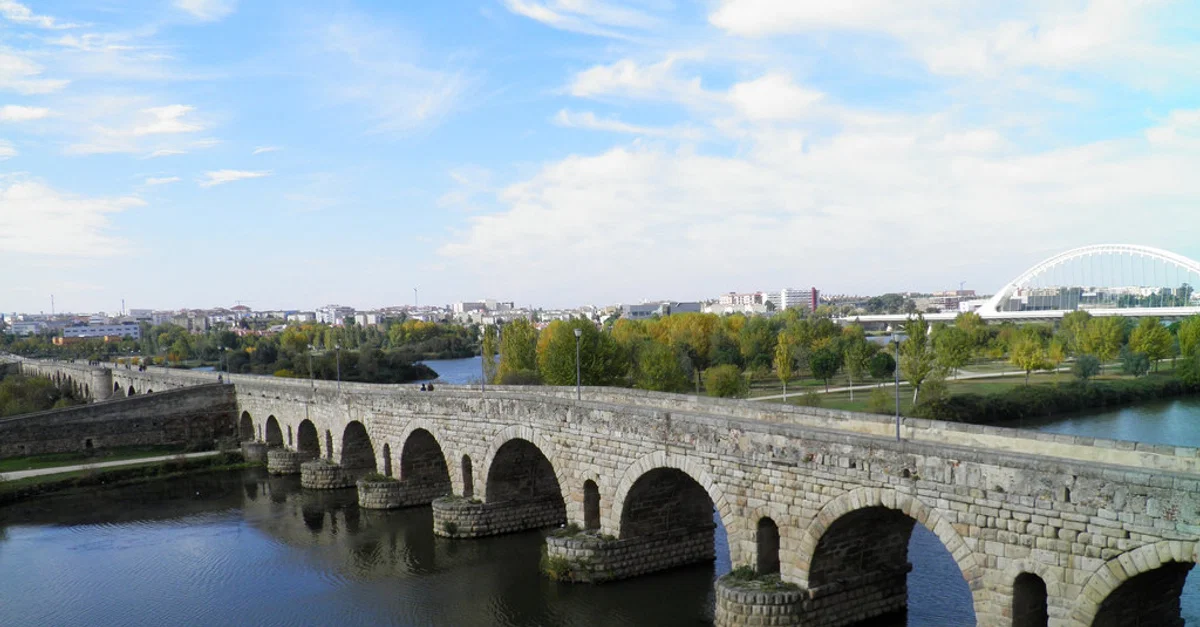
The Roman Bridge of Mérida is one of the most impressive surviving examples of Roman engineering. Built during the early period of the Roman Empire, it demonstrates the Romans’ mastery of durable construction, infrastructure planning, and hydraulic control. Remarkably, it has remained in use for nearly two thousand years.
Historical Background
The bridge was constructed in the 1st century BCE or early 1st century CE, during the time when Mérida (then Emerita Augusta) was a major Roman colony in Hispania.
The city itself was founded to settle retired soldiers from the Roman army, making strong infrastructure essential for:
Military movement
Trade and transport
Administrative control of the region
Engineering Design
Materials and Structure
The bridge was built using:
Granite blocks
Roman concrete (opus caementicium)
Precisely cut stone masonry
Its design includes:
Multiple semicircular arches
Strong piers to resist river flow
A long elevated roadway
Arch System
The bridge uses a series of arches, which distribute weight efficiently.
bridges than earlier civilizations.
The Role of the Guadiana River
The bridge crosses the Guadiana River, which posed significant engineering challenges:
Strong seasonal floods
Variable water levels
Fast currents during rain seasons
Roman engineers designed wide spans and strong piers to withstand these conditions.
Function in Roman Society
The bridge was essential for:
Connecting roads across Hispania
Facilitating trade and taxation
Moving Roman legions efficiently
Linking Mérida with other Roman cities
It formed part of the broader Roman road system that unified the empire.
Maintenance and Longevity
Unlike many ancient structures, the bridge has remained in continuous use.
Factors contributing to its survival:
Strong Roman construction techniques
Regular maintenance in later centuries
Strategic importance as a crossing point
Durable materials resistant to erosion
Even today, it is still partially used as a pedestrian bridge.
Architectural Significance
The Roman Bridge of Mérida demonstrates key Roman engineering principles:
Use of arches for strength and stability
Modular construction for durability
Integration with transportation networks
Adaptation to natural landscapes
These techniques influenced later European bridge construction.
Cultural and Historical Importance
The bridge is part of the archaeological ensemble of Mérida, which includes theaters, temples, and aqueducts.
It symbolizes:
Roman engineering excellence
Urban planning sophistication
The long-lasting impact of Roman infrastructure
It is recognized as part of a UNESCO World Heritage Site.
Conclusion
The Roman Bridge of Mérida stands as a lasting testament to Roman engineering skill and practical design. Built to serve the needs of a growing empire, it continues to function centuries after its construction. Its durability, elegance, and efficiency reflect the advanced technical knowledge of Roman engineers and their ability to shape landscapes for enduring human use.